
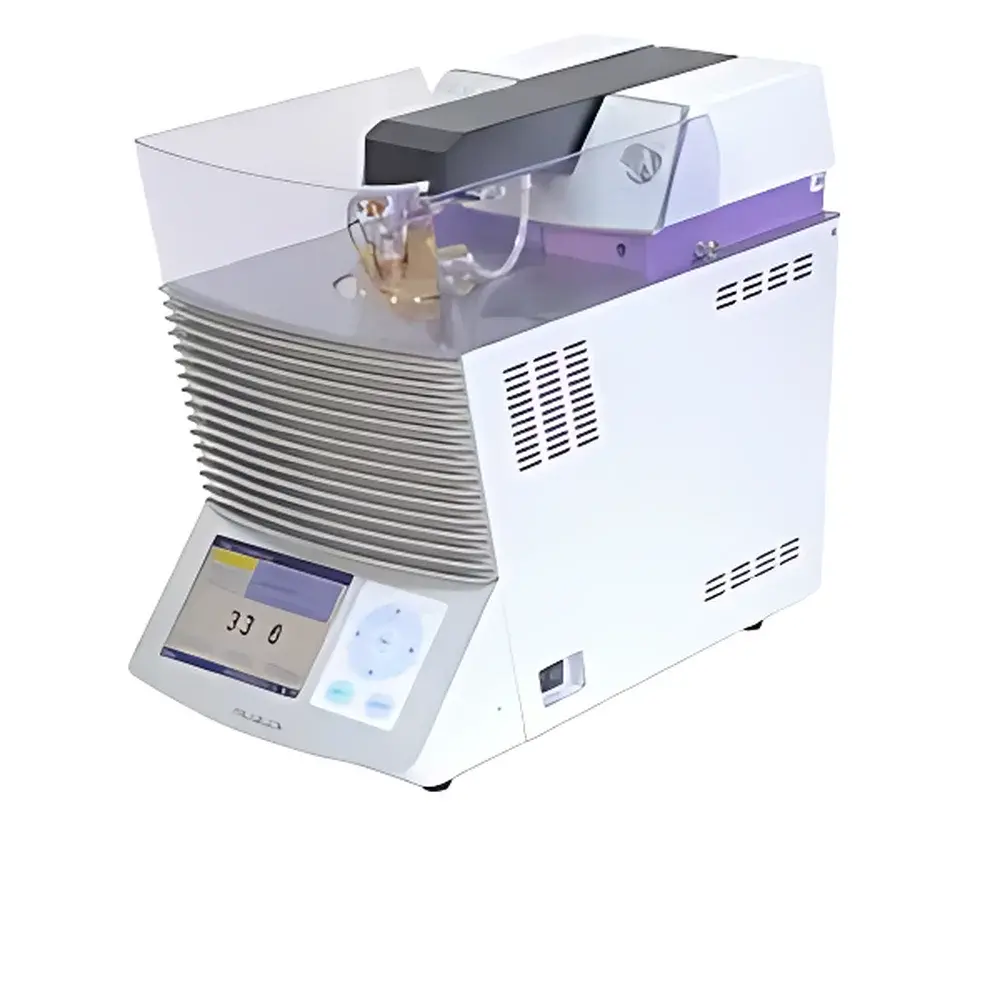
TANAKA ABL-8 Automatic Abel Closed-Cup Flash Point Tester
| Brand | TANAKA |
|---|---|
| Origin | Japan |
| Model | ABL-8 |
| Test Method | Closed-Cup (Abel) |
| Operation Mode | Fully Automatic |
| Applicable Standards | GB/T 21789, IP 170, ISO 13736, ISO 1516, ISO 1523 |
| Temperature Range | −30 °C to +80 °C |
| Ignition System | Dual-mode (Gas Flame & Electric Spark) |
| Repeatability | High |
| Cooling Method | Peltier-based Semiconductor Cooling |
| Display | 5.7-inch Color LCD |
| Data Storage Capacity | 200 Test Records |
| Atmospheric Pressure Compensation | Integrated Barometric Sensor |
| Safety Features | Auto Fire Suppression, Fault Diagnostics, Wind Shield Enclosure |
| Compliance Support | ASTM D3278, ISO/IEC 17025 Traceability Framework, GLP Audit Trail Ready |
Overview
The TANAKA ABL-8 Automatic Abel Closed-Cup Flash Point Tester is an eighth-generation precision instrument engineered for reliable, standardized flash point determination of low-viscosity petroleum products, solvents, and volatile organic liquids. It operates on the principle of the Abel closed-cup method—where a sample is heated in a sealed test cup under controlled atmospheric conditions, and flash ignition is detected upon application of a standardized flame or electric spark at prescribed temperature intervals. Designed in strict conformance with internationally harmonized test protocols—including GB/T 21789, IP 170, ISO 13736, ISO 1516, and ISO 1523—the ABL-8 delivers metrologically traceable results suitable for quality control, regulatory submission, and safety classification (e.g., UN GHS Category 2 or 3 flammability assignment). Its extended operating range from −30 °C to +80 °C enables accurate measurement of highly volatile substances such as acetone, ethanol, and light naphthas without external cryogenic units.
Key Features
- Integrated sensor assembly: Flash detection electrode, Pt100 temperature sensor, and magnetic stirrer blade are co-mounted on a single articulated test arm—ensuring precise spatial alignment and eliminating calibration drift between thermal and ignition sensing elements.
- Dual-mode ignition system: Switchable gas flame (butane/propane) and electric spark ignition—no hardware replacement required; selection is software-controlled and logged for audit compliance.
- Peltier-based cooling module: Enables rapid sub-ambient temperature ramping and stabilization without refrigerants, reducing environmental impact and maintenance overhead.
- Active wind shielding: Removable transparent acrylic enclosure suppresses draft-induced flame instability during gas ignition, improving detection consistency per ISO 1523 requirements.
- Real-time color-coded display: The 5.7-inch TFT LCD dynamically changes background hue (blue → amber → red) corresponding to test phase—pre-heating, equilibrium, and flash detection—enhancing operator situational awareness.
- Triple-layer safety architecture: Includes real-time fault diagnostics (e.g., sensor open-circuit, stirrer stall), automatic fire suppression via halogen-free inert gas discharge, and emergency thermal cutoff at 85 °C.
- Onboard barometric compensation: Integrated digital pressure sensor continuously corrects flash point values using the ASTM D3278 empirical algorithm, ensuring accuracy across elevation gradients.
Sample Compatibility & Compliance
The ABL-8 accommodates samples with kinematic viscosity ≤ 10 mm²/s at 40 °C and initial boiling point ≥ 20 °C. It is validated for use with gasoline blends, diesel distillates, jet fuels (Jet A-1), paint thinners, and cleaning solvents. All firmware and calibration routines comply with ISO/IEC 17025:2017 clause 7.8.2 (measurement traceability) and support GLP/GMP documentation requirements. Instrument logs—including date/time stamps, operator ID, ambient pressure, and raw sensor outputs—are stored with write-protection and exportable via USB 2.0 in CSV format compatible with LIMS platforms. Password-protected method editing ensures procedural integrity and prevents unauthorized parameter modification.
Software & Data Management
The embedded firmware provides full test sequence automation: users select a preloaded standard method (e.g., “ISO 1523”), enter estimated flash point, and initiate testing with one keypress. Results include observed flash point (°C), corrected value (barometrically adjusted), pass/fail status against specification limits, and confidence indicators (e.g., stirrer RPM stability, temperature ramp linearity). Up to 200 test records are retained with time-stamped metadata. Optional PC connectivity enables remote configuration, firmware updates, and batch report generation compliant with FDA 21 CFR Part 11 (electronic signature support available via optional software license).
Applications
- Refinery QC laboratories verifying crude fraction flash points prior to storage and transport.
- Paint and coating manufacturers validating solvent blend safety per ISO 8217 and ASTM D93.
- Pharmaceutical excipient suppliers assessing residual solvent flammability in accordance with ICH Q5C guidelines.
- Third-party testing labs performing accredited flash point analysis for UN TDG classification reports.
- Research institutions studying low-temperature ignition behavior of bio-derived fuels and synthetic hydrocarbons.
FAQ
Does the ABL-8 meet ASTM D3278 requirements for flash point testing?
Yes—the instrument’s temperature control accuracy (±0.1 °C), stir rate regulation (250 ± 5 rpm), and ignition timing logic align with ASTM D3278 Annex A1 for Abel-type apparatus.
Can test methods be customized beyond the built-in standards?
Yes—users may define custom ramp rates, hold times, ignition intervals, and pass/fail thresholds via password-protected advanced mode.
Is external calibration verification supported?
Yes—“Reference Standard Mode” allows validation using certified flash point standards (e.g., NIST SRM 2721); deviation reports are auto-generated.
What data security measures are implemented?
All test records are digitally signed, tamper-evident, and stored with immutable timestamps; USB export requires administrator-level credentials.
How is maintenance tracked and documented?
The system maintains a service log recording calibration events, sensor replacements, and firmware revisions—exportable as PDF for internal QA audits.




