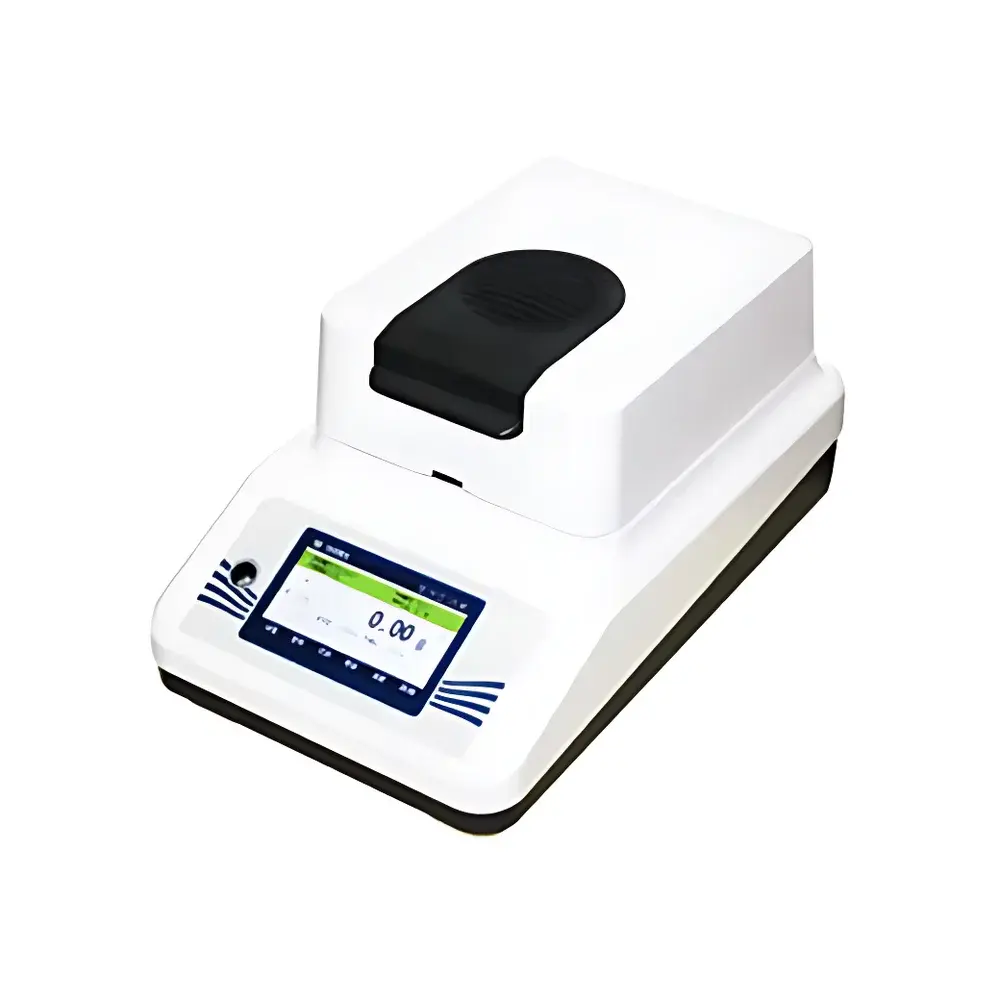
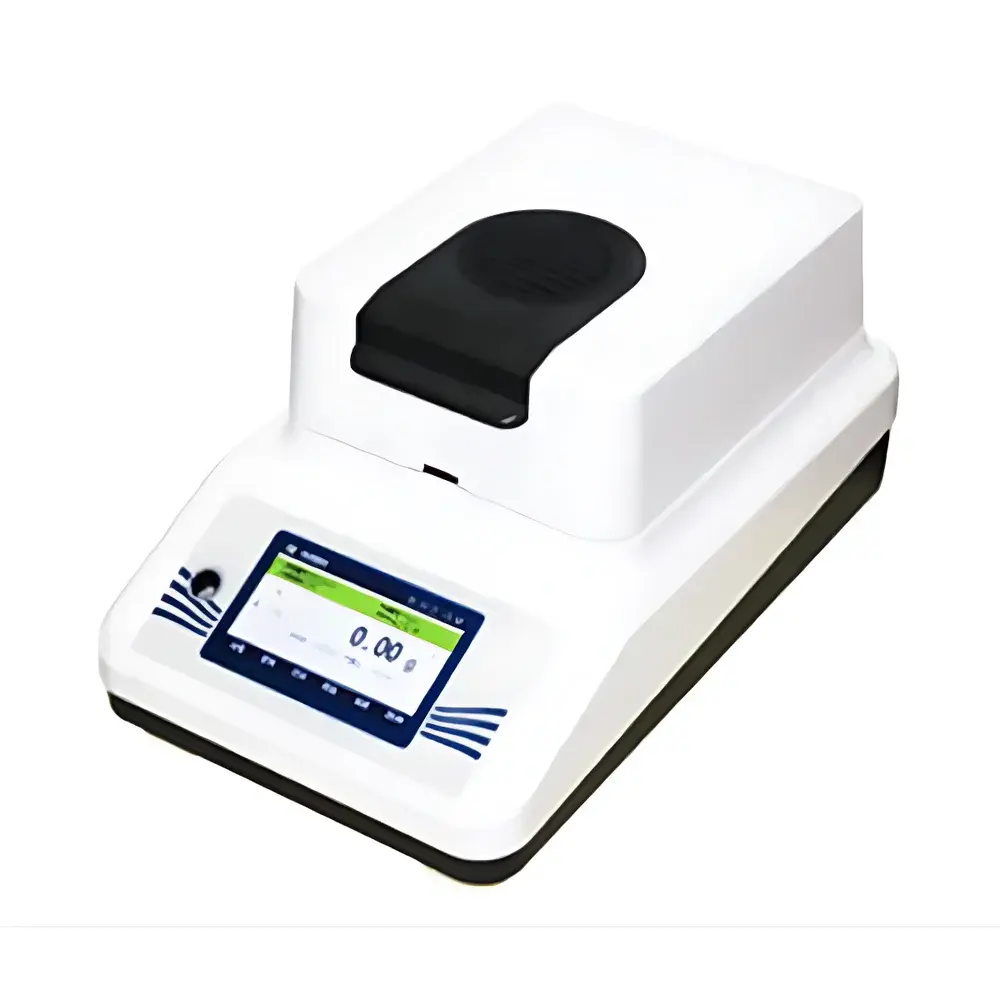
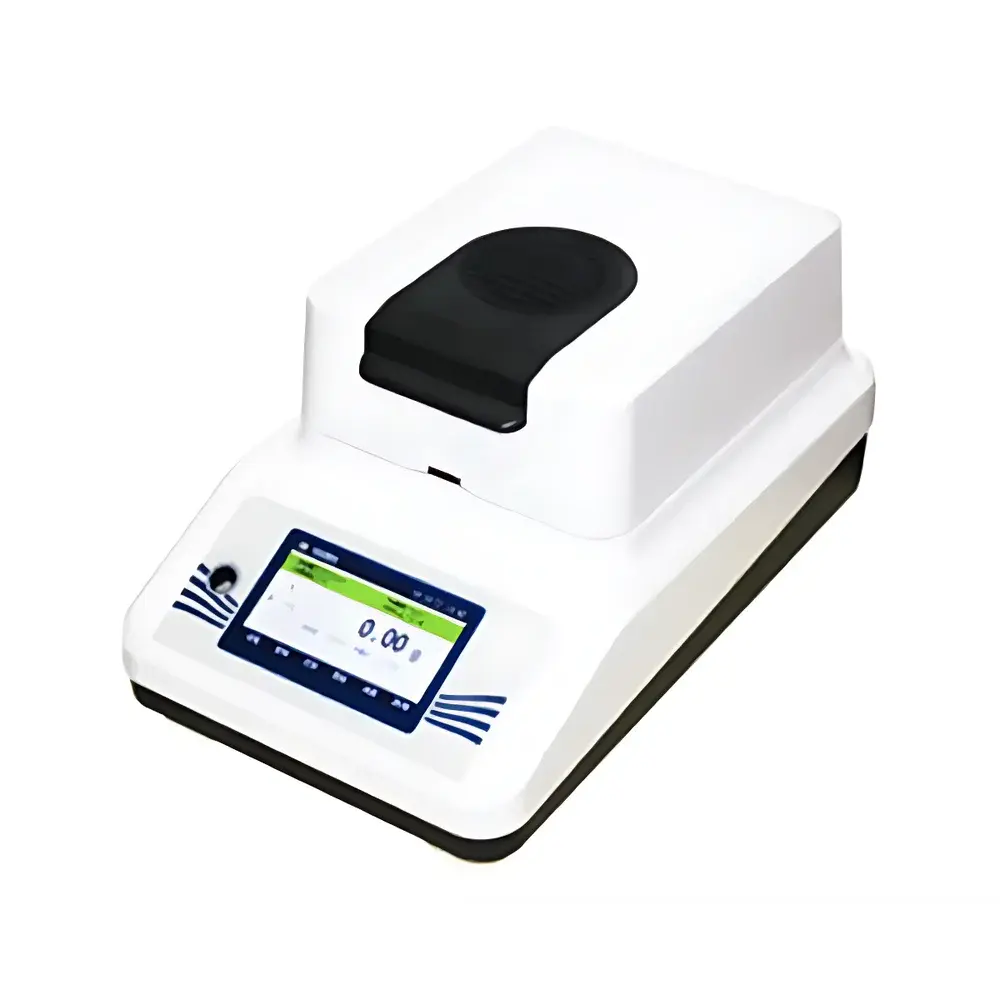
Yoke TSF-100A-1 Halogen Moisture Analyzer
| Brand | Yoke |
|---|---|
| Origin | Shanghai, China |
| Model | TSF-100A-1 |
| Heating Source | Halogen lamp |
| Weighing Sensor | Shielded electromagnetic force compensation sensor |
| Readability | 1 mg / 0.01% |
| Display | 4.3-inch capacitive touch LCD |
| Interface | RS232, USB for printer & PC connectivity |
| Compliance | GB/T 29249–2012 (Moisture Analyzers – Gravimetric Drying Method) |
Overview
The Yoke TSF-100A-1 Halogen Moisture Analyzer is a precision gravimetric instrument engineered for rapid, reliable moisture content determination in solid and semi-solid samples. It operates on the principle of thermogravimetry—applying controlled halogen heating to drive off volatile components (primarily water), while continuously monitoring mass loss with a high-stability electromagnetic force compensation weighing sensor. Unlike conventional oven-drying methods requiring hours, the TSF-100A-1 delivers repeatable results in minutes by optimizing heat transfer efficiency and minimizing thermal lag. Its design adheres strictly to the Chinese national standard GB/T 29249–2012, which specifies performance requirements, calibration protocols, and validation criteria for electronic moisture analyzers using the drying-weight-loss method. This ensures metrological traceability and comparability with reference oven-dry procedures across regulated environments.
Key Features
- Halogen heating system: Provides uniform, rapid, and controllable radiant heating (up to 160 °C) with fast thermal response—reducing test duration without compromising drying completeness.
- Shielded electromagnetic force compensation sensor: Delivers 1 mg readability and long-term stability under thermal stress; integrated shielding minimizes drift caused by temperature gradients during active heating.
- 4.3-inch capacitive touch LCD interface: Enables intuitive, glove-compatible operation for method setup—including temperature ramp profiles, drying time limits, termination criteria (e.g., auto-stop on <0.1 mg/min mass change), and real-time drying curve visualization.
- Embedded drying kinetics display: Plots mass vs. time and % moisture loss vs. time simultaneously, allowing users to verify drying behavior, detect anomalies (e.g., decomposition or sublimation), and optimize method parameters.
- Standardized data export architecture: Equipped with RS232 and USB ports for direct connection to laboratory printers (for GLP-compliant hardcopy reports) and PCs running third-party data acquisition or LIMS software.
- Robust mechanical architecture: All-metal housing with heat-resistant chamber lining and optimized airflow management ensures consistent thermal distribution and operator safety during extended use.
Sample Compatibility & Compliance
The TSF-100A-1 accommodates samples ranging from fine powders (e.g., pharmaceutical excipients, flour, catalysts) to granular materials (feed pellets, fertilizer blends), viscous pastes (dairy concentrates, slurries), and thin-film solids (polymer films, filter papers). Sample pans are standardized aluminum or stainless steel (100 mm diameter), compatible with optional pre-weighed disposable trays for cross-contamination control. While not certified to ISO/IEC 17025 or FDA 21 CFR Part 11 out-of-the-box, the instrument supports audit-ready workflows when paired with validated SOPs, user access logs (via external software), and electronic record backups. Its compliance with GB/T 29249–2012 confirms equivalence to ASTM E1447–22 (Standard Test Method for Moisture in Plastics by Thermogravimetry) and USP <921> (Water Determination) for routine QC applications where regulatory submission does not mandate full 21 CFR Part 11 compliance.
Software & Data Management
The analyzer operates autonomously via its embedded firmware—no proprietary PC software is required for basic operation. However, raw measurement data (timestamp, initial/final mass, moisture %, drying curve points) can be exported as CSV or TXT files for integration into Excel, MATLAB, or validated LIMS platforms. When connected to a Windows PC, users may implement simple scripting (e.g., PowerShell or Python) to automate report generation, trend analysis, or SPC charting. For GMP-regulated labs, the device supports manual documentation of calibration records, daily verification checks (using certified weights), and method version control—all essential elements of a compliant moisture testing process per ICH Q5C and ISO 9001:2015 clause 8.5.2.
Applications
- Pharmaceutical manufacturing: Moisture verification of APIs, tablet granules, and lyophilized powders prior to packaging—critical for stability, dissolution, and microbial control.
- Food & beverage QC: Routine testing of cereal grains, dairy powders, coffee beans, and pet food to ensure shelf-life compliance and prevent caking or Maillard reactions.
- Agricultural & feed analysis: Field-deployable assessment of silage, hay, and compound feed moisture to optimize storage conditions and nutritional labeling.
- Chemical & polymer R&D: Quantification of residual solvent in coatings, monomer purity screening, and hygroscopicity profiling of absorbent materials.
- Environmental & waste testing: Sludge dewatering efficiency evaluation and soil moisture characterization for remediation reporting.
FAQ
Does the TSF-100A-1 meet international standards such as ASTM or ISO?
Yes—the instrument complies with GB/T 29249–2012, which aligns methodologically with ASTM E1447 and ISO 15512 for thermogravimetric moisture analysis. Full conformance to ISO/IEC 17025 requires lab-specific validation and uncertainty budgeting.
Can it be used for volatile organic compounds (VOCs), not just water?
It measures total volatile loss—not water-specific. For selective water quantification in VOC-containing matrices, Karl Fischer titration remains the reference method per ASTM D6304.
Is calibration traceable to national standards?
Yes—external calibration uses NIST-traceable weights (Class M2 or better) and certified reference materials (e.g., sodium tartrate dihydrate for 15.66% moisture verification).
What maintenance is required for long-term accuracy?
Daily pan cleaning, weekly chamber inspection, annual sensor recalibration by authorized service centers, and biannual verification of heating uniformity using multi-point thermal mapping kits.
How does it compare to traditional oven drying?
It achieves equivalent accuracy (±0.2% RSD vs. AOAC 950.46) in 3–8 minutes versus 2–24 hours, with reduced energy consumption and no manual intervention during drying cycles.