
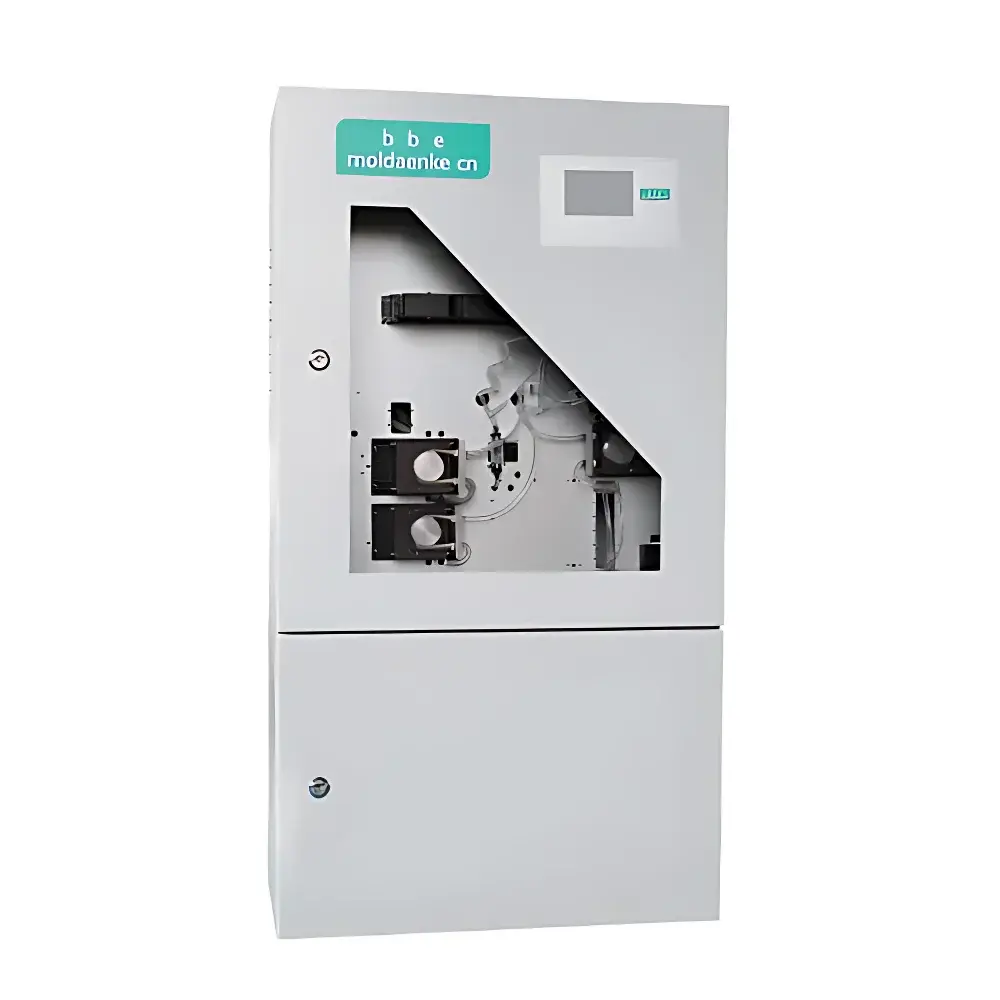
BBE BG00750003 Online Chloride Ion Analyzer
| Brand | BBE/bbe Moldaenke |
|---|---|
| Origin | Shanghai, China |
| Manufacturer Type | Manufacturer |
| Product Category | Domestic |
| Model | BG00750003 |
| Instrument Type | Benchtop |
| Analyte | Chloride Ion |
| Measurement Range | 0.1 mg/L |
| Limit of Detection (LOD) | 0.8 mg/L |
| Response Time | 10 min |
| Measurement Accuracy | ≤2% |
| Operating Temperature Range | 0–45 °C |
| Communication Interfaces | 4–20 mA, RS232/RS485, MODBUS RTU/TCP, TCP/IP (optional) |
Overview
The BBE BG00750003 Online Chloride Ion Analyzer is a benchtop, fully automated water quality monitoring system engineered for continuous, high-reliability quantification of chloride ion concentration in aqueous environmental and industrial matrices. It employs potentiometric detection with a solid-state chloride-selective electrode (CSE), calibrated against NIST-traceable standard solutions and validated per ISO 9964-1 (Water quality — Determination of chloride — Potentiometric method). The analyzer operates on the principle of ion activity measurement via membrane potential difference, delivering stable, drift-compensated readings under variable ionic strength conditions. Designed for unattended operation in municipal water treatment plants, surface water monitoring stations, wastewater reclamation facilities, and industrial process streams, it integrates sample conditioning, electrochemical sensing, signal processing, and digital communication into a single robust architecture. Its temperature-compensated measurement algorithm ensures accuracy across the full operational range (0–45 °C), making it suitable for both temperate and thermally dynamic environments.
Key Features
- Fully automated operation with programmable analysis cycles—including automatic sample aspiration, reagent dosing, electrode conditioning, and multi-stage cleaning—configurable from 15 minutes to 24 hours.
- Self-calibrating functionality with dual-point calibration (zero and span) using certified chloride standards; manual calibration override available for validation or troubleshooting.
- High-precision peristaltic pumping system with PTFE-tubing and ceramic-roller heads, ensuring consistent volumetric delivery and long-term repeatability (RSD <1.2% over 30-day continuous operation).
- Modular hardware design enables field-swappable sensor cartridges, pump modules, and fluidic manifolds—reducing mean time to repair (MTTR) and supporting future range extension (e.g., extended low-range configuration down to 0.05 mg/L with optional electrode upgrade).
- 7-inch capacitive touchscreen HMI with intuitive icon-driven navigation, multilingual UI (English, German, Spanish, Chinese), real-time trend graphs, and embedded event logging (including calibration history, alarm triggers, and maintenance timestamps).
- Comprehensive fault management: real-time diagnostics for electrode fouling, air bubble detection, flow interruption, temperature deviation, and power loss; auto-recovery after brownout with full state restoration and data continuity.
Sample Compatibility & Compliance
The BG00750003 accepts raw or filtered liquid samples with turbidity ≤100 NTU and suspended solids ≤50 mg/L. It is compatible with drinking water, surface water (rivers, lakes), treated wastewater effluent, and low-TDS industrial cooling water. Sample pH must be maintained between 4.5 and 8.5 for optimal CSE performance; integrated pH compensation eliminates need for external pH probes in most applications. The system conforms to IEC 61326-1 (EMC for laboratory equipment), IP54 enclosure rating, and CE marking requirements. Data integrity features—including audit trail, electronic signatures, and user-access levels—support compliance with GLP, ISO/IEC 17025, and FDA 21 CFR Part 11 when operated with optional secure firmware package.
Software & Data Management
Embedded firmware supports local data storage (≥12 months of 5-minute interval records) and bidirectional communication via industry-standard protocols: analog 4–20 mA output (HART-compatible), RS232/RS485 serial interface, MODBUS RTU/TCP, and Ethernet-based TCP/IP (with HTTP/HTTPS and SNMP v3 support). Optional BBE AquaLink™ software provides remote configuration, real-time dashboard visualization, predictive maintenance alerts, and automated report generation (PDF/CSV) compliant with ISO 5725-2 precision criteria. All data exports include timestamp, measurement uncertainty estimate, calibration metadata, and instrument status flags—enabling traceable QA/QC workflows.
Applications
- Continuous monitoring of chloride ingress in drinking water distribution networks to detect pipe corrosion or saltwater intrusion events.
- Effluent compliance tracking at municipal wastewater treatment plants against discharge limits per EU Urban Wastewater Directive and US EPA NPDES permits.
- Process control in desalination pre-treatment systems, where chloride serves as an early indicator of RO membrane integrity failure.
- Industrial boiler feedwater surveillance to prevent chloride-induced stress corrosion cracking in stainless steel components.
- Environmental monitoring of coastal aquifers and estuarine mixing zones, where chloride acts as a conservative tracer for salinity dynamics.
FAQ
What is the recommended maintenance schedule for the chloride-selective electrode?
Electrode cleaning and recalibration are recommended every 7 days for high-fouling matrices (e.g., wastewater); biweekly for potable water applications. Full cartridge replacement is advised every 6 months under continuous operation.
Can the analyzer operate without external PC connectivity?
Yes—the system functions autonomously with onboard control logic, local display, and internal data logging. Connectivity is required only for remote supervision, firmware updates, or advanced reporting.
Is the instrument compatible with SCADA systems?
Yes—via MODBUS TCP or RTU over RS485, enabling seamless integration with Siemens Desigo, Honeywell Experion, or ABB 800xA platforms.
Does the analyzer meet drinking water regulatory standards?
It meets analytical performance criteria specified in ISO 9964-1 and ASTM D4192 for chloride determination in potable water, and supports verification per US EPA Method 325.1 when used with certified reference materials.
How is temperature compensation implemented?
A built-in Pt1000 RTD sensor continuously measures sample temperature; the firmware applies a non-linear Nernstian correction factor derived from empirical calibration across the 0–45 °C range.
Related Products







