
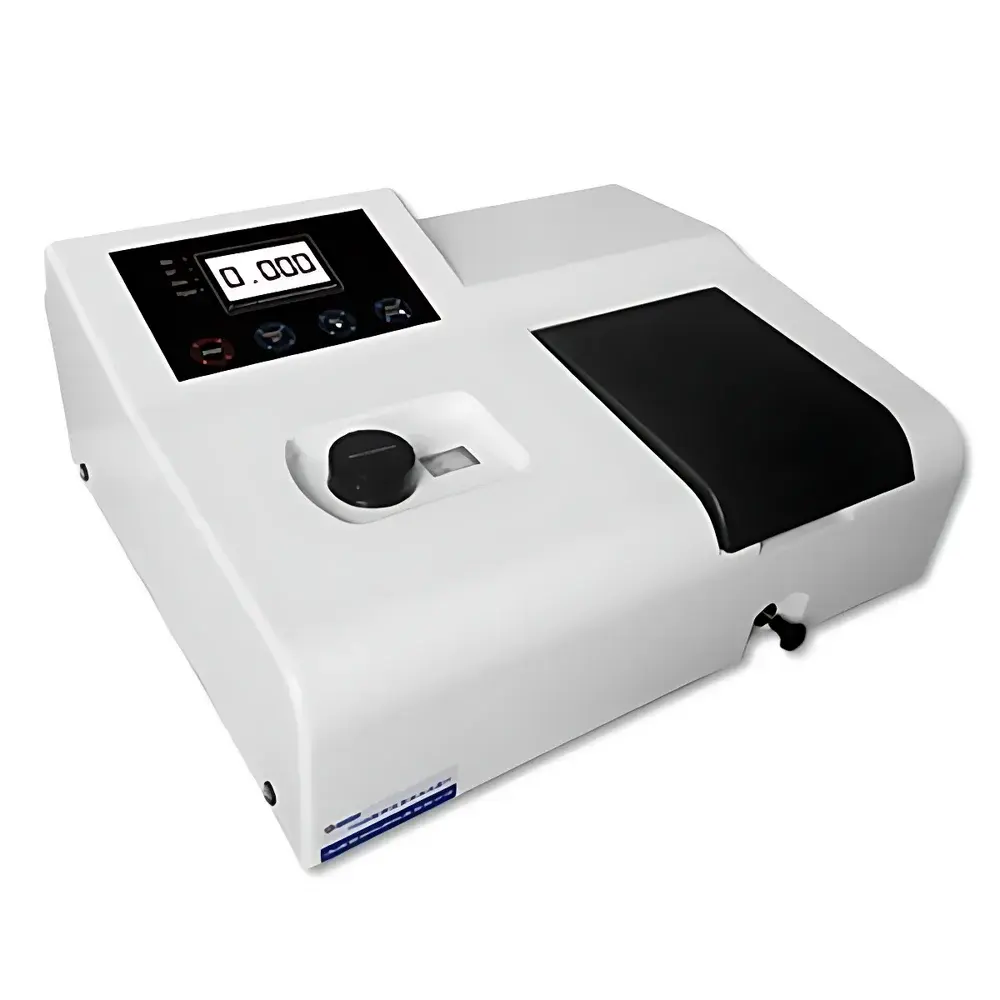
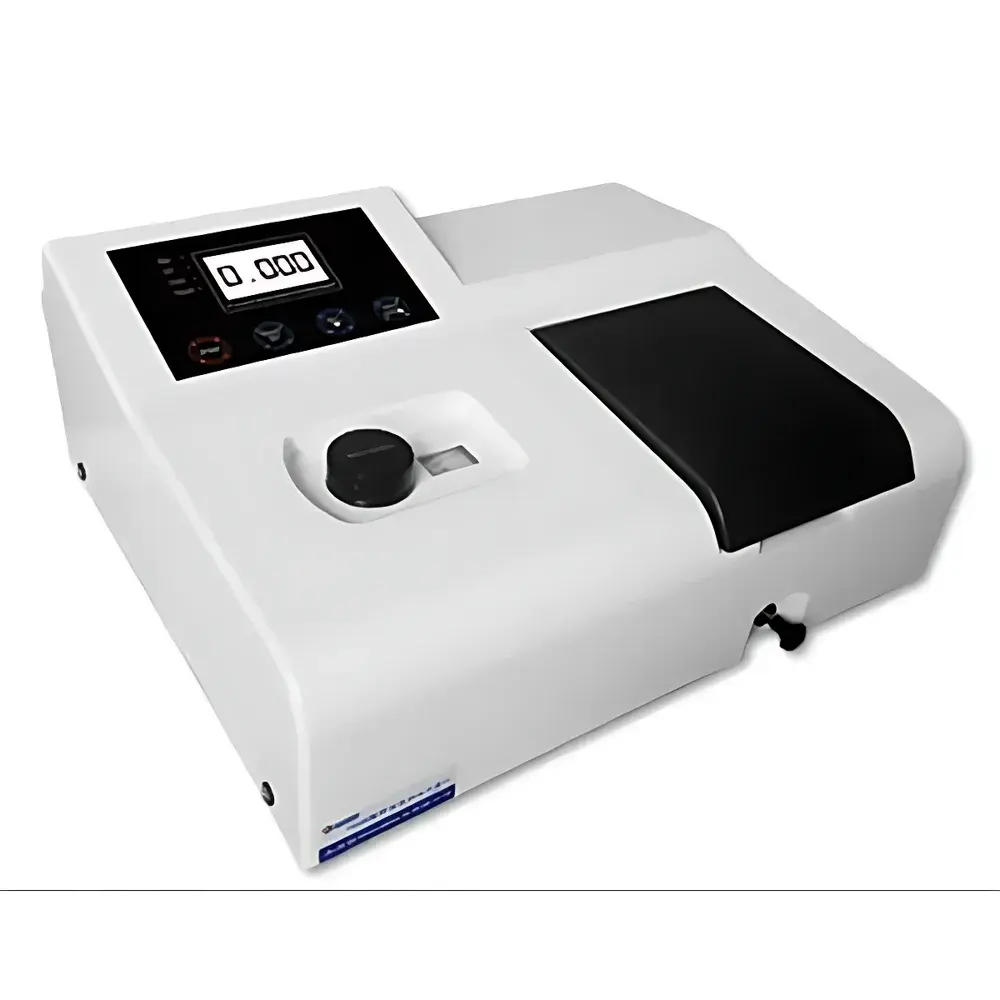
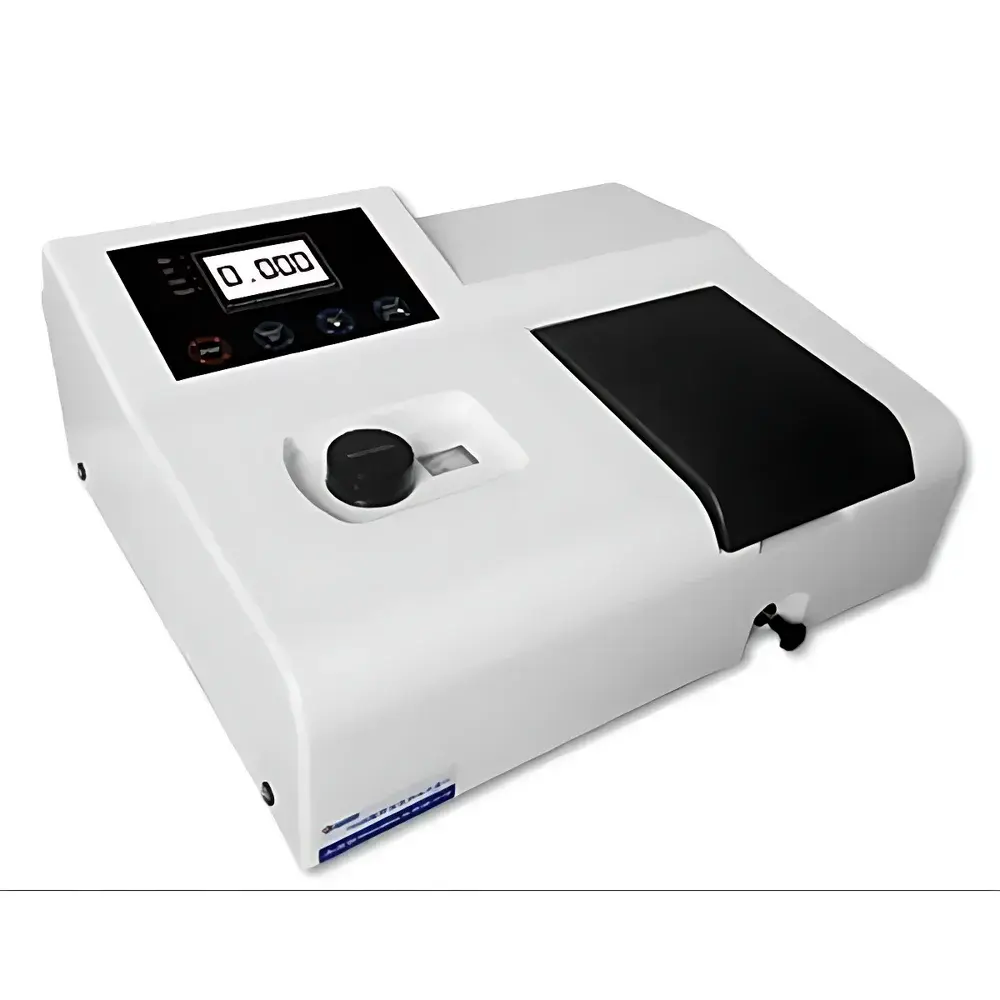
Yoke UV752 Ultraviolet-Visible Spectrophotometer
| Brand | Yoke |
|---|---|
| Origin | Shanghai, China |
| Model | UV752 |
| Optical System | Single-beam |
| Detector | Photodiode Array |
| Wavelength Range | 200–1000 nm |
| Wavelength Accuracy | ±2 nm |
| Wavelength Repeatability | ≤1 nm |
| Spectral Bandwidth | 2 nm |
| Stray Light | ≤0.5% (at 220 nm, using NaI solution) |
| Display | Digital LED/LCD readout |
| Sample Compartment | Accommodates cuvettes from 5 mm to 100 mm pathlength |
| Automation Level | Manual wavelength selection |
| Key Components | Imported optical and electronic components |
Overview
The Yoke UV752 Ultraviolet-Visible Spectrophotometer is a benchtop single-beam absorption spectrometer engineered for routine quantitative and qualitative analysis in academic, industrial, and regulatory laboratory environments. Operating on the fundamental principle of Beer–Lambert law-based absorbance measurement, the instrument quantifies the attenuation of ultraviolet and visible light (200–1000 nm) as it passes through a sample solution contained in a quartz or glass cuvette. Its fixed-slit optical design—featuring a grating monochromator coupled with a photodiode array detector—delivers stable spectral acquisition across the specified range. Designed for reliability in high-throughput settings, the UV752 integrates robust mechanical construction with temperature-stable electronics to minimize drift during extended operation. While not equipped with scanning or kinetic data acquisition capabilities, its optimized optical path and calibrated wavelength scale ensure consistent performance for endpoint absorbance measurements in compliance with standard analytical protocols.
Key Features
- Single-beam optical architecture with manually adjustable wavelength selection, enabling precise targeting of user-defined analytical wavelengths without software dependency.
- Photodiode array detector ensures rapid signal response and high signal-to-noise ratio across the full 200–1000 nm range, supporting both UV and visible region applications.
- Wide sample compartment accommodates standard rectangular cuvettes with optical path lengths from 5 mm to 100 mm—ideal for dilute and concentrated samples alike, including microvolume configurations with optional adapters.
- Integrated automatic shutter mechanism protects the photodiode array from prolonged exposure, extending detector service life and maintaining long-term photometric stability.
- Digital display interface provides real-time readout of transmittance (%T), absorbance (A), and concentration (when calibrated), eliminating analog meter parallax errors.
- Critical optical and electronic subassemblies—including diffraction grating, collimating mirrors, and amplifier circuitry—are sourced from internationally certified suppliers to meet ISO 9001-aligned manufacturing tolerances.
Sample Compatibility & Compliance
The UV752 accepts standard 10 mm square cuvettes (quartz for UV work below 350 nm; optical glass for visible-only assays) as well as longer-path cells up to 100 mm for low-absorbance measurements. It supports aqueous, organic, and mixed-solvent systems compatible with common UV-Vis chromophores (e.g., nucleic acids at 260 nm, proteins at 280 nm, nitrate at 220 nm). The instrument complies with foundational requirements outlined in ASTM E275 (Standard Practice for Describing and Measuring Performance of UV-Vis Spectrophotometers) and aligns with general principles of ISO/IEC 17025 for method validation in testing laboratories. While not inherently 21 CFR Part 11 compliant (lacking audit-trail-capable software), its manual operation mode permits straightforward integration into GLP- and GMP-aligned workflows where paper-based or printer-verified records are acceptable.
Software & Data Management
The UV752 operates independently of proprietary PC software, relying instead on front-panel controls and direct digital readouts. Optional thermal or dot-matrix printers can be connected via standard RS-232 or parallel interfaces to generate hard-copy reports of absorbance values, wavelength settings, and time-stamped measurements. All printed outputs include instrument ID (UV752), operator initials (if entered manually), and calibration reference details—supporting traceability in regulated environments. For laboratories requiring electronic data capture, third-party data acquisition modules may be interfaced using TTL-level trigger signals synchronized to wavelength positioning. No internal memory or USB storage is provided; data integrity is maintained through procedural documentation rather than digital archiving.
Applications
- Pharmaceutical quality control: assay of active pharmaceutical ingredients (APIs) per USP and EP 2.2.25 guidelines.
- Clinical biochemistry: determination of serum bilirubin, creatinine, and enzyme activity (e.g., LDH) using standardized colorimetric kits.
- Environmental monitoring: quantification of heavy metals (via complexometric reagents), nitrates, phosphates, and organic pollutants in water extracts.
- Food and beverage analysis: measurement of antioxidant capacity (DPPH assay), color index (b* value), and preservative concentrations (e.g., sulfites).
- Academic teaching labs: verification of molar absorptivity, construction of calibration curves, and demonstration of spectral interference effects.
- Materials science: characterization of dye concentrations in polymer solutions and thin-film transmittance profiling.
FAQ
What is the minimum detectable absorbance for the UV752 under standard conditions?
Under optimal alignment and using a 10 mm quartz cuvette with distilled water blank, the instrument reliably resolves absorbance changes ≥0.01 A units (corresponding to ~2.3% transmittance difference) at 280 nm.
Can the UV752 perform wavelength scans or kinetic measurements?
No. The UV752 is a fixed-wavelength or manually stepped instrument; it does not support continuous scanning or time-resolved acquisition.
Is quartz cuvette mandatory for all measurements?
Quartz is required for measurements below 350 nm due to glass absorption; above 350 nm, high-quality optical glass cuvettes are acceptable and recommended for cost-sensitive routine use.
How often should wavelength calibration be verified?
Per ASTM E275, wavelength accuracy should be confirmed at least daily using holmium oxide or didymium filters prior to critical measurements.
Does the UV752 support GLP-compliant record keeping?
Yes—when used with an external printer and documented operator logs, it satisfies core GLP documentation requirements for instrument identity, calibration status, and raw data retention.
Related Products





