
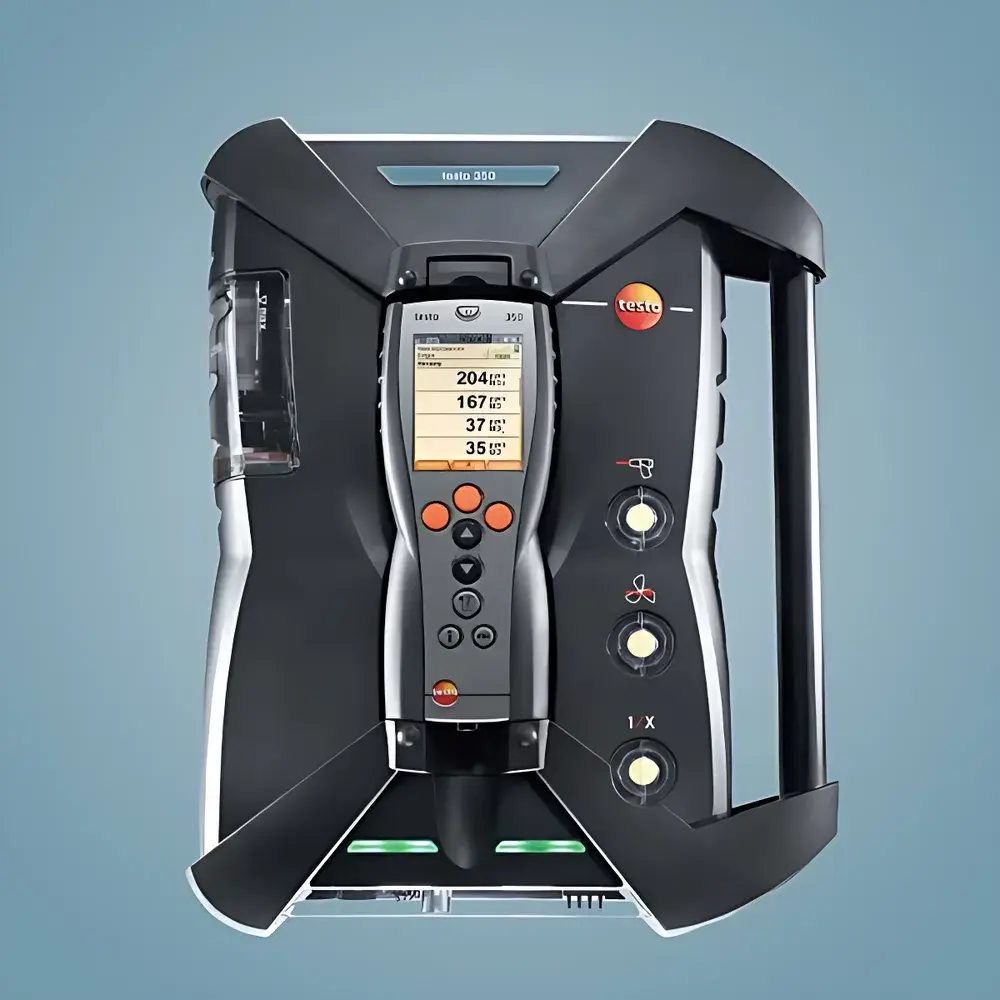
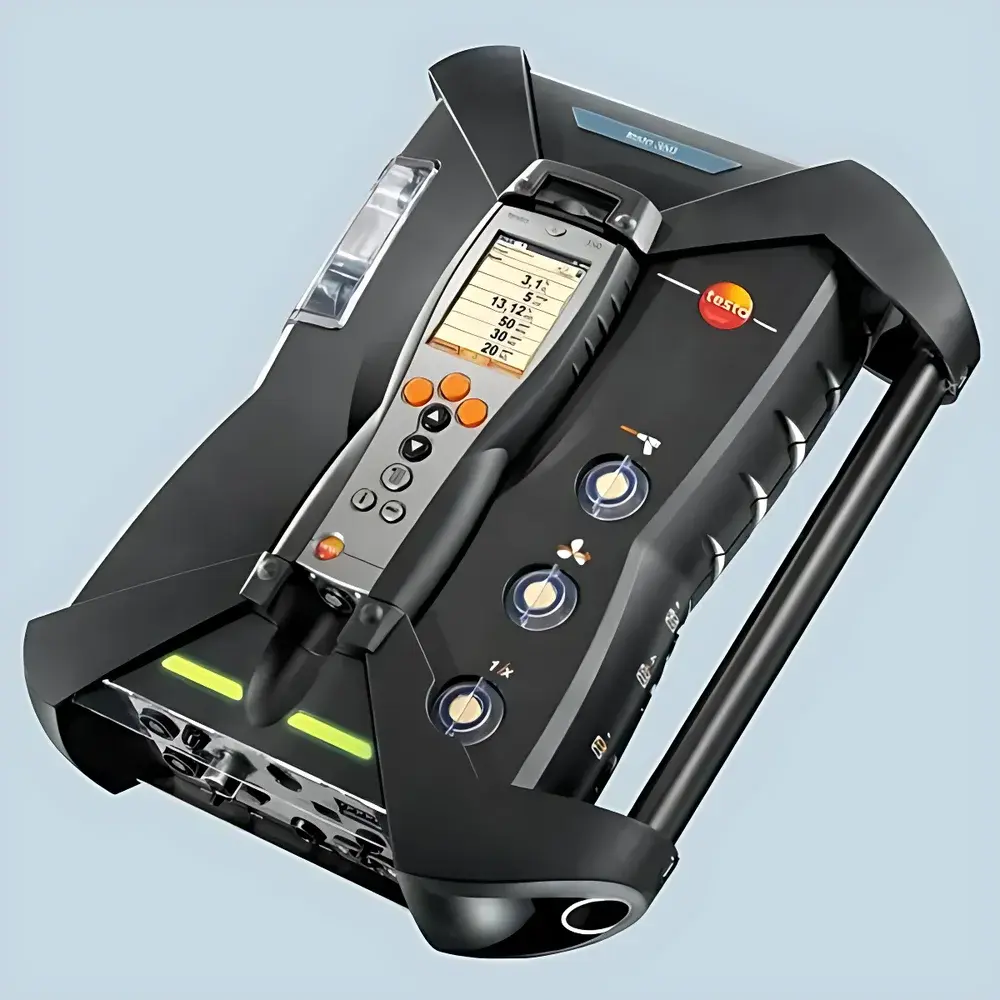
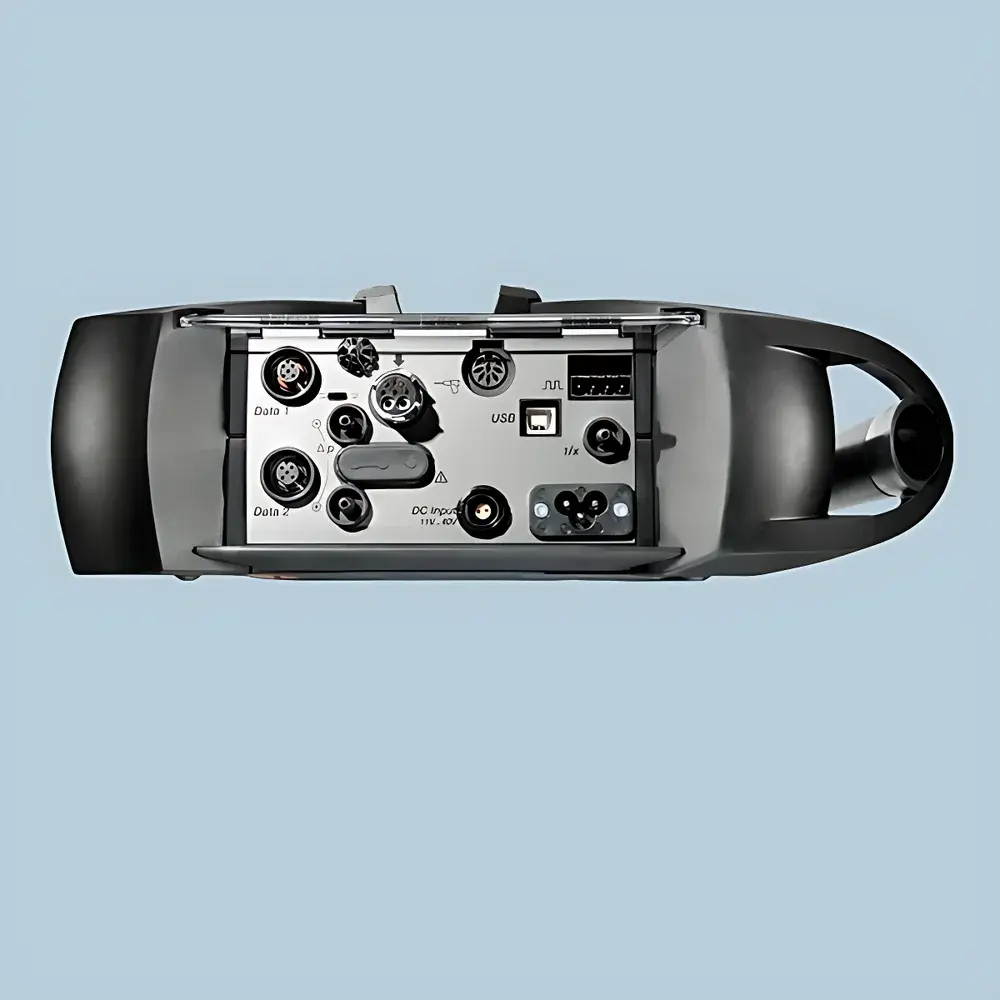
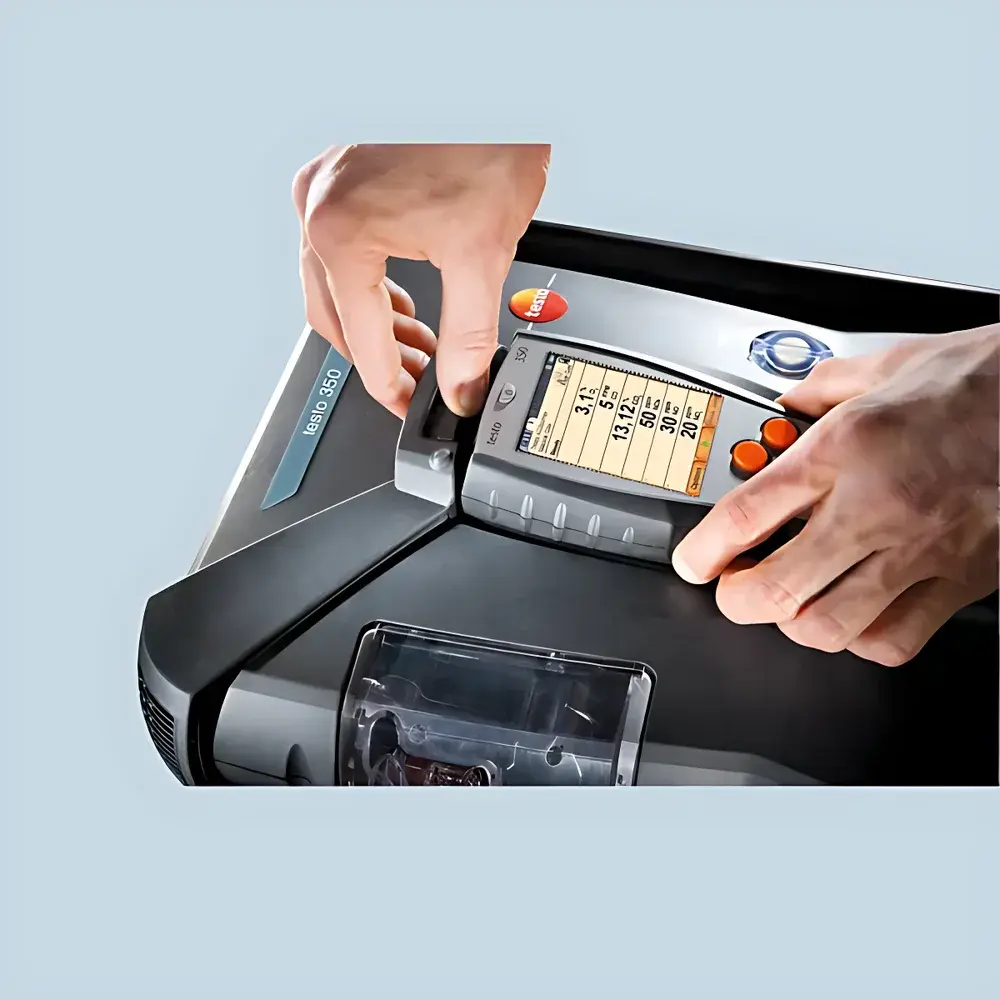
testo 350 Blue Edition Flue Gas Analyzer (Model 0632 3520)
| Brand | testo |
|---|---|
| Origin | Germany |
| Model | 0632 3520 |
| Instrument Type | Portable Flue Gas Analyzer |
| Measurement Accuracy | ±5 % of reading |
| Repeatability | ≤2 % |
| Response Time | 10 s |
| Stability | ±5 % |
| Measured Gases | CO, CO₂, NO, NO₂, SO₂, O₂ (standard), optional H₂S, CₓHᵧ, and infrared CO₂ |
Overview
The testo 350 Blue Edition Flue Gas Analyzer (Model 0632 3520) is a field-deployable, modular emission measurement system engineered for precision compliance with modern environmental regulations—including China’s HJ 57–2017 standard for sulfur dioxide determination by potentiostatic electrolysis. Designed around electrochemical sensor technology with integrated thermal management and real-time condensate handling, the instrument delivers high-fidelity gas concentration data under challenging industrial conditions: high moisture, elevated CO background (up to 10,000 ppm), low-SO₂ environments, and variable flue gas temperatures and pressures. Its dual-component architecture—comprising a handheld controller and a sensor-equipped analysis box—enables rapid configuration, on-site sensor replacement, and seamless integration into continuous monitoring workflows. All calculations—including mg/m³ conversion under actual stack conditions, excess air (λ), flue gas loss, dew point, and combustion efficiency—are executed in accordance with national regulatory frameworks and standardized thermodynamic models.
Key Features
- True cross-interference-free SO₂ sensing across full range (0–5000 ppm), enabled by a proprietary electrolyte formulation inert to CO
- Modular sensor bay accommodating up to six electrochemical or infrared sensors: O₂ (standard), plus five user-selectable from CO, NO, NO₂, SO₂, SO₂-low, H₂S, CₓHᵧ, and IR-based CO₂
- Integrated Peltier cooler and real-time condensate monitoring with automatic pump shutdown and visual alert upon tank saturation
- Adjustable-temperature heated probe (titanium construction) compliant with HJ 57–2017 requirements for sampling line heating control and insulation
- Auto-ranging dilution capability—both single-channel and full-stream—for reliable measurement in unknown or high-concentration gas matrices
- On-device zeroing (30 s) with probe remaining in-situ; pressure-compensated flow and velocity measurement concurrent with gas analysis
- External cooling loop isolating electronics and sensors from ambient particulate and corrosive gases
- Open firmware architecture supporting bidirectional communication with LIMS, SCADA, and custom enterprise platforms via standardized protocols
Sample Compatibility & Compliance
The testo 350 Blue Edition is validated for use in fixed-source emission monitoring per HJ 57–2017, HJ/T 44–1999, and GB/T 16157–1996. It meets functional requirements for ISO 12039 (CO, CO₂, SO₂, NOₓ), EN 14181 (QAL1/QAL2), and EPA Method 6C/7E where applicable. The analyzer operates reliably across flue gas conditions including: dew point ≤ +70 °C at inlet, dust loading ≤ 20 g/m³, negative pressure up to −300 mbar, positive pressure up to +50 mbar, and ambient operating temperature from −5 °C to +45 °C. Its IP40-rated ABS housing ensures mechanical robustness during transport and field deployment. Sensor calibration traceability aligns with national metrological standards; factory CO interference test reports are available upon request to verify SO₂ accuracy in high-CO matrices.
Software & Data Management
The handheld controller features a color TFT display with intuitive Chinese (Simplified/Traditional) and multilingual UI, preconfigured combustion templates (burner, engine λ > 1 / λ ≤ 1, turbine), and customizable measurement routines. All data—including raw sensor outputs, calculated parameters (mg/m³, %O₂, λ, efficiency, dew point), and metadata (probe temperature, differential pressure, timestamp, GPS if equipped)—are stored internally (250,000 readings capacity) and exportable via USB or Bluetooth. Firmware supports 21 CFR Part 11–compliant audit trails when interfaced with validated LIMS environments. Export formats include CSV, PDF reports, and XML for automated ingestion into QA/QC pipelines. Remote firmware updates and configuration backups are supported via testo’s secure cloud portal.
Applications
This analyzer serves as a primary tool for regulatory stack testing, boiler efficiency audits, incinerator compliance verification, cement kiln emissions profiling, and power plant CEMS validation. Its enhanced SO₂ anti-interference performance makes it especially suited for coal-fired and waste-to-energy facilities where CO concentrations exceed 5,000 ppm. The configurable HC sensor (factory-set to methane, adjustable to propane or butane) enables combustion optimization in gas-fired turbines and industrial furnaces. Integrated differential pressure and velocity measurement allows simultaneous flue gas volumetric flow calculation per ISO 5167 and GB/T 10184. Field technicians routinely deploy it alongside the testo 3007 external gas conditioning system for applications requiring aggressive water removal, particulate filtration, and acid gas scrubbing prior to analysis.
FAQ
Does the testo 350 Blue Edition comply with HJ 57–2017 for SO₂ measurement?
Yes—the instrument’s redesigned SO₂ sensor eliminates CO cross-sensitivity across its entire 0–5000 ppm range and meets all performance criteria specified in Clause 6.3 and Annex A of HJ 57–2017.
Can I replace sensors in the field without sending the unit to a service center?
Yes—all electrochemical sensors are hot-swappable via the front-access sensor bay; no calibration gas is required for immediate reuse after replacement.
Is the mg/m³ calculation based on actual measured flue gas conditions?
Yes—stack temperature, static/dynamic pressure, O₂ content, and moisture correction factors are applied in real time using China-specific stoichiometric coefficients and reference conditions (e.g., 273.15 K, 101.325 kPa).
What external pre-treatment systems are compatible?
The testo 3007 active cooling and filtration system is fully integrated; third-party NDIR analyzers or chilled-mirror hygrometers may be connected via analog 4–20 mA or digital Modbus RTU interfaces.
How is data integrity ensured during long-term unattended operation?
Internal clock synchronization, cyclic memory buffering, power-fail recovery, and sensor health diagnostics (e.g., electrolyte depletion warnings, zero drift alerts) maintain measurement continuity and traceability over extended campaigns.
Related Products







