
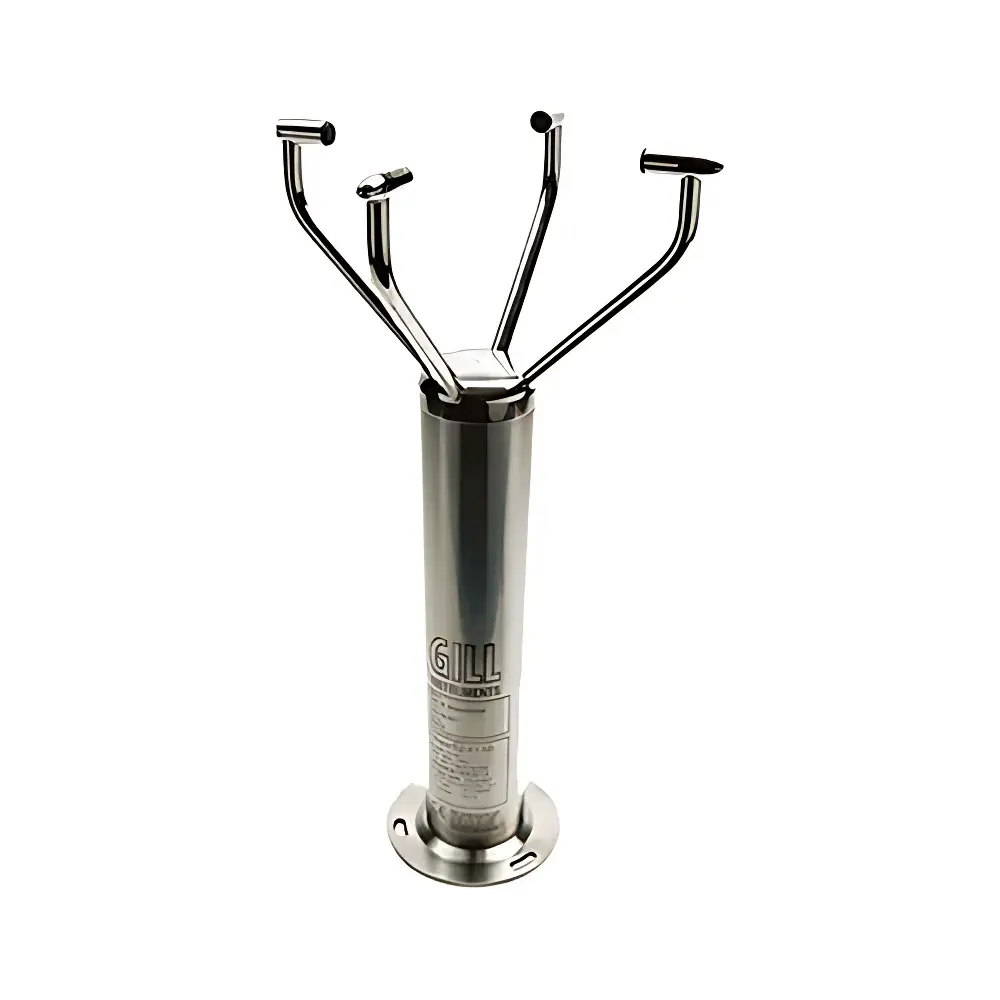

Gill WindObserver IS Ultrasonic Anemometer
| Brand | Gill |
|---|---|
| Origin | UK |
| Model | WindObserver IS |
| Instrument Type | Ultrasonic Anemometer |
| Resolution | 0.01 m/s |
| Measurement Range | 0 – 75 m/s |
| Accuracy | ±2% of reading |
| Operating Temperature | −30 °C to +70 °C |
| Operating Humidity | 0–100% RH |
| Certifications | ATEX II 2 G IIC T4 Ga, IECEx EXA 20.0029X, UKEX 20ATEX0002X |
| Compliance | UK CAA CAP 437, WMO Guide to Meteorological Instruments and Methods of Observation (WMO-No. 8, 7th Ed., 2008) |
| Output Options | Gill Serial Protocol, NMEA 0183, 4–20 mA (isolated), RS-485 |
| Power Supply | 12–30 VDC or 24 VAC |
| Ingress Protection | IP66 |
| Expected Service Life | >10 years in offshore environments |
Overview
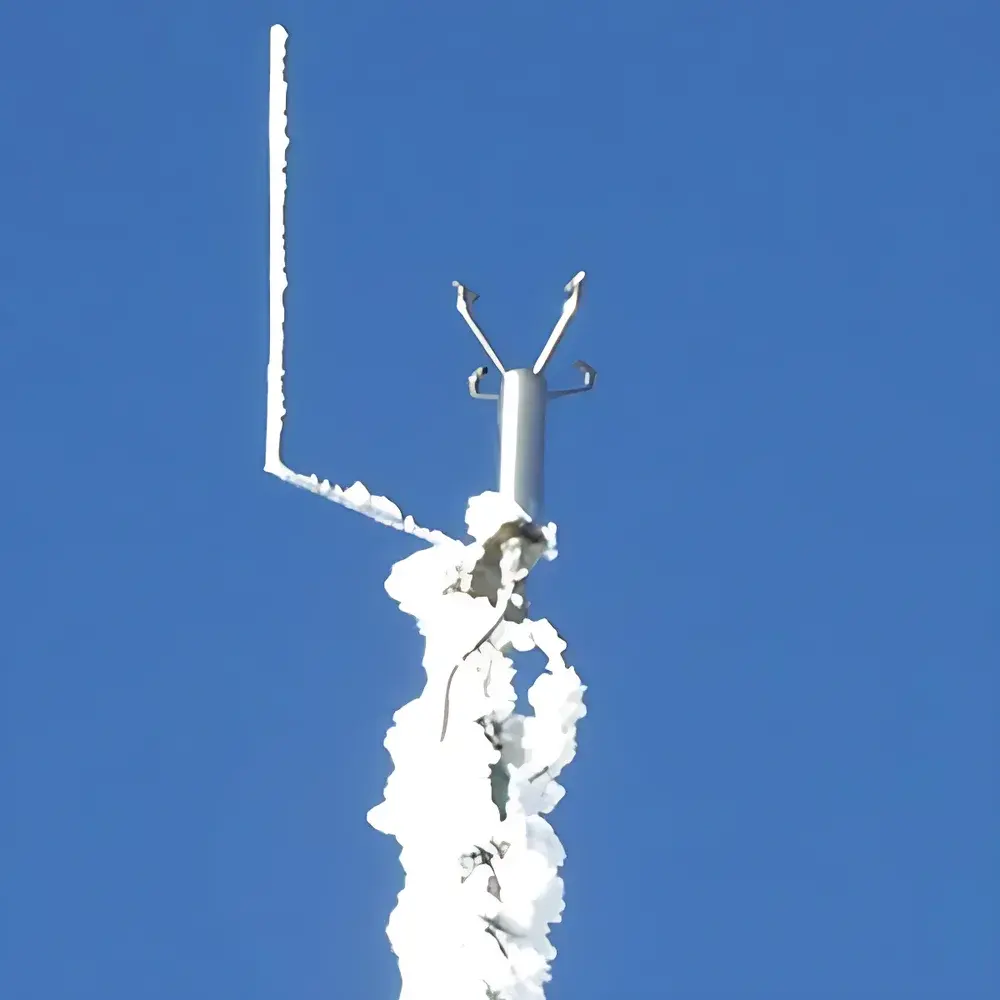
The Gill WindObserver IS is a certified intrinsically safe ultrasonic anemometer engineered for continuous, high-reliability wind speed and wind direction measurement in hazardous industrial environments. Unlike mechanical cup-and-vane sensors, it employs time-of-flight ultrasonic transit-time principle: four transducers arranged orthogonally transmit and receive ultrasonic pulses across fixed acoustic paths. By precisely measuring the differential time delay between upstream and downstream propagation, the instrument calculates both horizontal wind vector components—enabling simultaneous, contactless determination of wind speed (0–75 m/s) and direction (0–360°) with no moving parts. Its design eliminates mechanical wear, bearing failure, and icing susceptibility—critical advantages for unattended operation on offshore platforms, FPSOs, and process facilities where access is constrained and maintenance windows are infrequent.
Key Features
- Intrinsically safe certification to ATEX II 2 G IIC T4 Ga, IECEx EXA 20.0029X, and UKEX 20ATEX0002X—enabling direct installation in Zone 1 and Zone 2 hazardous areas without additional barriers or purging systems
- Compliance with UK Civil Aviation Authority CAP 437 for offshore meteorological monitoring, including helicopter landing site (HLS) wind reporting requirements
- Configurable averaging algorithms: user-selectable vector-based sliding average (1–3600 s) and 3-second gust detection aligned with WMO-No. 8 (7th Edition, 2008)
- Galvanically isolated analog output (4–20 mA) and digital interfaces (RS-485, Gill Serial, NMEA 0183) ensure noise immunity in electrically noisy refinery or pipeline environments
- Wide operating temperature range (−30 °C to +70 °C) and full 0–100% RH tolerance support deployment in Arctic offshore conditions and tropical refineries alike
- No scheduled recalibration required; factory calibration is traceable to UKAS-accredited standards and remains valid for the instrument’s service life under normal operating conditions
Sample Compatibility & Compliance
The WindObserver IS is designed for permanent outdoor installation on fixed structures—including drilling rigs, flare stacks, tank farms, and pipeline compressor stations—where exposure to hydrocarbon vapors, salt spray, and explosive atmospheres is routine. Its stainless-steel housing and UV-stabilized polymer components meet IP66 ingress protection, resisting corrosion from H2S, chlorine, and marine aerosols. Certification documentation includes full test reports per EN 60079-0, EN 60079-11, and IEC 60079-31, ensuring global regulatory acceptance without local re-certification. It satisfies functional safety requirements referenced in IEC 61508 (SIL 2 capable when integrated into certified control systems) and supports audit readiness for ISO 9001, ISO 14001, and OHSAS 18001 management systems.
Software & Data Management
Data output is protocol-agnostic and compatible with industry-standard SCADA, DCS, and CMS platforms (e.g., Siemens Desigo, Honeywell Experion, Emerson DeltaV). The device supports Modbus RTU over RS-485 for seamless integration into legacy plant networks. All configuration parameters—including averaging interval, output scaling, and alarm thresholds—are set via ASCII command interface or Gill’s free WindSoft configuration utility. No embedded firmware updates require physical access: remote diagnostics and parameter adjustments can be performed over the serial link without interrupting measurement continuity. While the WindObserver IS does not store historical data onboard, its deterministic real-time output enables direct ingestion into time-series databases compliant with FDA 21 CFR Part 11 (when deployed with validated acquisition software) and supports long-term trend analysis for predictive maintenance planning.
Applications
- Offshore oil & gas: Helideck wind monitoring per CAP 437, flare stack ventilation assessment, FPSO motion compensation input
- Onshore petrochemical facilities: Process area wind dispersion modeling, VOC emission plume tracking, emergency response decision support
- Tank terminal operations: Vapor recovery system optimization, loading/unloading safety interlocks based on crosswind thresholds
- Gas transmission infrastructure: Compressor station environmental monitoring, pipeline right-of-way microclimate logging
- Hazardous waste treatment sites: Fugitive emission dispersion verification and regulatory reporting (EPA Method 9, EN 15267)
FAQ
Is the WindObserver IS suitable for Class I, Division 1 locations in North America?
Yes—the UKEX and IECEx certifications are accepted by most AHJs under the US NEC Article 500 recognition framework; however, end-user validation with local authority having jurisdiction (AHJ) is recommended prior to installation.
Does the device require periodic recalibration?
No. Gill provides lifetime factory calibration traceable to UKAS-accredited standards. Field verification using known reference conditions (e.g., zero-wind enclosure test or calibrated wind tunnel spot-check) is optional but not mandated by manufacturer or certification bodies.
Can the WindObserver IS operate on standard 24 VAC building power?
Yes—it accepts 12–30 VDC or 24 VAC nominal input with built-in surge suppression and reverse-polarity protection, eliminating need for external power conditioners in industrial settings.
What is the minimum update rate for wind vector output?
The default output rate is 1 Hz; higher-frequency streaming (up to 4 Hz) is available via Gill Serial protocol for specialized turbulence studies or dynamic control applications.
How is lightning protection implemented?
The unit incorporates transient voltage suppression on all signal and power lines per IEC 61000-4-5 (Level 4, 4 kV line-to-earth), and must be installed with a properly grounded mounting mast and bonded to facility grounding grid per IEEE 1100.
Related Products







