
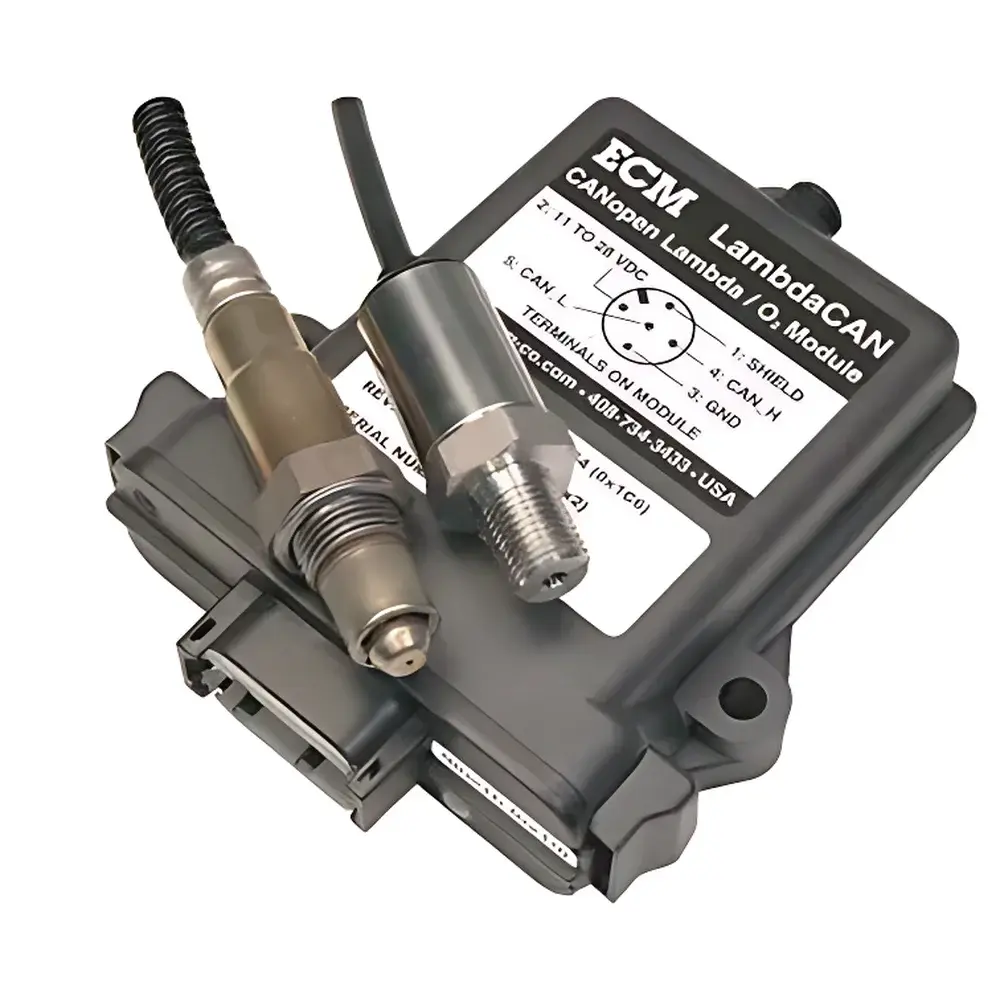
ECM LambdaCAN Wide-Range Air-Fuel Ratio Measurement Module
| Brand | ECM |
|---|---|
| Origin | USA |
| Model | LambdaCAN |
| Interface | High-Speed CAN (ISO 11898) |
| Input | 1 lambda sensor + optional pressure sensor |
| Lambda Range | 0.40–25.0 |
| AFR Range | 6.0–364.0 |
| O₂ Range | 0–25% |
| Pressure Range (optional) | 0–517 kPa |
| Accuracy (λ) | ±0.005 @ λ=1, ±0.008 @ λ=0.8–1.2, ±0.009 elsewhere |
| Accuracy (AFR) | ±0.1 @ 14.6, ±0.2 @ 12–18, ±0.5 elsewhere |
| Accuracy (O₂) | ±0.2 @ 0–2%, ±0.4 elsewhere |
| Accuracy (Pressure) | ±5.2 kPa |
| Response Time | <150 ms |
| Fuel Composition Parameters | Configurable H:C, O:C, N:C, H₂ ratios |
| Operating Temperature | −40 °C to +105 °C |
| Dimensions | 145 mm × 120 mm × 40 mm |
| Power Supply | 11–28 VDC |
| Sensor Thread | 18 mm × 1.5 mm (lambda), 1/4" NPT (pressure) |
| Cable Length | Standard 0.6 m (1 m / 2 m optional) |
Overview
The ECM LambdaCAN is a high-precision, wide-range air-fuel ratio (AFR) and lambda (λ) measurement module engineered for real-time combustion analysis in engine development, emissions certification, and powertrain calibration laboratories. Based on electrochemical zirconia-sensor technology with integrated pump-cell control and Nernst voltage monitoring, the LambdaCAN delivers traceable, factory-calibrated measurements of lambda (0.40–25.0), stoichiometric-equivalent AFR (6.0–364.0), and oxygen concentration (0–25% vol). Its core architecture implements dual-sensor signal conditioning—accepting input from industry-standard wideband lambda sensors (Bosch LSU 4.9, NTK UEGO, Delphi EGO-100 series)—and optionally integrates a calibrated piezoresistive pressure transducer to correct for barometric and intake manifold pressure variations. This pressure compensation is critical for maintaining accuracy under non-standard atmospheric conditions (e.g., altitude testing, boosted intake systems) and off-stoichiometric mixtures (λ ≠ 1), where uncompensated pressure deviations of +34 kPa can introduce up to ±0.58 error in λ at λ = 3. All calibration coefficients—including sensor-specific slope/offset, aging factors, and pressure transducer gain—are stored in non-volatile memory embedded within the sensor connector, enabling plug-and-play traceability without host-side calibration tables.
Key Features
- Factory-traceable calibration with embedded EEPROM storage for sensor-specific parameters, eliminating manual coefficient entry
- Real-time pressure compensation (0–517 kPa range) via optional integrated pressure sensor; pressure data broadcast over CAN bus for synchronization with ECU or DAQ systems
- Configurable fuel composition modeling: user-defined H:C, O:C, N:C, and H₂ ratios enable accurate λ-to-AFR conversion across gasoline, diesel, ethanol blends (E85), methanol, natural gas (CNG), hydrogen, and synthetic fuels
- High-speed CAN 2.0B interface compliant with ISO 11898-2, supporting data rates up to 1 Mbps and seamless integration into automotive test benches using standard J1939 or custom CAN message protocols
- Ruggedized industrial design rated for −40 °C to +105 °C ambient operation, suitable for under-hood deployment, dynamometer cells, and mobile emissions testing platforms
- Sub-150 ms system response time (t90) ensures fidelity in transient engine cycles including rapid throttle sweeps and misfire detection
Sample Compatibility & Compliance
The LambdaCAN interfaces directly with OEM-grade wideband oxygen sensors utilizing standard 18 mm × 1.5 mm M18 thread mounting (e.g., Bosch LSU 4.9, NTK UEGO 2-series, Delphi EGO-100), requiring no external signal conditioners or analog breakout boxes. It supports both heated and unheated sensor variants and accommodates optional 1/4″ NPT pressure tap connections. The module complies with CISPR 25 Class 3 electromagnetic compatibility requirements for automotive environments and meets ISO 26262 ASIL-B readiness for functional safety integration. While not certified as a standalone emissions analyzer per EPA 40 CFR Part 1065 or EU Regulation (EU) 2017/1151, its metrological performance—validated against NIST-traceable reference gases and certified calibration standards—is routinely accepted in R&D, homologation support, and GLP-aligned engine mapping workflows. All firmware and configuration files are version-controlled and support audit-ready change logs for ISO/IEC 17025-accredited laboratories.
Software & Data Management
Configuration and real-time monitoring are performed via ECM’s Windows-based LambdaCAN Configuration Tool, which communicates over CAN using a USB-to-CAN adapter (e.g., PEAK PCAN-USB FD). The tool enables full parameterization of fuel type, pressure compensation enablement, CAN message ID assignment, and sensor health diagnostics—including real-time display of pump current, Nernst resistance, and calculated sensor aging index. All operational data—including λ, AFR, %O₂, absolute pressure, sensor temperature estimate, and diagnostic flags—are output via configurable CAN frames (default 100 Hz update rate), compatible with industry-standard DAQ platforms such as ETAS INCA, dSPACE SCALEXIO, NI VeriStand, and AVL PUMA Open. Raw CAN messages include CRC-16 checksums and support extended data length (EDL) for future firmware expansion. Audit trails, calibration history, and firmware version metadata are exportable in CSV and XML formats to support FDA 21 CFR Part 11-compliant electronic records in regulated development environments.
Applications
- Engine control unit (ECU) calibration and closed-loop lambda control validation
- Transient emissions testing (WLTC, FTP-75, RDE) with simultaneous λ, AFR, and intake pressure logging
- Fuel formulation studies involving multi-component hydrocarbon blends and alternative fuels
- Aftertreatment system efficiency analysis (TWC, DOC, DPF, SCR) under dynamic load conditions
- Combustion research in optical engines and rapid compression machines (RCMs)
- On-vehicle OBD-II correlation and fault code root-cause analysis
FAQ
Does LambdaCAN require periodic recalibration in the field?
No—factory calibration is permanently stored in the sensor connector’s EEPROM. However, users may perform optional zero-point recalibration in ambient air at any time; updated coefficients are written back to the same memory location and persist across power cycles.
Can LambdaCAN operate without the optional pressure sensor?
Yes—the module functions fully with only the lambda sensor. Pressure compensation is disabled by default and only activated when a valid pressure signal is detected on the designated CAN channel or analog input.
Is the LambdaCAN compatible with non-ECM-branded CAN interfaces?
Yes—it adheres strictly to ISO 11898-2 physical layer specifications and uses standard CAN 2.0B frame formatting. Any CAN interface meeting these specifications (e.g., Vector VN1630, Kvaser Leaf Light v2) will achieve full interoperability.
What is the recommended maintenance interval for the lambda sensor?
Sensor lifetime depends on exposure conditions (e.g., leaded fuel, oil contamination, thermal cycling). ECM recommends monitoring the aging factor output and replacing the sensor when the value exceeds 1.3× nominal resistance or when λ deviation exceeds ±0.02 under stable stoichiometric conditions.
How is traceability ensured for regulatory reporting?
Each LambdaCAN module ships with a unique serial number and a NIST-traceable calibration certificate documenting sensor-specific coefficients, pressure transducer linearity, and temperature-compensated accuracy envelopes—all archived in the embedded EEPROM and accessible via CAN diagnostic requests.
Related Products







