
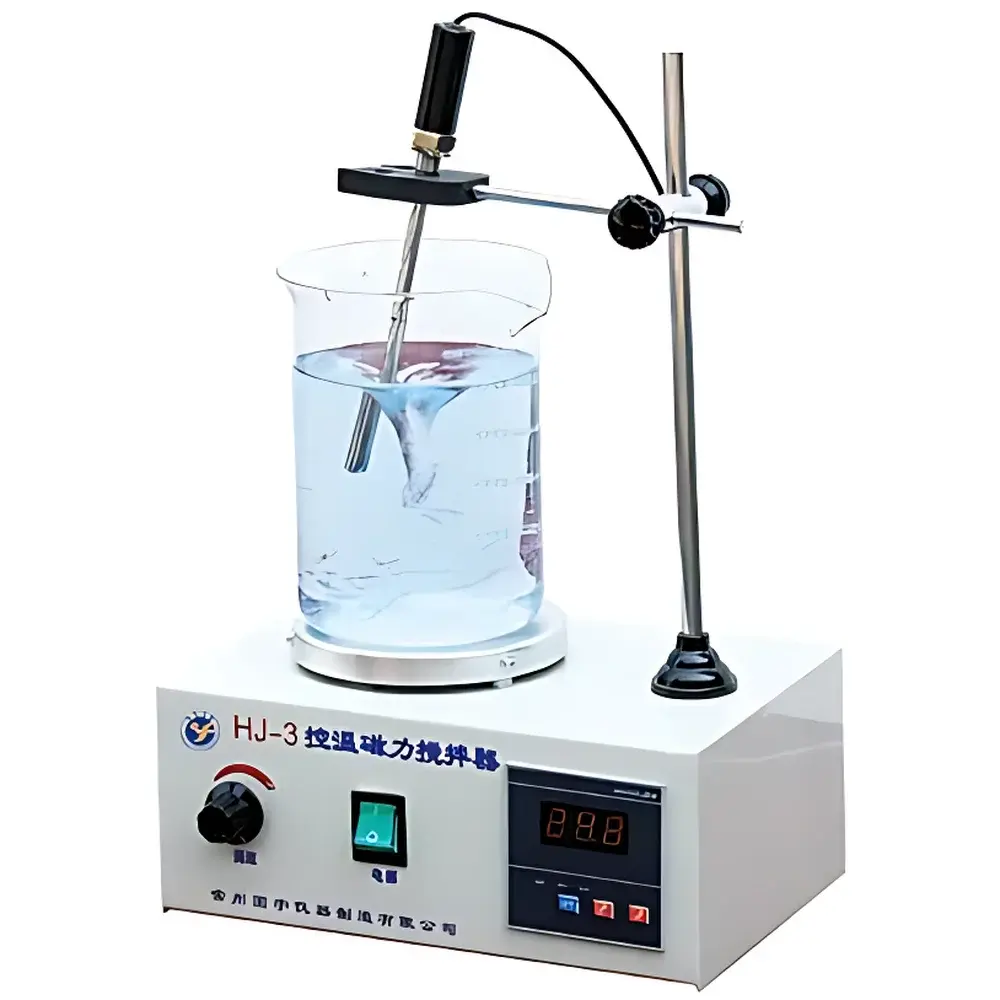
CZGY 85-2 Digital Temperature-Controlled Magnetic Stirrer
| Brand | CZGY |
|---|---|
| Origin | Jiangsu, China |
| Manufacturer Type | Direct Manufacturer |
| Model | 85-2 |
| Instrument Type | Magnetic Stirrer |
| Max. Stirring Volume | 1000 mL |
| Speed Range | 0–1600 rpm |
| Temperature Control Range | Ambient to 100 °C |
| Heating Power | 150 W |
| Motor Power | 25 W |
| Plate Diameter | 120 mm |
| Power Supply | AC 220 V, 50 Hz |
Overview
The CZGY 85-2 Digital Temperature-Controlled Magnetic Stirrer is an entry-level yet robust benchtop instrument engineered for precise, reproducible mixing and simultaneous temperature regulation in routine laboratory workflows. It operates on the principle of magnetic coupling: a rotating permanent magnet beneath the ceramic-coated aluminum heating plate induces synchronous rotation of a PTFE- or glass-coated magnetic stir bar immersed in the sample vessel. Integrated resistive heating elements enable closed-loop temperature control via a PID algorithm, with real-time feedback from a stainless-steel RTD probe inserted directly into the solution. Designed for stability under continuous operation, the unit features low-vibration motor architecture and electromagnetic shielding to minimize interference with sensitive measurements—making it suitable for applications requiring thermal homogeneity and mechanical consistency across aqueous, organic, and viscous media.
Key Features
- Digital dual-display interface showing both setpoint and real-time speed (rpm) and temperature (°C), with 0.1 °C resolution
- Stepless speed control from 0 to 1600 rpm, optimized for gentle suspension formation or vigorous homogenization
- PID-based temperature regulation with adjustable parameters (P, T, E) accessible via multi-press SET key sequence
- 120 mm diameter chromium-plated aluminum heating plate offering uniform thermal distribution and chemical resistance
- Thermal cut-off protection and overheat alarm prevent dry-run damage and ensure operator safety
- Grounded chassis design compliant with IEC 61010-1 safety standards for laboratory electrical equipment
- Compact footprint (200 × 150 × 90 mm) ideal for fume hoods, biosafety cabinets, and shared lab benches
Sample Compatibility & Compliance
The 85-2 accommodates standard laboratory glassware including beakers (up to 1000 mL), Erlenmeyer flasks, and round-bottom vessels placed centrally on the plate. Its non-corrosive surface supports use with mild acids, bases, alcohols, and saline solutions—though prolonged exposure to strong oxidizers or halogenated solvents is not recommended. The instrument meets CE marking requirements per Directive 2014/30/EU (EMC) and 2014/35/EU (LVD). While not certified for GMP or GLP environments out-of-the-box, its digital logging capability (via optional RS232 output) supports traceability when integrated into validated workflows adhering to ISO/IEC 17025 or ASTM E2500 guidelines.
Software & Data Management
The 85-2 operates as a standalone analog-digital hybrid controller without embedded firmware or network connectivity. All parameter adjustments—including setpoints, PID tuning constants (P, T, E), and calibration offsets—are performed manually using front-panel keys. No proprietary software is required; however, users may interface the unit with external data acquisition systems via its TTL-level RS232 port (optional accessory) for time-stamped logging of speed and temperature profiles. Audit trails must be maintained manually or through third-party DAQ platforms compliant with FDA 21 CFR Part 11 if used in regulated quality control settings.
Applications
- Preparation of buffer solutions, reagent dilutions, and culture media in microbiology and molecular biology labs
- Heating-assisted dissolution of solids during analytical sample preparation (e.g., prior to HPLC or ICP-MS analysis)
- Controlled-rate warming in enzymatic reaction studies where thermal ramping affects kinetic outcomes
- Homogenization of suspensions in environmental testing (e.g., soil leachate extraction, wastewater treatment simulations)
- Supporting synthesis protocols in organic chemistry requiring inert-atmosphere stirring under reflux conditions
- Calibration verification of thermometers and temperature probes using stable isothermal baths
FAQ
What is the maximum continuous operating time at high speed?
At speeds above 1200 rpm, continuous operation is rated for up to 4 hours. For extended runs (>8 h), maintain speeds below 800 rpm and ensure adequate ventilation around the unit.
Can the stirrer be used without temperature control?
Yes—the heating function can be disabled independently while retaining full speed control, enabling ambient-temperature mixing only.
Is the RTD temperature probe included with the unit?
Yes, a stainless-steel immersion probe with 1.5 m cable is supplied as standard equipment.
Does the device support external temperature sensors?
No—it is configured exclusively for its integrated probe; no user-replaceable or third-party sensor input is supported.
What maintenance is required to ensure long-term accuracy?
Wipe the plate surface after each use with ethanol or isopropanol; inspect stir bars for coating integrity before reuse; verify temperature readout against a NIST-traceable reference thermometer annually.



