
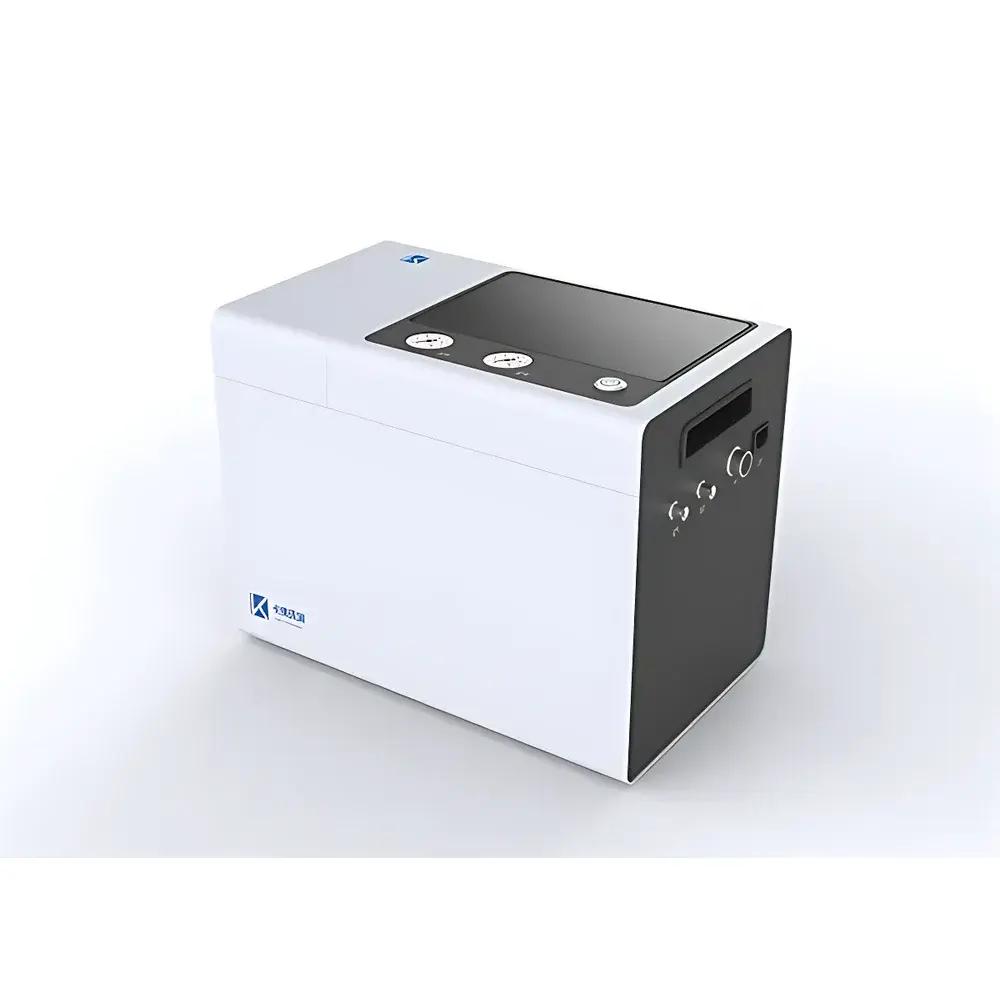
BANFF Da Vinci I Portable Total Hydrocarbons Analyzer (NMHC)
| Brand | BANFF |
|---|---|
| Model | Da Vinci I |
| Type | Portable Gas Chromatograph with FID |
| Origin | Zhejiang, China |
| Manufacturer | BANFF Biotechnology |
| Application Domain | Environmental Monitoring |
| Compliance Standards | HJ 38-2017, HJ 1012-2018, HJ 604-2017, GB/T 31705-2015, JJG 700-2016, JJF (Su) 225-2019 |
| Certification Framework | RB/T 214, HJ 630 |
| Connectivity | Wi-Fi & 4G remote control |
| Detection Principle | Gas Chromatography–Flame Ionization Detection (GC-FID) |
| Operational Modes | Lab-based stationary analysis & field-deployable on-site analysis (including explosion-proof environments) |
| Data Output | Auto-generated audit-trail-compliant reports |
Overview
The BANFF Da Vinci I Portable Total Hydrocarbons Analyzer is a purpose-engineered gas chromatograph system designed for quantitative determination of total hydrocarbons (THC), methane (CH₄), and non-methane hydrocarbons (NMHC) in ambient air, stack emissions, and fugitive sources. Built upon a robust GC-FID architecture, the instrument implements a dual-path separation strategy optimized for C₁–C₆ hydrocarbon resolution under field-constrained conditions. Its core innovation lies in hardware-level integration of carrier gas generation, purification, and thermal management—eliminating dependence on external high-purity gas cylinders and enabling reliable operation in laboratories with limited infrastructure or in hazardous locations requiring intrinsically safe deployment. The Da Vinci I meets the analytical rigor defined by Chinese environmental standards HJ 38-2017, HJ 1012-2018, and HJ 604-2017, supporting both direct injection and pre-concentration sampling protocols. Its “chromatographic amphibious” capability—seamlessly transitioning between fixed-lab calibration workflows and mobile field measurements—makes it uniquely suited for regulatory compliance verification, source attribution studies, and time-resolved emission flux monitoring.
Key Features
- Ultra-fast thermal stabilization: Proprietary ramp-and-hold temperature control algorithm reduces cold-start-to-first-report time to under 12 minutes, ensuring rapid deployment during emergency response or short-duration site surveys.
- Remote operation architecture: Full instrument control—including method selection, valve sequencing, detector biasing, and gas mixing—is achievable via encrypted Wi-Fi or LTE 4G link, maintaining operator distance from hazardous atmospheres or high-noise zones.
- Modular autosampler compatibility: Optional 12/24-position rotary autosampler enables unattended sequential analysis of canister, Tedlar bag, or sorbent tube samples—ideal for multi-point fence-line monitoring or longitudinal campaign data collection.
- Regulatory-grade data integrity: Onboard software generates timestamped, digitally signed analytical records compliant with RB/T 214-2017 and HJ 630-2011 requirements; each report includes full audit trail metadata (user ID, method version, calibration status, raw chromatogram hash).
- Ruggedized field design: IP54-rated enclosure, shock-absorbing chassis, and wide operating temperature range (−10 °C to +45 °C) ensure mechanical stability during vehicle-mounted transport or outdoor deployment without climate-controlled shelters.
Sample Compatibility & Compliance
The Da Vinci I accepts gaseous samples collected in evacuated stainless-steel canisters (SUMMA-type), flexible polymer bags (Tedlar®), or pre-packed sorbent tubes (e.g., Tenax TA/Carbotrap). It supports both direct injection (for high-concentration stack gases per HJ 38-2017) and cryo-focused enrichment (for sub-ppbv ambient air per HJ 604-2017). All hardware and firmware components are validated against national metrological regulations JJG 700-2016 (GC verification) and JJF (Su) 225-2019 (NMHC analyzer calibration). System-level traceability aligns with ISO/IEC 17025:2017 general requirements for competence of testing and calibration laboratories. For GLP/GMP-aligned operations, optional 21 CFR Part 11-compliant electronic signature modules are available upon request.
Software & Data Management
Da Vinci Control Suite v3.2 provides intuitive method setup, real-time chromatogram visualization, peak integration with customizable retention time windows, and automated NMHC calculation (NMHC = THC − CH₄). Raw data (.cdf) and processed reports (.pdf/.xlsx) are stored locally on an industrial-grade SSD with automatic RAID-1 mirroring. Cloud synchronization (via secure HTTPS endpoint) enables centralized database ingestion for enterprise-level QA/QC dashboards. All software modules undergo annual validation per HJ 630 Annex A, including linearity verification across 0.05–100 ppmC ranges, carryover assessment (<0.5% at 100 ppmC), and detector stability monitoring (RSD <2% over 8 h).
Applications
- Regulatory enforcement: Unannounced inspections of VOC-emitting facilities (paint booths, printing plants, petrochemical terminals) using HJ 1012-2018-compliant walk-through surveys.
- Fugitive emission quantification: Correlating leak detection (LDAR) findings with mass balance calculations for refinery flanges, valves, and pump seals.
- Agricultural GHG flux studies: Field-deployed measurement of CH₄ oxidation and NMHC co-emissions from rice paddies—supporting carbon accounting per IPCC Tier 2 methodologies.
- Mobile source characterization: Real-time profiling of exhaust plumes from diesel generators, marine engines, and biomass boilers to support emission factor refinement.
- Method validation benchmarking: Cross-calibration against reference-grade online GC systems (e.g., Thermo Scientific TRACE™ 1300) in inter-laboratory comparison exercises.
FAQ
Does the Da Vinci I meet U.S. EPA Method 25/25A equivalency requirements?
While designed primarily for Chinese regulatory frameworks (HJ series), its GC-FID configuration, linear dynamic range (>10⁶), and documented LOD (<0.02 ppmC) enable method adaptation for EPA-compliant applications subject to local authority approval and supplemental validation.
Can the system operate continuously for 72+ hours without maintenance?
Yes—when powered by external 12 V DC supply and equipped with extended-capacity gas generator cartridges, the Da Vinci I sustains uninterrupted analysis for up to 96 hours with <0.5% baseline drift (FID current), verified per JJG 700-2016 long-term stability criteria.
Is raw chromatographic data exportable in open formats?
All acquired signals are saved in ASTM E1319-compliant .cdf format, fully compatible with third-party processing tools including Chromeleon™, OpenChrom, and MATLAB-based custom algorithms.
What calibration gases are required for routine operation?
Primary calibration uses certified NIST-traceable methane-in-air standards (0.5, 5, 25, 50 ppmC); zero gas is generated internally via catalytic hydrocarbon scrubber—no external zero-air cylinder needed.
How is cybersecurity addressed in remote operation mode?
Wi-Fi/LTE communication employs TLS 1.2 encryption, device-authenticated handshake, and configurable firewall rules; no default credentials are shipped, and all firmware updates require SHA-256 signature verification.






