
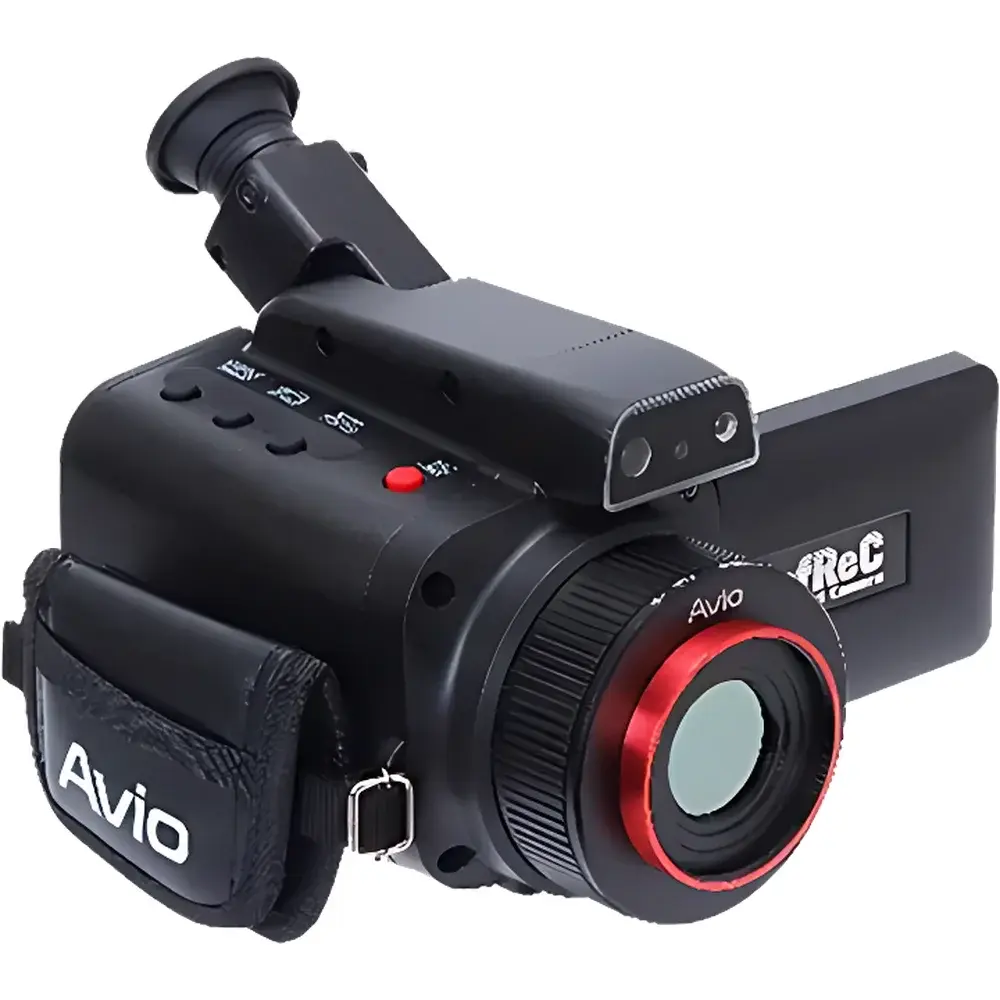
Avio R450 Series Uncooled Infrared Thermal Imaging Camera
| Brand | Avio |
|---|---|
| Origin | Japan |
| Manufacturer Type | Authorized Distributor |
| Product Origin | Imported |
| Model | R450 Series |
| Price Range | USD 13,500–40,500 (FOB) |
| Spectral Band | Long-Wave Infrared (LWIR) |
| Detector Type | Uncooled Microbolometer Focal Plane Array (FPA) |
| Application | Non-Contact Temperature Measurement |
| Measurement Principle | Radiometric Thermal Imaging |
| Operating Mode | Uncooled |
| Frame Rate | 8–40 Hz |
| Accuracy | ±1 °C or ±1% of reading (at 30 °C, within –20 to 60 °C range |
| Temperature Range | –40 °C to 1500 °C (R450Pro-D) |
| IR Resolution | 960 × 720 (Super-Resolution mode), 480 × 360 (standard mode) |
| Spectral Response | 8–14 µm |
| NETD | ≤0.025 °C @ 30 °C (with SNR enhancement) |
| IFOV (Standard Lens) | 0.87 mrad (480×360), 0.58 mrad (SR mode) |
| Field of View | 24° H × 18° V (standard lens) |
| Focus Range | 10 cm to ∞ (auto/manual) |
| Visible Camera | 5 MP CMOS |
| Display | 3.5″ rotatable LCD + color tilting viewfinder |
| Storage | SD/SDHC card (JPEG + embedded 14-bit radiometric data |
| Compliance | CE (EMC Class A), IP54, IEC 60825-1:2007/2014 (Class 2 laser), RoHS |
Overview
The Avio R450 Series is a high-performance, uncooled long-wave infrared (LWIR) thermal imaging camera engineered for precision radiometric measurement and diagnostic thermography in industrial, scientific, and infrastructure applications. Utilizing a microbolometer focal plane array with spectral sensitivity across the 8–14 µm atmospheric transmission window, the R450 delivers quantitative surface temperature data without physical contact—enabling safe, repeatable, and non-intrusive thermal analysis. Its dual-mode architecture supports both standard 480 × 360 resolution imaging and Super-Resolution (SR) processing, upscaling static frames to 960 × 720 pixels while enhancing spatial resolution to 0.58 mrad. Designed for field-deployable robustness, the system operates across –15 °C to 50 °C ambient conditions, features IP54 ingress protection, and complies with CE electromagnetic compatibility standards (Class A) and laser safety requirements (IEC 60825-1). The R450 Series serves as a foundational tool for predictive maintenance, thermal validation, energy auditing, and R&D thermal profiling where traceable, calibrated temperature mapping is required.
Key Features
- Uncooled microbolometer detector with 8–14 µm spectral response—eliminates cryogenic cooling requirements and enables rapid startup (<5 s).
- Super-Resolution (SR) imaging mode: synthetically enhances still-image resolution to 960 × 720 pixels with improved spatial detail and reduced pixelation artifacts.
- Wide dynamic temperature range: –40 °C to 1500 °C (R450Pro-D variant); no manual range switching needed during multi-stage thermal testing.
- High thermal sensitivity: NETD ≤0.025 °C at 30 °C under SNR-enhanced acquisition—critical for detecting subtle thermal gradients in low-contrast targets.
- Multi-modal visualization: simultaneous visible-light (5 MP CMOS) and IR overlay via fusion, picture-in-picture (adjustable transparency), or side-by-side display.
- Automated radiometric workflows: auto-focus, auto-leveling (temperature span adjustment), auto-color palette selection, and real-time emissivity compensation.
- Integrated laser pointer (Class 2, 635 nm) and LED illumination for target identification and low-light alignment—calibrated to optical axis for geometric fidelity.
- Robust mechanical design: magnesium alloy housing, 3G vibration tolerance, 30G shock resistance, and sealed optics compatible with dusty or humid environments.
Sample Compatibility & Compliance
The R450 Series accommodates diverse sample geometries and emissivity profiles through configurable radiation parameters—including multi-point emissivity correction, background temperature compensation, and distance-based atmospheric attenuation modeling. It supports materials with emissivity values from 0.1 to 1.0 (e.g., oxidized metals, composites, ceramics, painted surfaces, and electrical insulation). For regulated environments, the platform supports audit-ready documentation: embedded radiometric metadata (14-bit temperature data per pixel), timestamped JPEG+thermal archives, and alarm-triggered event logging. While not inherently 21 CFR Part 11 compliant out-of-the-box, the InfReC Analyzer NS9500Pro software suite enables user-defined electronic signatures, change logs, and export controls suitable for GLP/GMP-aligned thermal validation protocols. The instrument meets ISO 18434-1 (condition monitoring — thermography) guidelines for equipment classification and measurement uncertainty reporting.
Software & Data Management
Data acquisition and post-processing are managed via Avio’s InfReC Analyzer software—NS9500Pro (full-featured) or NS9500Std (base edition). NS9500Pro unlocks SR image reconstruction, panoramic stitching (75° H × 56° V), time-series thermal trending, and customizable report generation (PDF/Excel). All thermal images embed full radiometric data (14-bit per pixel), enabling offline reanalysis of emissivity, level/span, and color mapping without raw file loss. Video recording uses proprietary SVX format with synchronized visible-light capture; external trigger input allows hardware-synchronized acquisition (e.g., motor start signal, furnace ramp command) without external I/O modules. Data export supports CSV (temperature matrix), TIFF (radiometric), and standardized JPEG with embedded EXIF tags containing calibration coefficients and measurement settings—facilitating integration into LIMS or CMMS platforms.
Applications
- Electrical Infrastructure Diagnostics: Detection of loose connections, overloaded breakers, and failing insulators in substations, switchgear, and photovoltaic arrays—per IEEE 1207 and NFPA 70E guidelines.
- Mechanical & Rotating Equipment Monitoring: Bearing temperature profiling, gearbox thermal imbalance assessment, and steam trap functionality verification—aligned with ISO 18436-7 certification criteria.
- Building Envelope Analysis: Identification of thermal bridging, moisture intrusion, insulation voids, and HVAC duct leakage per ASTM C1060 and ISO 6781-3.
- R&D and Process Validation: Real-time thermal mapping of battery cell cycling, composite curing, additive manufacturing build plates, and semiconductor packaging under thermal stress.
- Fire Safety & Search Support: Smoke-penetrating visibility, hotspot localization in structural fires, and post-event thermal residue analysis—compatible with NFPA 1801 operational parameters.
FAQ
What is the difference between R450 and R450Pro-D models?
The R450Pro-D extends the upper temperature limit to 1500 °C and includes enhanced NETD performance and SR-enabled video streaming capabilities. Standard R450/R450-D units are rated to 650 °C and support SR only for still images.
Does the R450 require periodic factory recalibration?
Yes—Avio recommends annual radiometric calibration traceable to NIST standards to maintain stated accuracy (±1 °C or ±1%). Calibration certificates include uncertainty budgets per ISO/IEC 17025.
Can the R450 interface with PLC or SCADA systems?
Via optional Ethernet-to-USB gateway or third-party OPC UA middleware, real-time temperature data (e.g., max/min spot values, region averages) can be streamed to industrial control systems using Modbus TCP or ASCII serial protocols.
Is the SR mode applicable to video recording?
No—Super-Resolution is applied exclusively to still-frame capture. Video output remains at native 480 × 360 resolution (40 Hz) or 8 Hz depending on model configuration.
How is emissivity handled during live measurement?
Users select preset material emissivities (e.g., aluminum, copper, concrete) or define custom values (0.01–1.00 in 0.01 increments); multi-point emissivity correction is supported in post-processing via NS9500Pro.




