
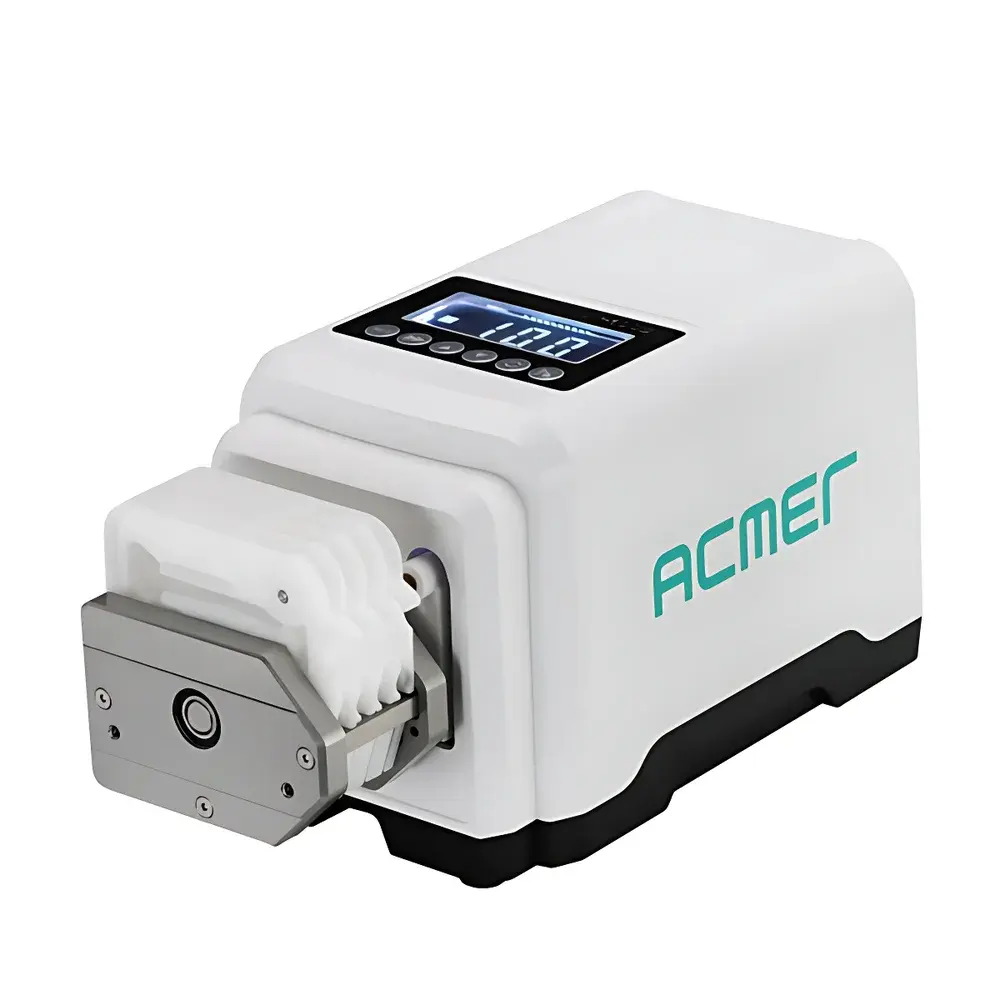
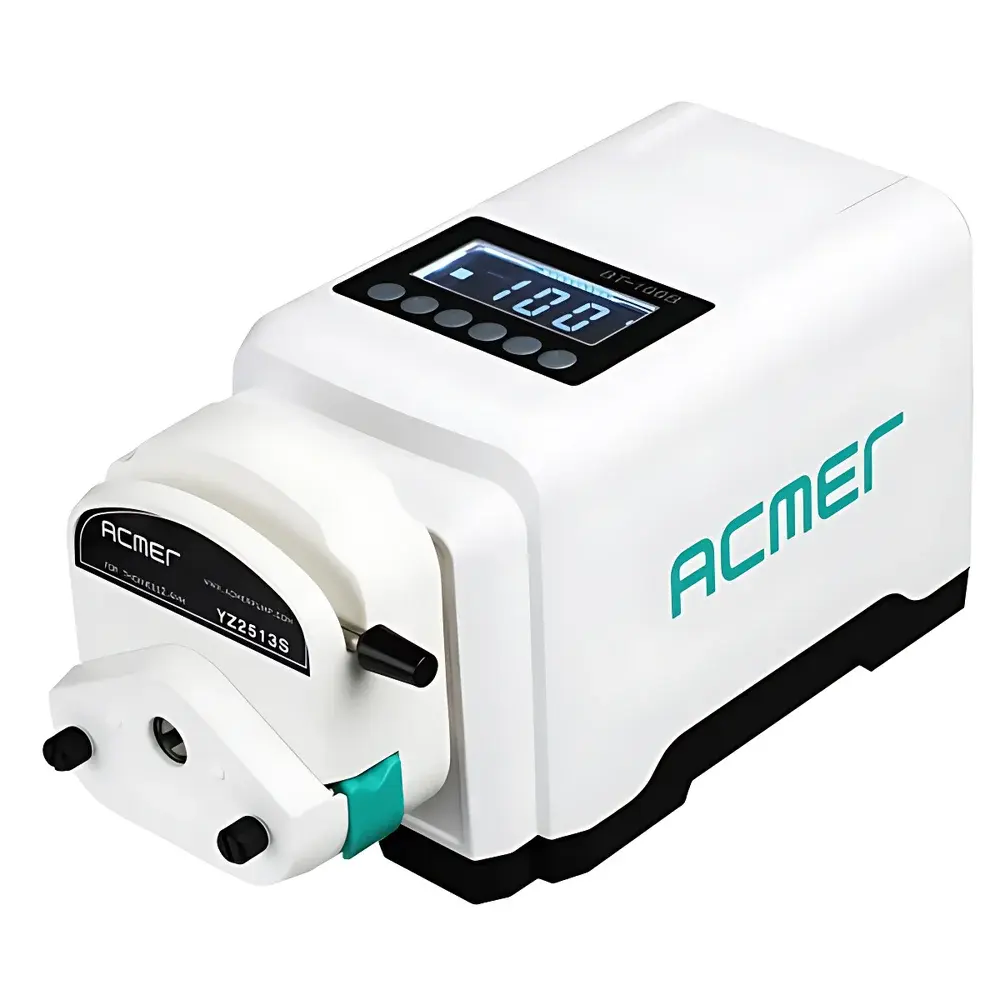
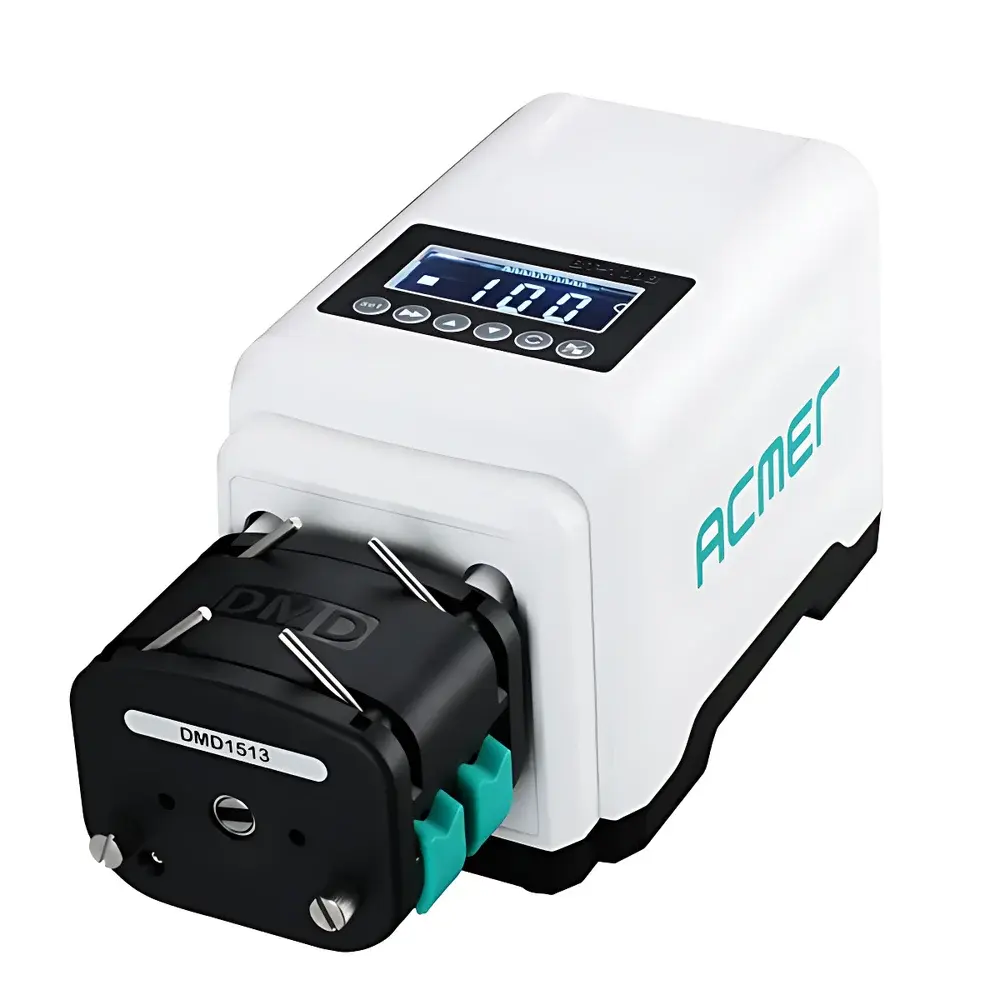
Acmer BT-100B Precision Peristaltic Pump
| Brand | Acmer |
|---|---|
| Origin | Hebei, China |
| Manufacturer Type | Authorized Distributor |
| Country of Origin | China |
| Model | BT-100B |
| Pump Type | Peristaltic Pump |
| Flow Rate Range | 0.00013–560 mL/min |
| Maximum Speed | 150 rpm |
| Pump Head Compatibility | YZ1513, YZ2513S, BZ, DG, DMD1513 |
| Control Modes | Manual Keypad & External Analog/Digital Input |
| Display | Real-time RPM, Direction, and Operational Status |
| Direction | Bidirectional (Forward/Reverse) |
| Keypad Lock | Configurable via Key Combination |
| Max Speed Limit | User-Settable via Front Panel |
Overview
The Acmer BT-100B Precision Peristaltic Pump is an engineered solution for accurate, contamination-free fluid transfer in analytical laboratories, bioprocessing workflows, and quality control environments. Operating on the principle of peristalsis—where rollers compress a flexible tubing segment against a curved housing to generate positive displacement—the BT-100B delivers pulseless, low-shear flow ideal for shear-sensitive media including cell suspensions, enzymes, proteins, and viscous reagents. Its design prioritizes repeatability and operational stability over extended duty cycles, making it suitable for applications requiring precise volumetric dosing, gradient delivery in chromatography systems, or continuous feed in fermentation monitoring setups. Unlike diaphragm or piston pumps, the BT-100B isolates the fluid path entirely within the tubing, eliminating risk of cross-contamination and simplifying cleaning validation—a critical advantage in GLP-compliant labs and regulated pharmaceutical QC settings.
Key Features
- Wide Flow Range: Capable of delivering flow rates from 0.00013 mL/min to 560 mL/min—enabling both ultra-low-volume microfluidic sampling and high-throughput buffer exchange.
- Multi-Head Compatibility: Supports interchangeable pump heads—including YZ1513, YZ2513S, BZ, DG, and DMD1513—allowing users to optimize tube bore size, pressure tolerance, and flow profile for specific fluid viscosities and system backpressure conditions.
- Dual Control Architecture: Offers local operation via intuitive keypad interface and remote control via analog voltage (0–5 V or 0–10 V) or digital TTL signal input, facilitating integration into automated platforms such as PLC-controlled reactors or LIMS-linked dispensing stations.
- Real-Time Operational Feedback: Integrated LCD display continuously indicates actual rotational speed (rpm), direction (CW/CCW), and system status (e.g., running, paused, error), supporting rapid troubleshooting and process verification.
- User-Configurable Safety Limits: Maximum speed can be programmatically capped at any value ≤150 rpm through front-panel configuration—preventing accidental overspeed that could compromise tubing integrity or introduce flow instability.
- Keypad Lock Function: A dedicated key combination disables all front-panel inputs during unattended operation, mitigating unintended parameter changes in shared lab environments.
Sample Compatibility & Compliance
The BT-100B accommodates standard silicone, Viton®, and Tygon® tubing sizes compatible with its supported pump heads—ensuring chemical resistance across aqueous, organic, and mildly acidic/basic solutions. While not certified to IEC 61000-6-2/4 or UL 61010-1 out-of-the-box, the pump meets essential electrical safety requirements for Class I laboratory equipment when operated within specified ambient conditions (5–40 °C, <80% RH non-condensing). Its tubing-based fluid path inherently satisfies ISO 8573-1 purity class 4 for particulate generation and aligns with USP guidance on analytical instrument qualification for peristaltic components used in method-critical liquid handling steps.
Software & Data Management
The BT-100B operates as a standalone hardware module without proprietary software dependency. However, its analog/digital control interface enables seamless integration with third-party data acquisition systems (e.g., LabVIEW, MATLAB, or SCADA platforms) for time-stamped flow logging, closed-loop PID regulation, or synchronization with spectrophotometric detectors. All operational parameters—including setpoint speed, direction, and lock state—are retained in non-volatile memory after power cycling. Though lacking native 21 CFR Part 11 audit trail functionality, the device supports external electronic recordkeeping when deployed within validated workflows where user actions are logged by upstream controllers.
Applications
- Continuous infusion in HPLC mobile phase delivery and column equilibration
- Cell culture media feeding and harvest in bioreactor auxiliary loops
- Calibration standard delivery in atomic absorption spectroscopy (AAS) and ICP-OES sample introduction systems
- Low-flow reagent addition in automated titration and dissolution testing apparatus
- Environmental water sampling where particulate-laden samples must avoid filter clogging or shear-induced aggregation
- Educational demonstrations of positive displacement mechanics and flow-rate calibration principles
FAQ
What tubing materials are recommended for use with the BT-100B?
Silicone tubing (for general aqueous applications), Viton® (for organic solvents and elevated temperatures), and Tygon® E-3603 (for improved UV transparency and low extractables) are commonly employed—selection depends on chemical compatibility, pressure rating, and regulatory requirements.
Can the BT-100B maintain consistent flow under variable backpressure?
Yes—within the mechanical limits of the selected tubing and pump head, flow rate remains highly stable up to ~2 bar backpressure; however, sustained operation above 1.5 bar may accelerate tubing fatigue and require more frequent replacement.
Is firmware upgrade capability available?
No—firmware is fixed at time of manufacture; functional updates are implemented only through hardware revision (e.g., BT-100B v2.1) released by Acmer.
Does the pump support RS-485 or Modbus communication?
No—only analog voltage (0–5 V / 0–10 V) and TTL-level digital start/stop/direction signals are supported; protocol-based communication requires external signal conversion hardware.
How often should tubing be replaced during continuous operation?
Typical service life ranges from 100–500 hours depending on speed, tubing material, and operating pressure; routine visual inspection for flattening, cracking, or loss of elasticity is advised as part of preventive maintenance.



