
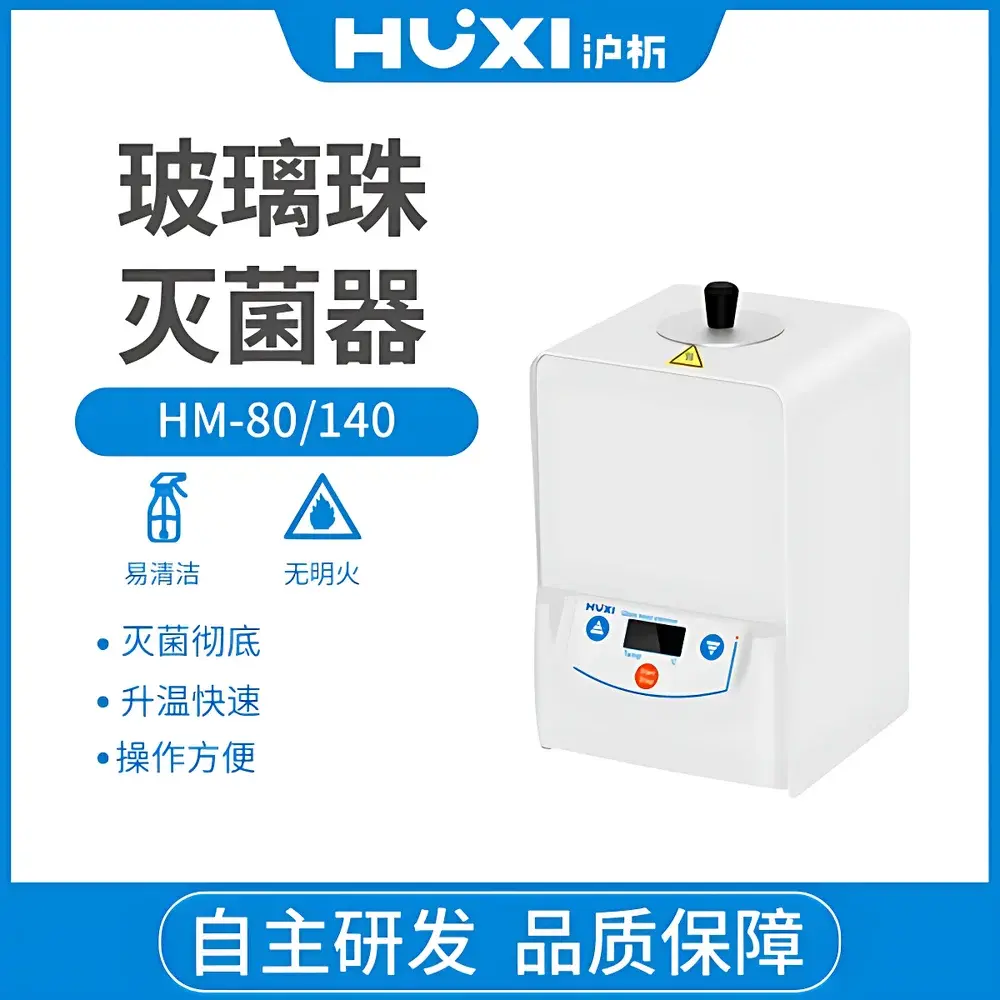
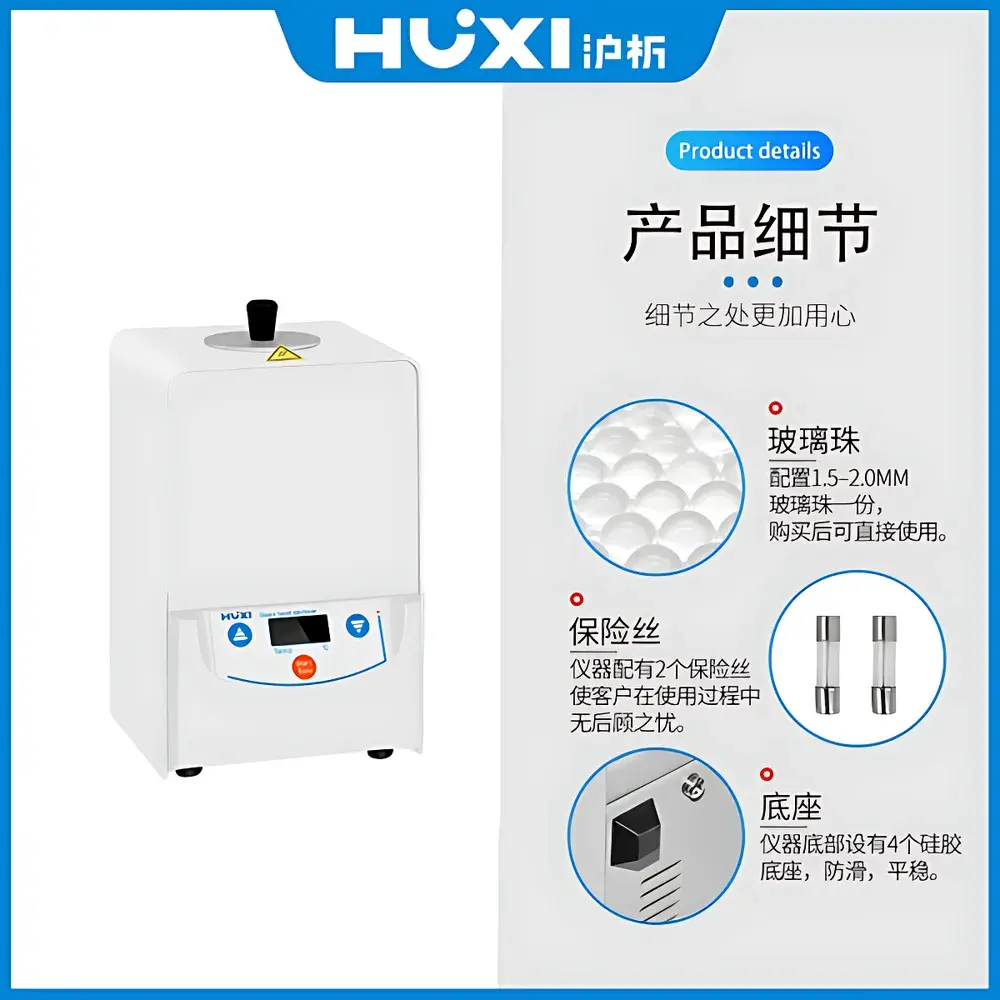
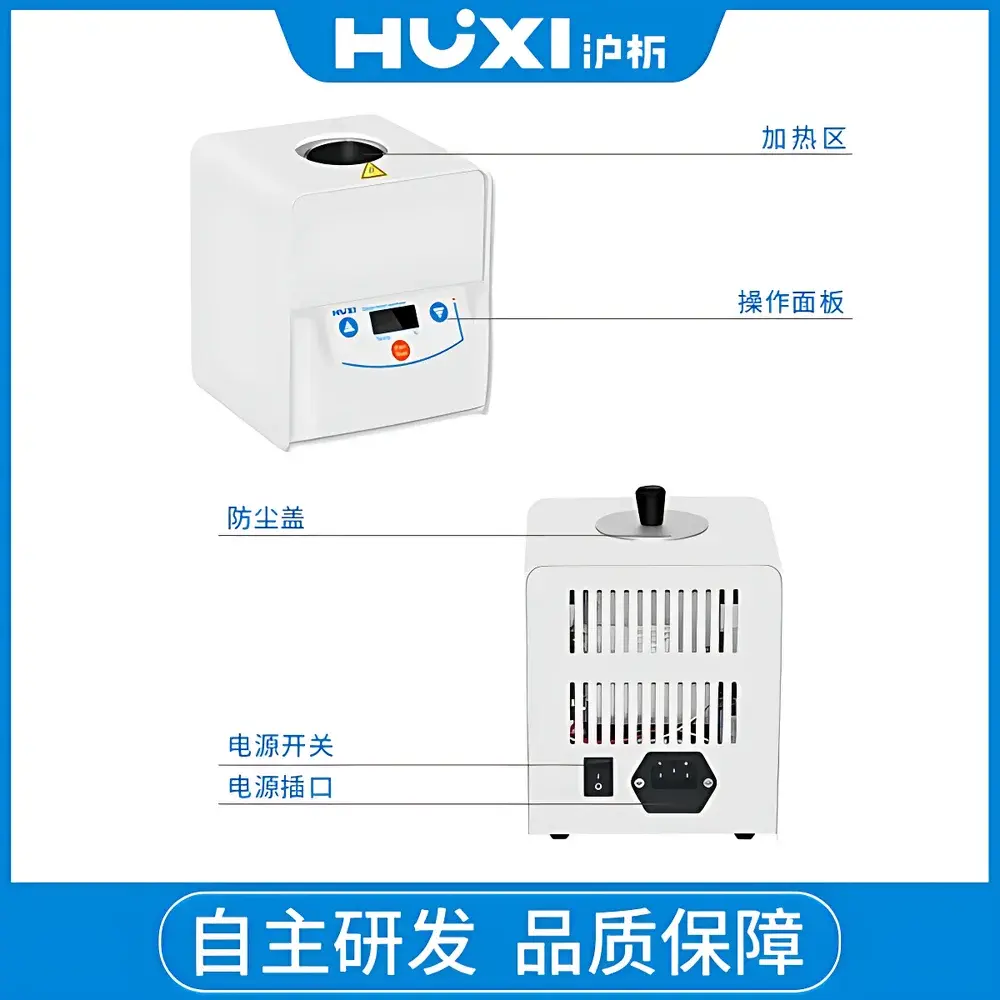
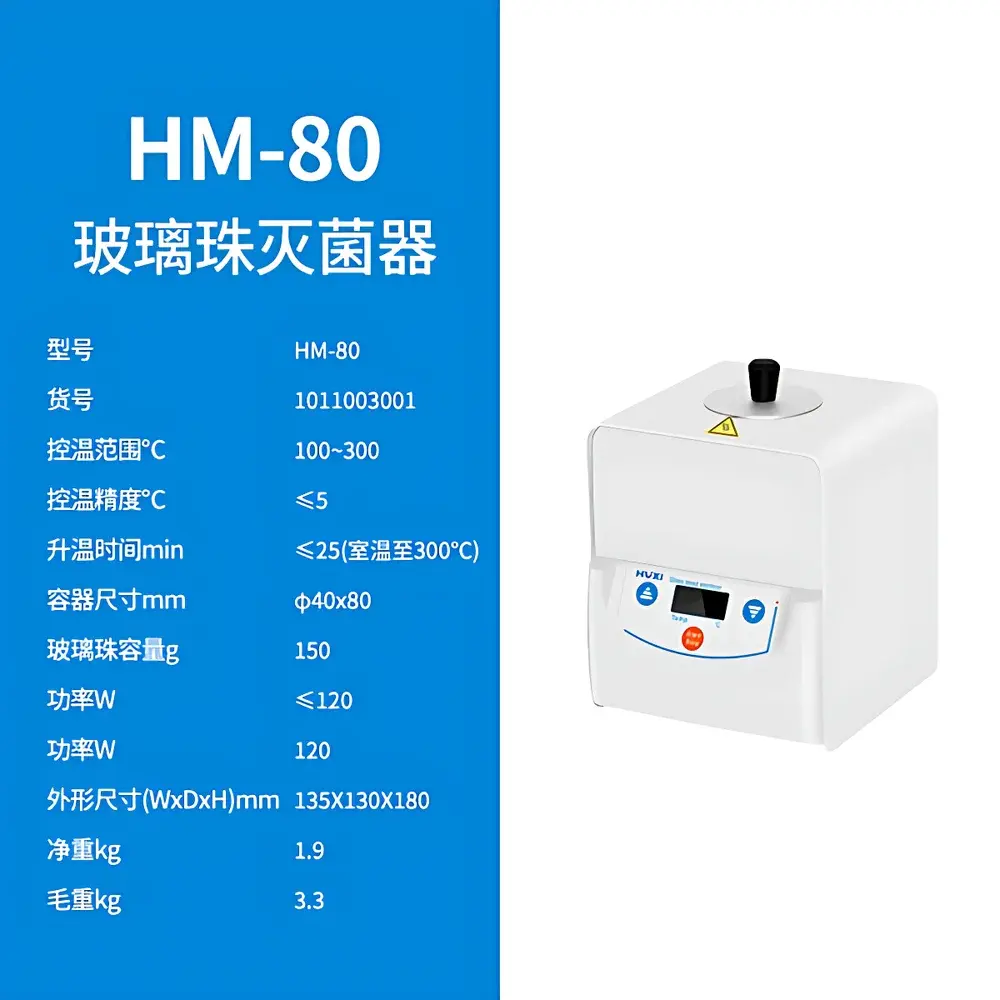
HUXI HM-80 Glass Bead Dry Heat Sterilizer
| Brand | HUXI |
|---|---|
| Origin | Shanghai, China |
| Manufacturer Type | Direct Manufacturer |
| Region of Origin | Domestic (China) |
| Model | HM-80 |
| Price | USD 450 (FOB Shanghai) |
| Operating Temperature Range | 100–300 °C |
| Temperature Control Accuracy | ≤ ±5 °C |
| Heating Power | 120 W |
| Chamber Dimensions (Ø × H) | 40 × 80 mm |
| Glass Bead Capacity | 150 g |
| Warm-up Time | ≤25 min (from ambient to 300 °C) |
| Input Voltage | AC 100–120 V / 220–240 V, 50–60 Hz |
| Net Weight | 1.9 kg |
| Gross Weight | 3.3 kg |
| External Dimensions (L×W×H) | 133 × 130 × 180 mm |
| Packing Dimensions (L×W×H) | 260 × 235 × 320 mm |
Overview
The HUXI HM-80 Glass Bead Dry Heat Sterilizer is a compact, benchtop thermal sterilization device engineered for rapid, non-contact decontamination of small, heat-stable instruments via conduction through thermally stabilized glass beads. Unlike steam-based autoclaves or UV cabinets, this unit operates on the principle of dry heat conduction: heated borosilicate glass beads (typically operating at 250–300 °C) transfer thermal energy directly to instrument surfaces upon brief immersion—achieving microbial inactivation—including bacterial endospores—within 5–10 seconds. Its design complies with fundamental microbiological sterilization principles outlined in ISO 17665-1 (moist heat) and ISO 11138-4 (dry heat sporicidal validation), though it is intended for immediate-use sterilization rather than terminal sterilization of packaged items. The HM-80 is widely deployed in academic research labs, teaching facilities, and clinical microbiology support areas where frequent, low-throughput sterilization of metallic or glass tools is required without water, pressure, or extended cycle times.
Key Features
- Compact cylindrical chamber (Ø40 × 80 mm) optimized for rapid thermal equilibration and minimal bead volume (150 g), reducing energy consumption and thermal inertia;
- Digital LED temperature display with adjustable setpoint (100–300 °C) and ±5 °C control accuracy, enabling precise alignment with validated sporicidal thresholds;
- Stainless steel inner vessel with embedded high-efficiency resistive heating element and redundant safety architecture—including independent overtemperature cutoff (≥320 °C) and thermal fuse protection;
- Low-power operation (120 W nominal) compatible with standard laboratory circuits; supports dual-voltage input (100–120 V / 220–240 V, 50–60 Hz) for global deployment;
- Benchtop footprint (133 × 130 × 180 mm) and lightweight construction (1.9 kg net) facilitate integration into laminar flow hoods, biosafety cabinets, or shared instrumentation benches;
- No consumables beyond initial glass bead fill; beads are chemically inert, non-porous, and retain thermal stability over >10,000 cycles when maintained per manufacturer guidelines.
Sample Compatibility & Compliance
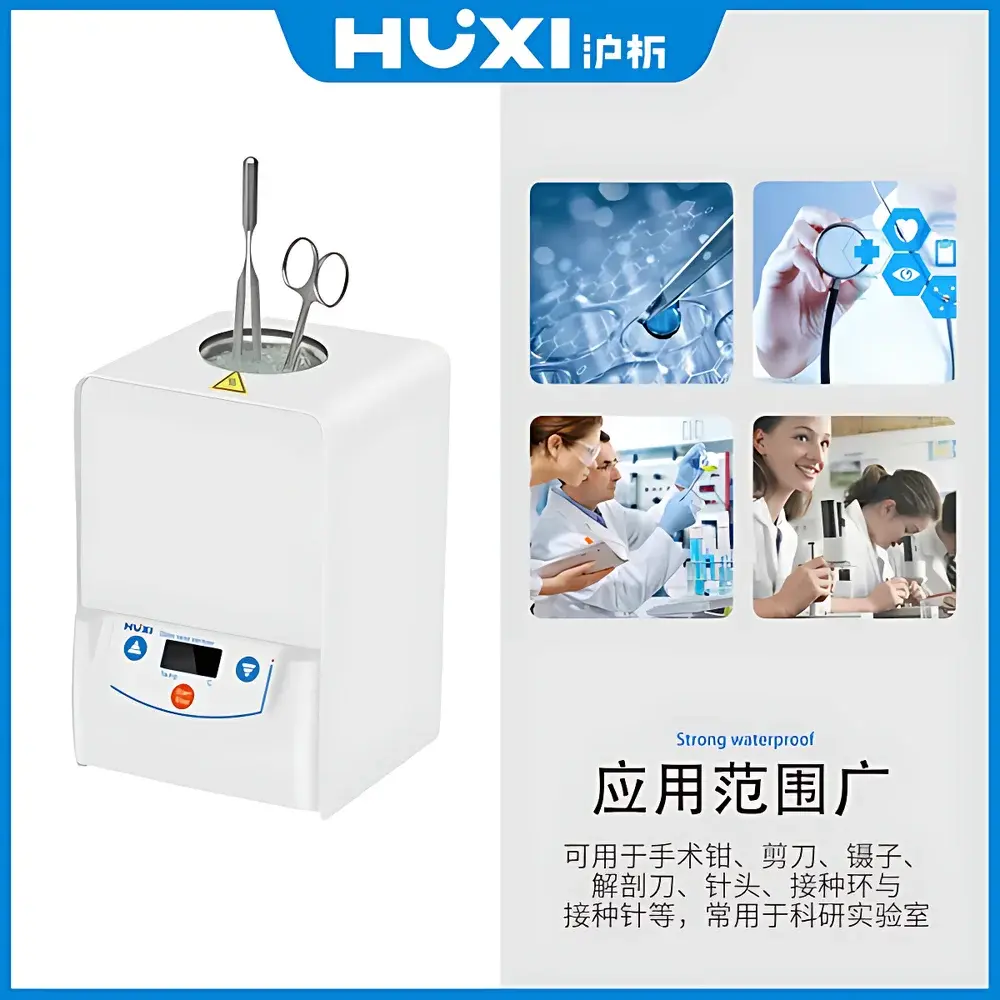
The HM-80 is validated for use with solid, non-porous, heat-resistant instruments including stainless steel forceps, scalpels, biopsy punches, inoculation loops and needles, microtome blades, and glass capillaries. It is not suitable for plastics, coated tools, rubber, or any material with melting point below 250 °C. While not certified to IEC 61010-1 or EN 61326-1 as a standalone medical device, its operational parameters align with CLSI M29-A4 recommendations for rapid sterilization of critical instruments in non-sterile field settings. For GLP/GMP environments, users must establish internal SOPs documenting bead replacement intervals, temperature verification (e.g., traceable NIST-calibrated probe checks weekly), and logbook entries for each sterilization event—supporting audit readiness under FDA 21 CFR Part 11 when paired with manual recordkeeping.
Software & Data Management
The HM-80 is a hardware-only instrument with no embedded firmware, network interface, or data export capability. Temperature monitoring is analog-to-digital converted and displayed locally via LED; no data logging, remote access, or electronic audit trail is provided. This architecture intentionally minimizes complexity, electromagnetic interference, and regulatory classification burden—making it appropriate for Class II laboratory use where digital validation is not mandated. Users requiring traceability may integrate external calibrated thermocouple loggers (e.g., Omega OM-CP-HITEMP140) placed adjacent to the bead bed during routine qualification runs.
Applications
- Routine sterilization of inoculation loops and needles between microbial streaks in bacteriology and mycology workflows;
- Decontamination of microsurgical instruments (e.g., ophthalmic forceps, microscissors) during live-tissue procedures where steam or chemical residues are contraindicated;
- Teaching lab environments requiring safe, visual, and repeatable sterilization demonstrations for undergraduate microbiology courses;
- Field-deployable sterilization in mobile diagnostic units or resource-limited settings lacking autoclave infrastructure;
- Pre-sterilization of glassware components prior to flame-polishing or vacuum sealing in materials science sample prep.
FAQ
What types of instruments can be safely sterilized in the HM-80?
Metallic and borosilicate glass tools with continuous surface geometry and no crevices, seams, or organic coatings—such as straight forceps, platinum loops, and scalpel blades. Avoid instruments with plastic handles, silicone gaskets, or adhesive labels.
How often should the glass beads be replaced?
Under normal usage (≤50 immersions/day), beads require replacement every 6–12 months or when discoloration, cracking, or reduced thermal response is observed. Always inspect beads visually before each use.
Is the HM-80 compliant with ISO 13485 or FDA 510(k) requirements?
No—it is classified as a general-purpose laboratory instrument, not a medical device. Regulatory responsibility for sterilization validation rests with the end-user’s quality system per ISO 13485 Clause 7.5.11.
Can the unit be used inside a biosafety cabinet?
Yes, provided adequate clearance (≥10 cm) is maintained around ventilation slots and the cabinet’s airflow is not disrupted; verify cabinet integrity post-installation using smoke testing.
Does the HM-80 require annual calibration?
While not mandatory, periodic verification (e.g., quarterly) using a traceable reference thermometer inserted into the bead bed at 250 °C and 300 °C is recommended to ensure continued compliance with internal SOPs.



