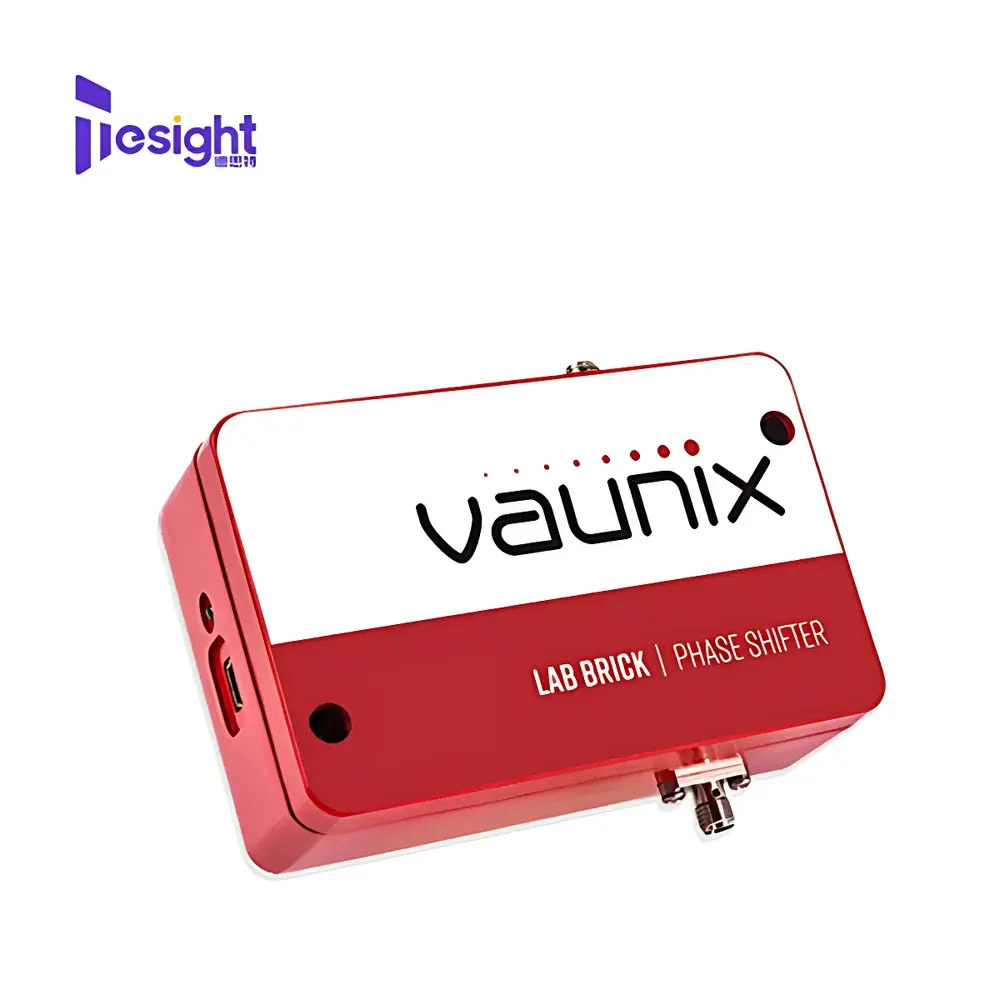
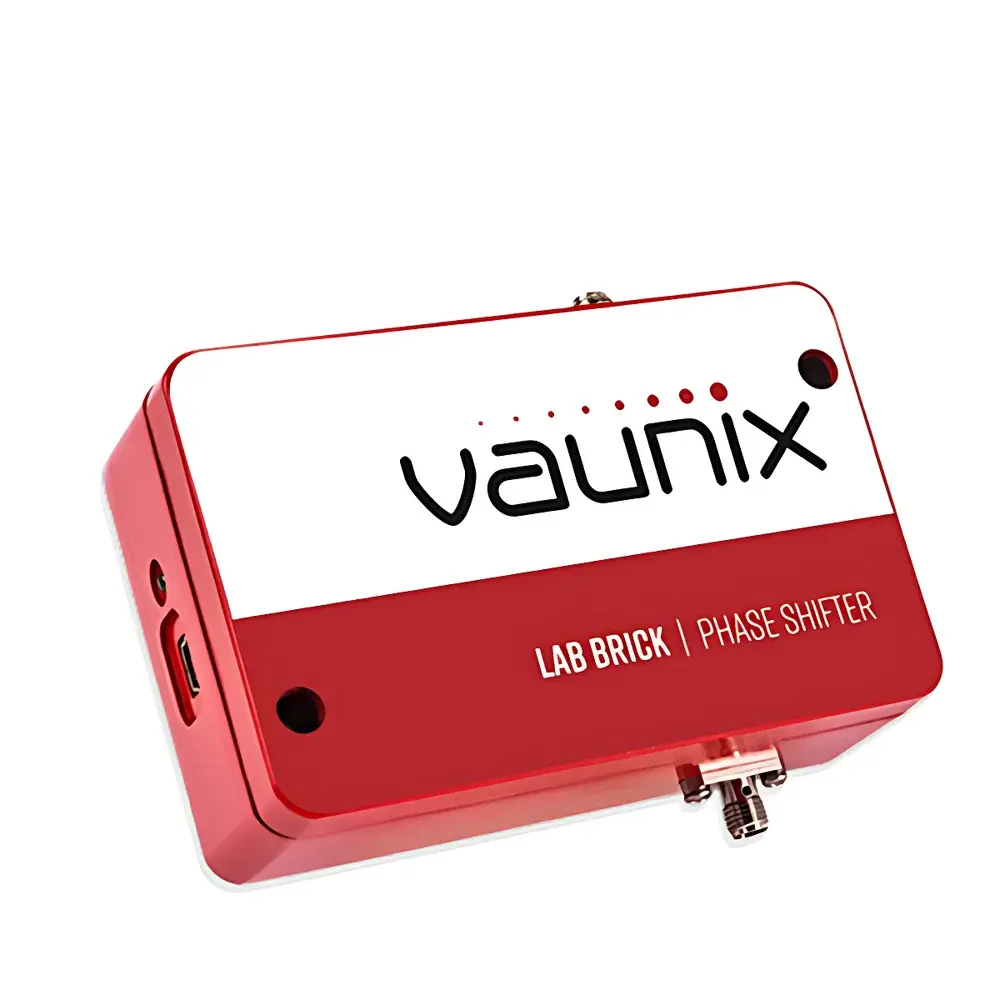
Vaunix TS-LPS-802 Compact Miniature RF Phase Shifter
| Brand | Vaunix |
|---|---|
| Origin | Italy |
| Model | LPS-802 |
| Type | Analog Voltage-Controlled Linear Phase Shifter |
| Frequency Range | 2–8 GHz |
| Phase Shift Range | 0–360° |
| Insertion Loss | < 4.5 dB (typ.) |
| VSWR | < 1.5:1 |
| Control Voltage Range | 0–10 VDC |
| Phase Accuracy | ±3° (over temperature and frequency) |
| Repeatability | ±0.5° |
| Power Handling | +27 dBm (max, CW) |
| Connector Type | SMA Female (input/output) |
| Operating Temperature | –20 °C to +70 °C |
Overview
The Vaunix TS-LPS-802 is a compact, voltage-controlled analog RF phase shifter engineered for precision phase manipulation in demanding microwave test and measurement environments. Based on a monolithic ceramic substrate architecture with integrated varactor-tuned delay lines, the LPS-802 operates across a continuous 2–8 GHz bandwidth—covering key bands used in modern wireless infrastructure including LTE Bands 3, 7, 40, 41, and WiFi 2.4/5 GHz UNII segments. Its design adheres to fundamental transmission-line phase-shift principles: differential electrical path length modulation via analog DC bias control enables monotonic, linear phase response without discrete stepping or harmonic distortion. This makes it suitable for closed-loop calibration, real-time beam steering validation, and dynamic channel emulation where sub-degree repeatability and low group delay variation are critical.
Key Features
- Compact 2.0″ × 1.25″ × 0.5″ footprint with lightweight aluminum housing—designed for integration into ATE racks, PXIe-based test platforms, and portable MIMO over-the-air (OTA) chambers.
- Voltage-controlled linear phase shift (0–360°) with 0–10 VDC analog input; no digital interface required—enabling direct integration with function generators, DAC outputs, or FPGA-based control systems.
- Typical insertion loss below 4.5 dB across full band, with VSWR maintained under 1.5:1—minimizing signal degradation in cascaded multi-element test configurations.
- Phase accuracy of ±3° over full temperature (–20 °C to +70 °C) and frequency range—validated per IEC 61000-4-2 ESD immunity and MIL-STD-202G thermal shock testing protocols.
- Ruggedized SMA female connectors rated for >500 mating cycles; hermetically sealed internal circuitry ensures long-term stability in laboratory and light industrial settings.
- Compliant with RoHS Directive 2011/65/EU and CE-marked per EMC Directive 2014/30/EU and RED 2014/53/EU—supporting deployment in EU-regulated R&D and manufacturing QA labs.
Sample Compatibility & Compliance
The TS-LPS-802 interfaces seamlessly with standard 50 Ω RF signal chains and is compatible with common vector network analyzers (Keysight PNA, Rohde & Schwarz ZNB), signal generators (Anritsu MG3700E, Keysight MXG), and software-defined radio platforms (Ettus USRP X410, NI PXIe-5840). It supports continuous-wave, modulated (QPSK, 256-QAM), and pulsed RF signals up to +27 dBm average power. Device-level compliance includes ISO/IEC 17025 traceable calibration data (available upon request), and its performance characteristics align with relevant sections of IEEE Std 145-2013 (antenna measurements) and 3GPP TR 37.847 (MIMO OTA test methodology). No firmware or driver installation is required—operational readiness is achieved at physical connection.
Software & Data Management
As a fully analog passive-active hybrid component, the LPS-802 requires no embedded firmware, USB drivers, or proprietary software. Phase state is determined solely by applied control voltage, enabling deterministic behavior in time-critical applications such as real-time adaptive antenna tuning. For automated test systems, integration is accomplished via standard DAQ hardware (e.g., National Instruments USB-6211, Keysight 34972A) or programmable power supplies with analog output capability. LabVIEW, Python (with PyVISA or nidaqmx), MATLAB, and SCPI-compliant test executive environments can directly orchestrate phase sweeps and synchronization with stimulus-response acquisition. Audit trails and calibration metadata may be logged externally in accordance with GLP and FDA 21 CFR Part 11 requirements when paired with validated data acquisition software.
Applications
- Calibration and verification of phased array antenna elements in near-field and far-field test ranges.
- MIMO channel emulation for LTE-Advanced and WiFi 6/6E conformance testing—particularly in 2×2, 4×4, and 8×8 spatial multiplexing validation.
- Phase-nulling and interference cancellation subsystems in electronic warfare (EW) receiver test benches.
- Dynamic linearity assessment of RF front-end components (LNAs, mixers, filters) using phase-modulated two-tone stimuli.
- Education and research laboratories requiring stable, repeatable phase perturbation for microwave propagation studies and metamaterial characterization.
FAQ
Is the TS-LPS-802 compatible with 50 Ω and 75 Ω systems?
The device is designed exclusively for 50 Ω impedance environments. Use with 75 Ω systems requires external impedance-matching networks and may degrade VSWR and phase linearity.
Can multiple LPS-802 units be synchronized for multi-channel phase control?
Yes—provided identical control voltage waveforms are delivered simultaneously via low-skew analog distribution (e.g., using precision op-amp buffers), phase tracking error remains within ±0.8° across four units at 5 GHz.
Does Vaunix provide NIST-traceable calibration certificates?
Standard units ship with factory test reports. NIST-traceable calibration (ISO/IEC 17025 accredited) is available as an optional service with lead time and documentation per ANSI/NCSL Z540-1.
What is the maximum recommended modulation bandwidth for the control voltage input?
For stable phase response, control voltage slew rate should not exceed 1 V/ms. Higher rates may induce transient phase overshoot due to internal bias network time constants.
Is the LPS-802 suitable for outdoor or high-humidity environments?
It is rated for indoor laboratory use only. Extended operation above 85% RH or condensing conditions is not supported; enclosure-level environmental sealing is the user’s responsibility.
Related Products