
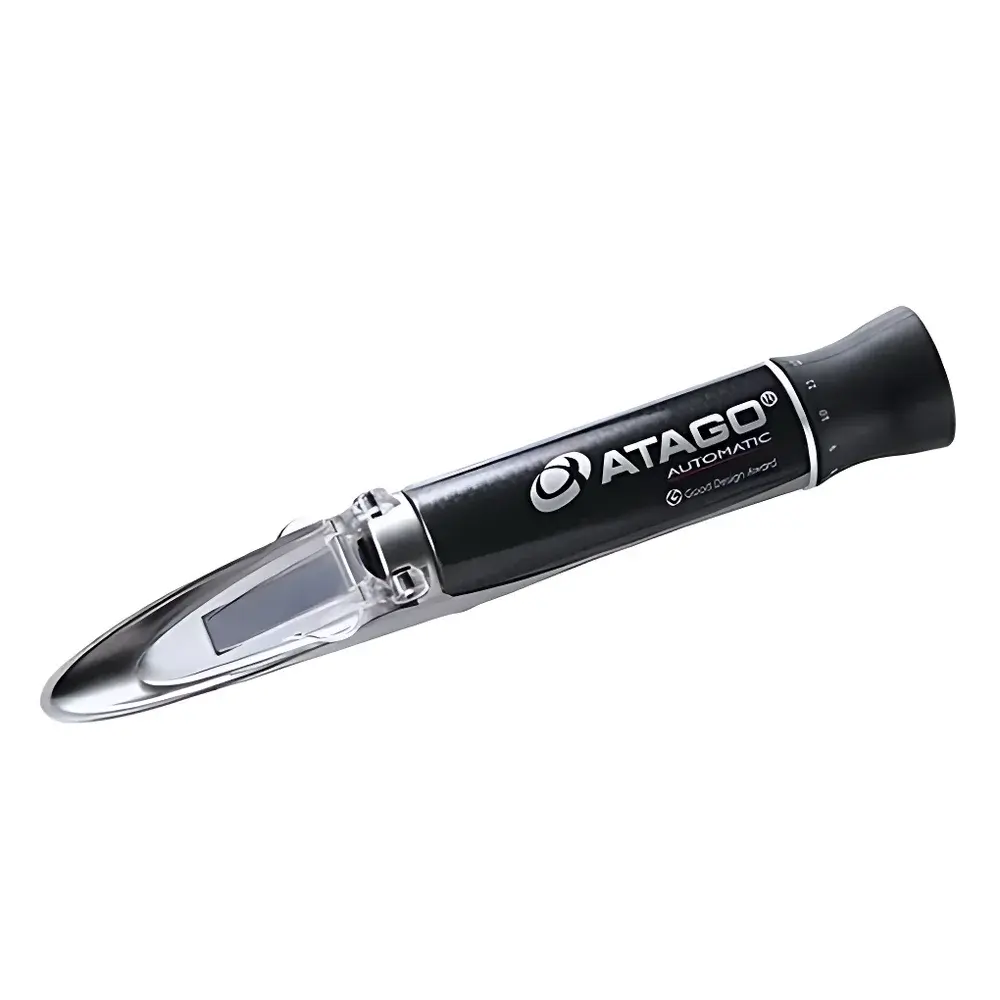
ATAGO MASTER-20T Analog Handheld Refractometer
| Brand | ATAGO |
|---|---|
| Origin | Japan |
| Model | MASTER-20T |
| Type | Analog Handheld Refractometer |
| Brix Range | 0.0–20.0% (ATC) |
| Accuracy | ±0.2% Brix |
| Resolution | 0.1% Brix |
| Repeatability | ±0.1% Brix (10–30°C) |
| ATC | Yes |
| IP Rating | IP65 (excluding eyepiece) |
| Dimensions | 3.2 × 3.4 × 20.7 cm |
| Weight | 165 g |
Overview
The ATAGO MASTER-20T is a precision-engineered analog handheld refractometer designed for rapid, field-deployable Brix concentration measurement in low-to-moderate concentration aqueous solutions. Based on the fundamental optical principle of total internal reflection, the instrument determines refractive index by analyzing the critical angle shift at the prism-sample interface—directly correlating to solute concentration in standardized sucrose solutions. Its robust metal body and integrated Automatic Temperature Compensation (ATC) mechanism—calibrated to the standard 20°C reference temperature—ensure consistent readings across ambient conditions from 10°C to 30°C without manual correction. Unlike digital units requiring batteries or calibration software, the MASTER-20T operates entirely passively, delivering high reproducibility and long-term stability with zero electronic drift. It is optimized for routine quality control in food processing, beverage production, horticulture, and laboratory pre-screening workflows where portability, mechanical reliability, and regulatory traceability are prioritized over data logging capabilities.
Key Features
- Mechanically calibrated analog scale with engraved Brix graduation (0.0–20.0%) and 0.1% resolution for direct visual readout
- Integrated bimetallic ATC system compensates for sample temperature variations between 10°C and 30°C, maintaining accuracy per ISO 2173:2003 guidelines for fruit juice analysis
- Durable anodized aluminum housing rated IP65 (excluding eyepiece), resistant to dust ingress and low-pressure water jets—suitable for wet industrial environments
- High-precision optical glass prism with anti-scratch coating and optimized light path geometry for sharp shadow-line definition under natural or LED illumination
- Zero-power operation eliminates battery dependency, firmware updates, or electromagnetic interference concerns—ideal for GMP-compliant cleanrooms and explosion-hazard zones
- Compact ergonomic form factor (3.2 × 3.4 × 20.7 cm; 165 g) enables one-handed use and seamless integration into mobile QC carts or field sampling kits
Sample Compatibility & Compliance
The MASTER-20T is validated for transparent or mildly turbid aqueous solutions with low viscosity and minimal suspended solids—such as fruit juices, syrups, soft drinks, honey dilutions, and plant sap extracts. It is not intended for highly viscous, opaque, or volatile organic solvents (e.g., ethanol >10%, essential oils, or hydrocarbon-based fluids), which may damage the prism surface or distort the critical angle. The instrument complies with core metrological requirements outlined in ASTM D1298 (Standard Test Method for Density, Relative Density, and API Gravity of Crude Petroleum and Liquid Petroleum Products) when adapted for sucrose-equivalent reporting, and supports adherence to HACCP-based process verification protocols. While it does not generate electronic audit trails, its mechanical design facilitates straightforward calibration verification using certified NIST-traceable sucrose standards (e.g., 5.0%, 10.0%, and 15.0% w/w), supporting GLP documentation practices in regulated laboratories.
Software & Data Management
The MASTER-20T is a standalone analog instrument with no embedded electronics, firmware, or connectivity interfaces. Consequently, it does not require software installation, driver configuration, or cybersecurity validation. All measurements are recorded manually in lab notebooks or LIMS-compatible spreadsheets. This architecture inherently satisfies FDA 21 CFR Part 11 requirements for instruments where electronic records are not generated—eliminating validation overhead related to data integrity, user access controls, or electronic signature implementation. Calibration logs, operator entries, and environmental condition notes remain fully auditable through traditional paper-based or scanned-document workflows.
Applications
- Routine Brix verification during fruit harvest and post-harvest grading in orchards and packing houses
- In-line concentration checks for syrup blending tanks and pasteurization feed streams in beverage manufacturing
- Field-based assessment of sugar accumulation in leaf petiole sap for precision irrigation scheduling in viticulture and horticulture
- Pre-shipment quality screening of jams, jellies, and confectionery intermediates prior to thermal processing
- Educational demonstration of refractive index principles in university physics and food science laboratories
- Backup verification tool in ISO/IEC 17025-accredited labs where redundant measurement methods strengthen uncertainty budgets
FAQ
Does the MASTER-20T require battery replacement or charging?
No—it is a fully mechanical optical instrument with no electronic components.
Can it measure samples below 10°C or above 30°C?
Readings outside the 10–30°C range fall outside ATC compensation limits; accuracy degrades progressively beyond this interval.
How often should I calibrate the unit?
Calibration is recommended before each measurement session using distilled water (0.0% Brix) and a certified sucrose standard; frequency increases with heavy usage or exposure to aggressive cleaning agents.
Is the prism surface chemically resistant?
The optical glass prism withstands mild acids, bases, and alcohols typical in food matrices but is incompatible with strong oxidizers (e.g., peracetic acid) or chlorinated solvents.
What documentation accompanies the instrument for regulatory audits?
Each unit ships with a factory calibration certificate referencing traceable sucrose standards and conforms to ATAGO’s ISO 9001-certified manufacturing system—supporting equipment qualification under Annex 11 and EU GMP Chapter 4.




