
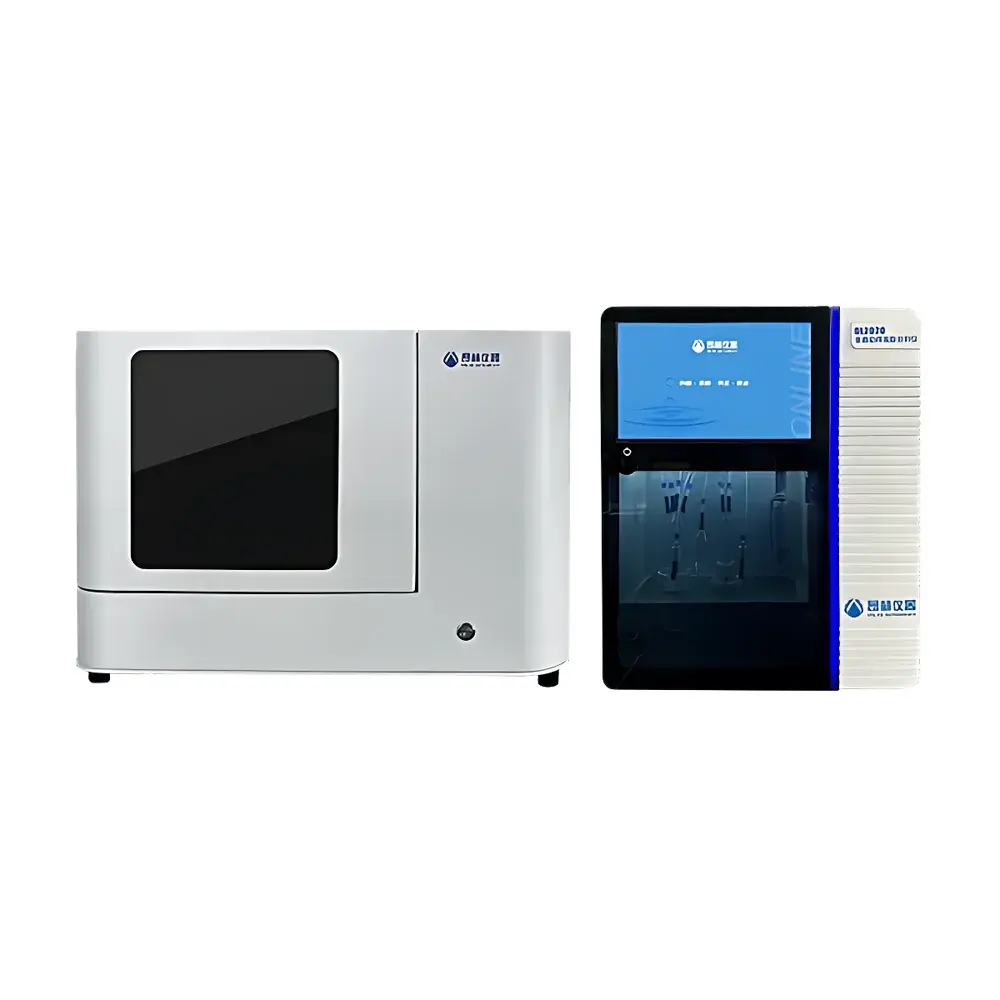
Online Instrument OL2020N Fully Automated Volatile Phenol Analyzer
| Brand | Online Instrument |
|---|---|
| Origin | Shanghai, China |
| Manufacturer Type | Original Equipment Manufacturer (OEM) |
| Product Category | Domestic |
| Model | OL2020N |
| Instrument Type | Laboratory-Grade Volatile Phenol Analyzer |
| Sample Capacity | 10 / 22 / 25 positions (field-upgradable) |
| Automation Level | Fully Automated (distillation, reagent addition, liquid transfer, extraction, spectrophotometric measurement) |
| Calibration | Auto-standard preparation & multi-point calibration curve generation |
| Reagent Management | Real-time monitoring, low-reagent alert, closed-loop waste & fume collection |
| Data Interface | LIMS-compatible, remote monitoring via web browser or mobile application |
| Compliance | Designed per HJ 503–2009 and HJ 998–2018 (China EPA standards) |
| Safety Architecture | Fully enclosed operation with integrated fume absorption system |
Overview
The Online Instrument OL2020N Fully Automated Volatile Phenol Analyzer is an integrated laboratory system engineered for precise, reproducible quantification of volatile phenolic compounds—including phenol, cresols, and xylenols—in aqueous matrices. It operates on the principle of 4-aminoantipyrine (4-AAP) colorimetric reaction under controlled pH and oxidation conditions, followed by spectrophotometric detection at 510 nm. The instrument implements a validated, end-to-end analytical workflow compliant with Chinese Environmental Protection Standards HJ 503–2009 (“Determination of Volatile Phenols in Water—Spectrophotometric Method Using 4-Aminoantipyrine”) and HJ 998–2018 (“Determination of Volatile Phenols in Water—Automated Flow Injection Analysis Method”). Unlike semi-automated benchtop systems, the OL2020N eliminates manual intervention across all critical steps—steam distillation, buffer and reagent dosing, phase separation, organic solvent extraction, and absorbance measurement—ensuring metrological traceability, operator safety, and inter-laboratory comparability.
Key Features
- Fully automated analytical sequence: Steam distillation (compatible with third-party distillation modules), programmable reagent dispensing (buffer, 4-AAP, potassium ferricyanide), liquid-phase transfer, chloroform-based extraction, and dual-beam photometric measurement.
- Modular sample handling: Rotating carousel accommodates 10, 22, or 25 sample vials; configurable for extended capacity via field firmware update and mechanical retrofit.
- Closed-system architecture: All fluidic pathways, distillation condensate routing, and extraction chambers operate under negative pressure with integrated activated carbon + alkaline scrubber for H2S and phenol vapor capture.
- Intelligent reagent management: Optical level sensors monitor reagent reservoirs; system halts assay execution and triggers alert upon threshold depletion—preventing invalid runs and ensuring stoichiometric consistency.
- Embedded touchscreen HMI (10.1″ capacitive display) with intuitive workflow navigation; optional Ethernet/WiFi connectivity for remote desktop control and real-time audit log streaming.
- Self-calibration capability: Onboard dilution module prepares serial standard solutions from stock; generates NIST-traceable calibration curves using least-squares linear regression (r² ≥ 0.999).
Sample Compatibility & Compliance
The OL2020N accepts raw water samples within pH 2–12 and turbidity ≤ 100 NTU without pre-filtration. Validated matrices include surface water, groundwater, potable water, municipal wastewater, and industrial effluents containing up to 50 mg/L chloride or 10 mg/L sulfide (with optional sulfide masking protocol). Method performance meets QC requirements outlined in HJ 503–2009: detection limit ≤ 0.001 mg/L, repeatability RSD ≤ 3.5% (n = 6 at 0.1 mg/L), spike recovery 92–105%. The system supports GLP-compliant operation through time-stamped, user-locked electronic records, electronic signatures per FDA 21 CFR Part 11, and immutable audit trails for all method edits, calibration events, and result exports.
Software & Data Management
Control software (OL-Analyzer Suite v3.2) provides ISO/IEC 17025-aligned data integrity features: role-based access control (administrator, analyst, reviewer), automatic metadata tagging (sample ID, operator, instrument ID, environmental temperature/humidity), and encrypted SQLite database storage. Raw absorbance spectra, calibration logs, and chromatogram-like reaction kinetics plots are archived with SHA-256 hash verification. LIMS integration uses ASTM E1482-compliant HL7 v2.5 messaging or direct ODBC connection; data fields map to standard water quality ontologies (e.g., WQX, EN 14800). Audit logs retain ≥ 18 months of operational history with tamper-evident timestamps synchronized to NTP servers.
Applications
This analyzer serves environmental testing laboratories accredited to CNAS-CL01 (equivalent to ISO/IEC 17025), municipal water quality surveillance units, industrial pretreatment compliance facilities, and academic research groups studying phenolic contaminant fate and transport. Typical use cases include regulatory reporting for discharge permits (e.g., China’s “Integrated Wastewater Discharge Standard” GB 8978), source water vulnerability assessment, activated sludge process optimization, and validation of advanced oxidation or adsorption treatment efficacy. Its modular design enables deployment in fixed labs, mobile environmental monitoring vehicles, and ISO-classified cleanroom QA/QC environments.
FAQ
Does the OL2020N require dedicated distillation hardware?
No—it natively interfaces with any steam distillation unit via analog I/O or Modbus RTU; alternatively, it accepts pre-distilled condensate directly into the sample carousel.
Can calibration standards be prepared manually outside the system?
Yes, though auto-preparation is recommended for traceability; external standards may be loaded as reference points during calibration setup.
What maintenance intervals are specified for fluidic components?
Per manufacturer guidelines: pump tubing replacement every 6 months (or 500 cycles), extraction chamber cleaning after 200 analyses, and photometer lamp recalibration annually.
Is method validation documentation provided?
Yes—each unit ships with a Certificate of Conformance, Factory Verification Report (including LOD/LOQ, linearity, precision), and a customizable IQ/OQ protocol template aligned with GMP Annex 15.
How is data backup and disaster recovery handled?
Local database auto-backups occur hourly to internal SSD; optional cloud sync (AWS S3 or on-premise NAS) enables versioned, encrypted offsite replication with retention policies configurable per organizational policy.
Related Products







