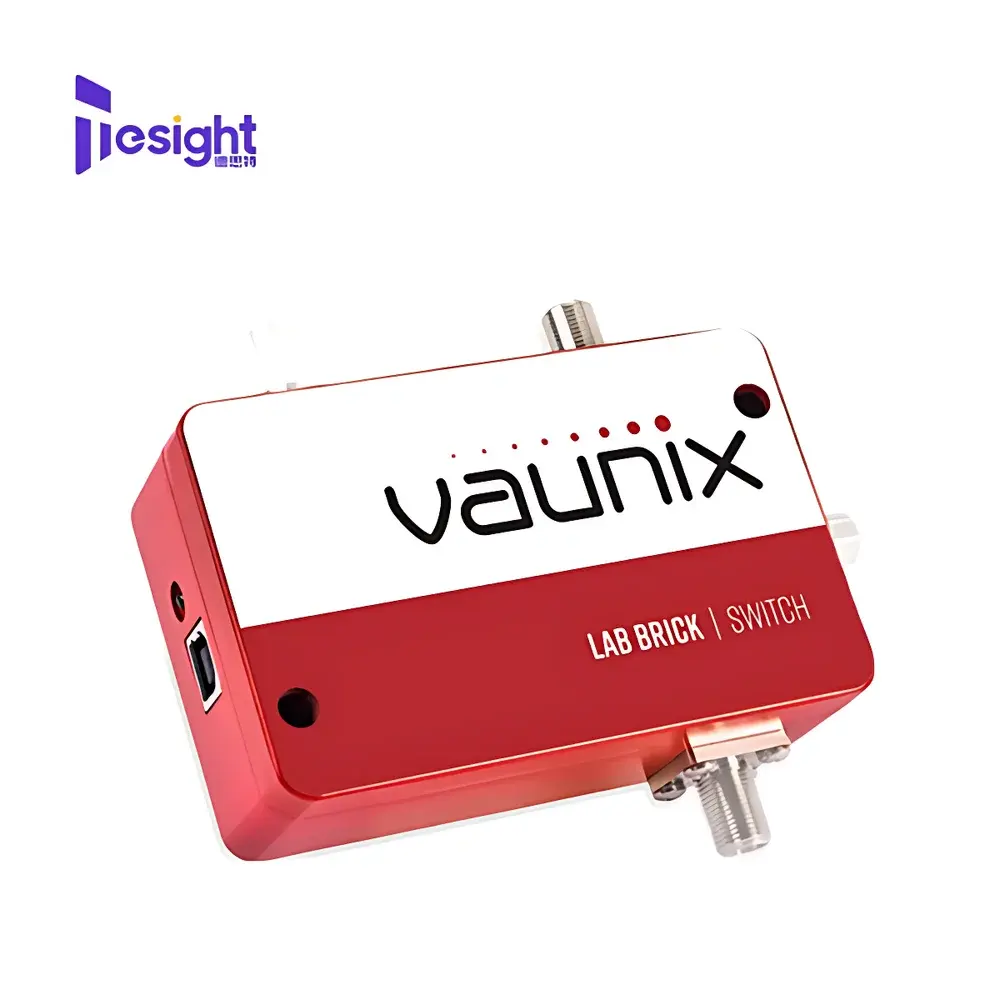
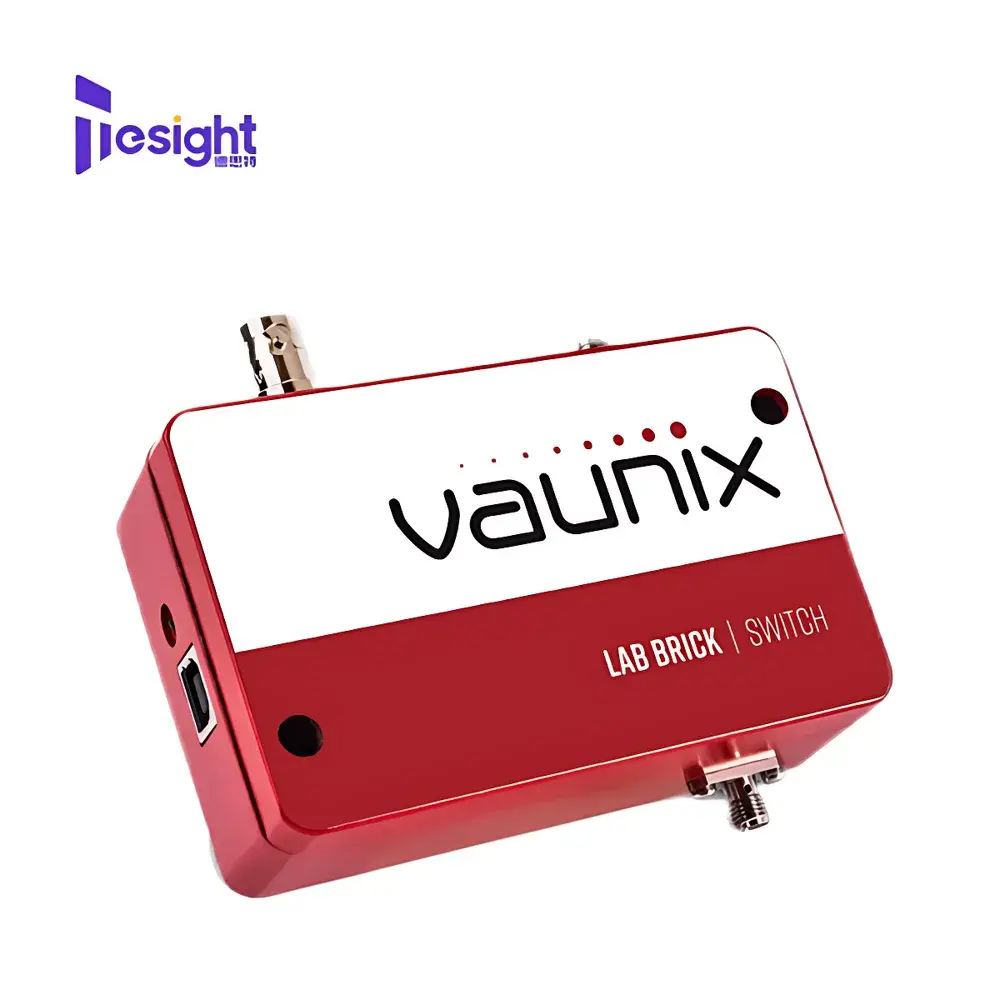
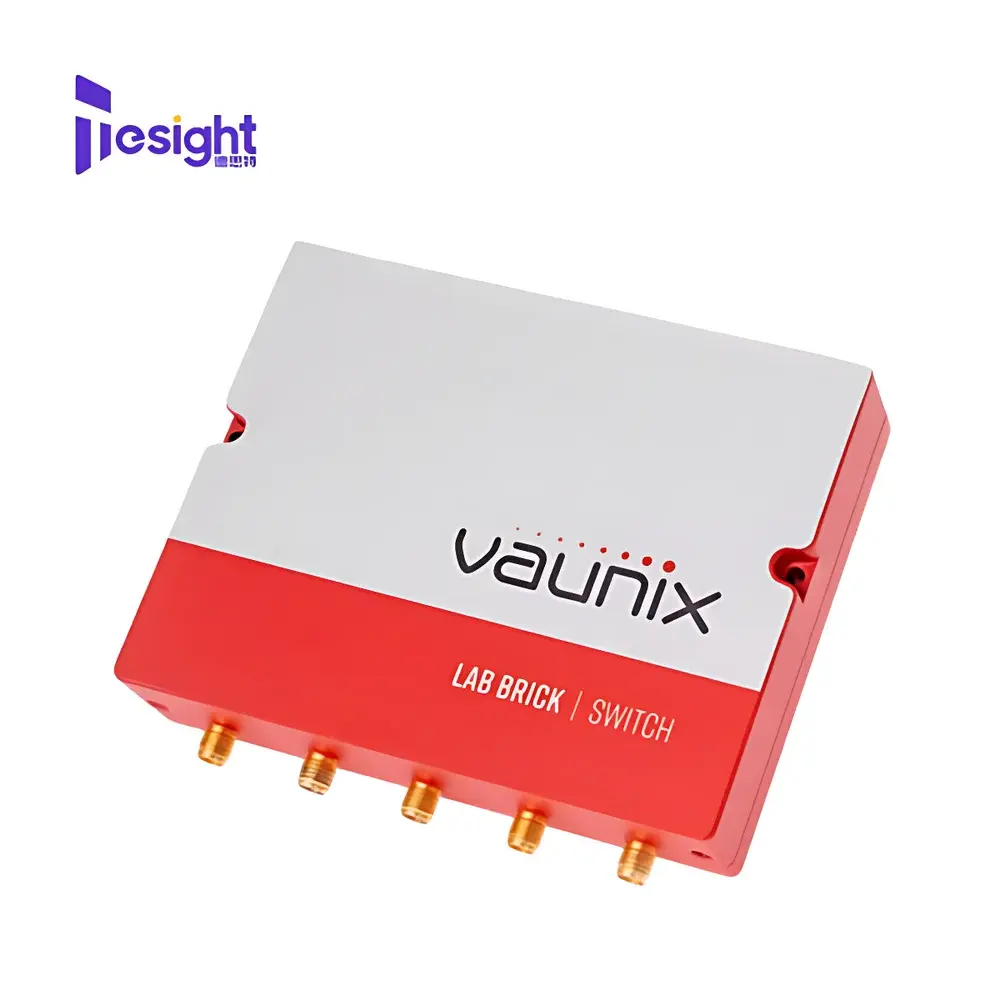
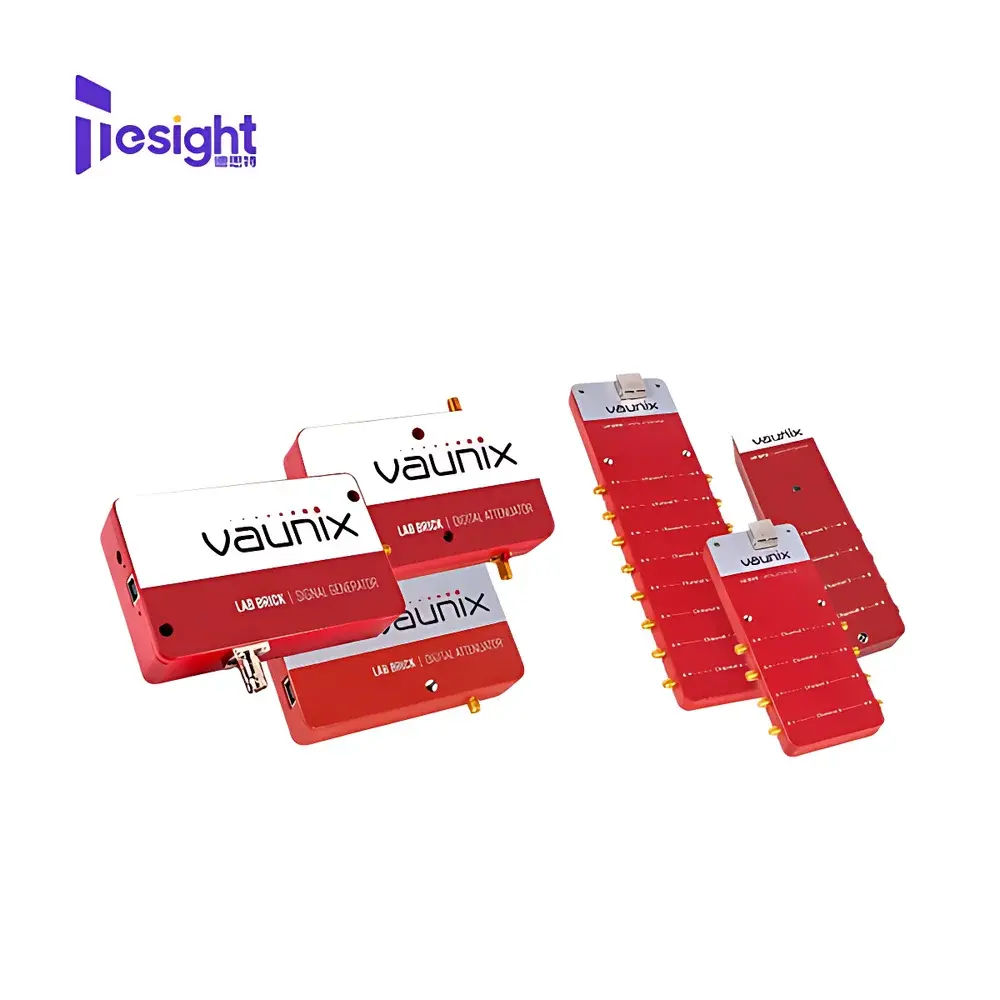
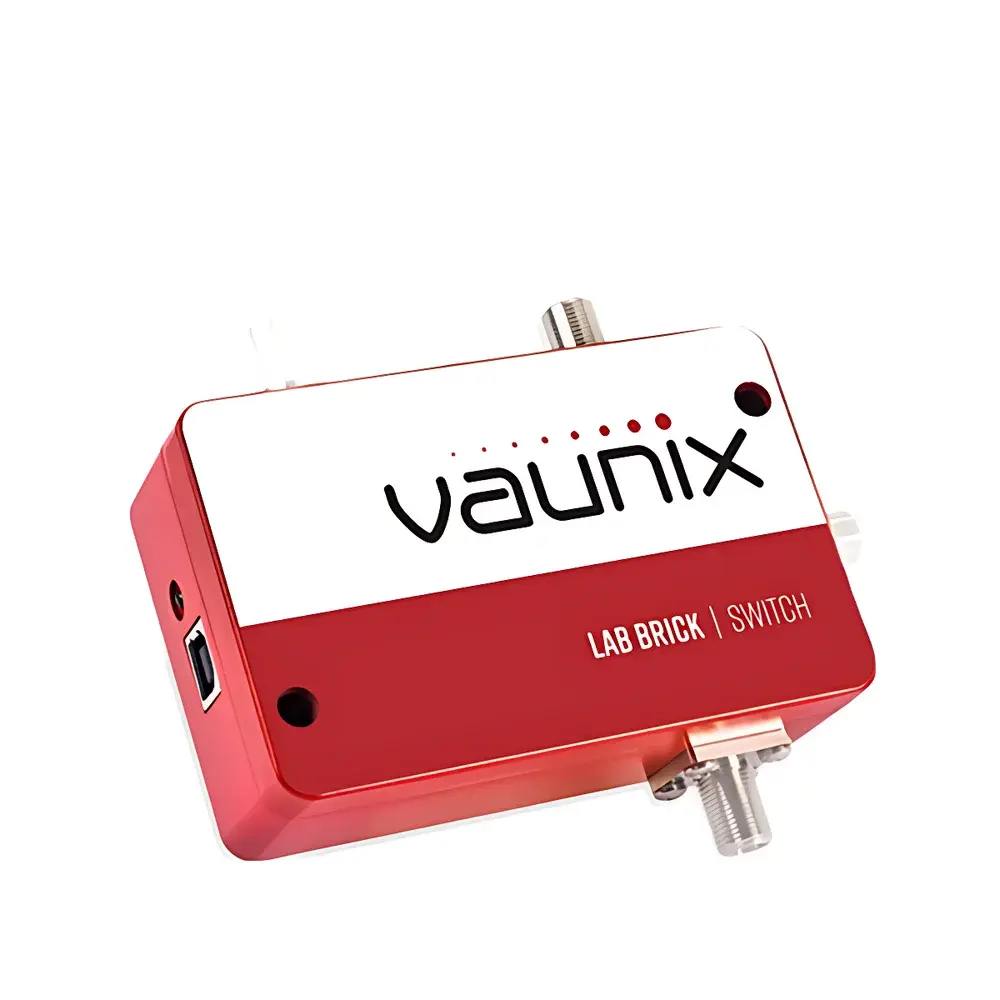
Vaunix LSW-602P4T Compact Programmable RF/Microwave Switch
| Brand | Vaunix |
|---|---|
| Origin | Italy |
| Model | LSW-602P4T |
| Power Supply | USB Bus-Powered |
| Control Interface | USB 2.0 (Virtual COM Port) |
| Switch Type | SP4T (Single-Pole, Four-Throw) |
| Frequency Range | DC to 6 GHz |
| Insertion Loss | < 1.2 dB (typ. @ 3 GHz) |
| Isolation | > 75 dB (typ. @ 3 GHz) |
| VSWR | < 1.5:1 (typ. @ 3 GHz) |
| Switching Speed | < 15 µs (settle time) |
| Repeatability | ±0.02 dB amplitude, ±0.1° phase (typ.) |
| Operating Temperature | 0 °C to +50 °C |
| Compliance | RoHS 2, CE, FCC Part 15 Class B |
Overview
The Vaunix LSW-602P4T is a compact, USB-powered, programmable single-pole, four-throw (SP4T) RF/microwave switch engineered for precision signal routing in laboratory, production test, and field-deployable measurement systems. Designed around a solid-state PIN diode architecture, it delivers high repeatability and low intermodulation distortion across its full DC–6 GHz operational bandwidth. Unlike electromechanical alternatives, the LSW-602P4T eliminates mechanical wear, enabling >100 million switching cycles with consistent insertion loss and isolation performance. Its miniature form factor (89 × 51 × 17 mm) and bus-powered operation eliminate the need for external power supplies or bulky control cabling—making it ideal for integration into automated test equipment (ATE), vector network analyzer (VNA) multi-port extensions, antenna array calibration rigs, and embedded RF subsystems where space, thermal management, and EMI resilience are critical constraints.
Key Features
- DC–6 GHz broadband performance with flat amplitude response and minimal group delay variation
- Typical port-to-port isolation exceeding 75 dB at 3 GHz, ensuring minimal crosstalk in multi-channel RF stimulus/response configurations
- Amplitude repeatability of ±0.02 dB and phase repeatability of ±0.1° over temperature and lifetime—validated per IEC 61000-4-3 radiated immunity testing
- Firmware-upgradable via USB; supports both SCPI-like ASCII command set and vendor-neutral IVI-COM drivers
- Integrated USB 2.0 interface emulates a virtual COM port—no proprietary hardware dongles or PCIe slots required
- Low power consumption (< 1.2 W typical), enabling deployment on battery-powered laptops, industrial PCs, and USB-hub-based rack systems
- Front-panel LED status indicators for real-time confirmation of active path selection and communication link integrity
Sample Compatibility & Compliance
The LSW-602P4T is compatible with standard 50 Ω RF environments and supports SMA female connectors (included). It has been validated for use with major instrumentation platforms including Keysight PNA/LPX, Rohde & Schwarz ZNB, Anritsu MS46522B, and NI PXIe-5632 RF signal analyzers. From a regulatory standpoint, the device conforms to EN 55032:2015 (EMC emission limits), EN 55024:2010 (immunity requirements), and IEC 61000-6-2/6-4 for industrial environments. It meets RoHS 2 Directive 2011/65/EU and carries CE and FCC Part 15 Subpart B Class B markings. While not certified for safety-critical or aviation-grade applications, its design adheres to IPC-A-610 Class 2 workmanship standards and supports GLP-compliant audit trails when used with compliant host software.
Software & Data Management
Vaunix provides a Windows-native GUI application (LSSW) for manual path selection, timing configuration, and firmware updates. For automated integration, the device ships with native support for Python (PySerial, PyVISA), MATLAB Instrument Control Toolbox, LabVIEW (NI-VISA and IVI-COM drivers), and C/C++ SDKs—including detailed API documentation, callback registration examples, and error-code mapping tables. All commands generate timestamped ASCII responses over USB CDC ACM, enabling deterministic logging for ISO/IEC 17025 traceability. When deployed in regulated environments, users may implement FDA 21 CFR Part 11-compliant electronic signatures and audit logs through third-party middleware (e.g., TestStand with NI’s Audit Trail Toolkit), as the switch itself provides no onboard user authentication or role-based access control.
Applications
- Multi-DUT RF characterization in semiconductor wafer probing stations
- Automated antenna pattern measurement systems requiring fast, repeatable port switching
- Calibration path selection in multiport VNA setups (e.g., S-parameter de-embedding of fixtures)
- RF front-end validation in 5G NR FR1 baseband and mmWave sub-system test benches
- Signal conditioning chains for software-defined radio (SDR) transceivers and cognitive radio testbeds
- EMC pre-compliance testing where rapid antenna or LISN switching improves throughput
FAQ
Is the LSW-602P4T compatible with Linux or macOS hosts?
Yes—USB CDC ACM class compliance enables native serial communication on Linux (via /dev/ttyACM*) and macOS (via /dev/cu.usbmodem*), provided the host application implements the documented ASCII command protocol.
Can multiple LSW-602P4T units be daisy-chained or synchronized?
No daisy-chaining is supported; each unit requires a dedicated USB endpoint. However, precise temporal coordination (sub-microsecond alignment) is achievable using host-synchronized command queues and hardware trigger input (optional add-on module LSW-TG1).
Does the switch support TTL or GPIO external triggering?
Not natively—the standard LSW-602P4T relies solely on USB command control. External trigger capability is available only with the optional LSW-TG1 accessory board, which adds opto-isolated TTL inputs and a 10 MHz reference clock input.
What is the maximum RF input power the switch can handle continuously?
The device is rated for +30 dBm (1 W) average RF power across its full frequency range under free-air convection cooling. Derating is recommended above +25 °C ambient or under sustained pulsed conditions exceeding 10% duty cycle.