
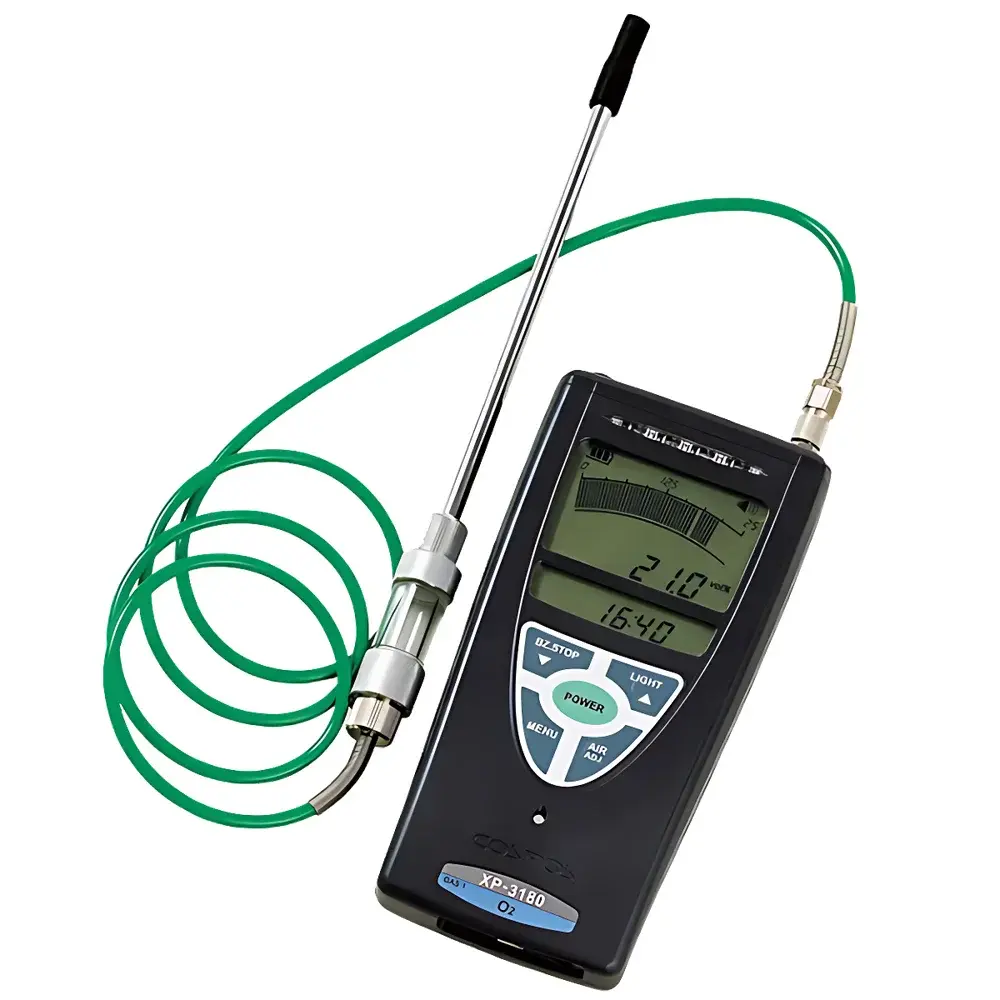
XP-3180 Oxygen Concentration Detector (Pump-Aspirated, Electrochemical Cell Type)
| Origin | Japan |
|---|---|
| Manufacturer Type | Authorized Distributor |
| Origin Category | Imported |
| Model | XP-3180 |
| Pricing | Upon Request |
Overview
The XP-3180 Oxygen Concentration Detector is a portable, pump-aspirated gas analyzer engineered for precise, real-time measurement of ambient oxygen concentration in confined spaces and hard-to-access locations. It operates on the electrochemical cell principle—specifically, a galvanic (fuel-cell-type) oxygen sensor with a gas-permeable membrane—ensuring stable output, minimal drift, and high reproducibility across its full 0–25.0 vol% measurement range. Designed to meet JIS T 8201:2019 requirements for occupational safety instrumentation, the device delivers ±0.3 vol% indication accuracy under standard operating conditions (23 °C, 50% RH, 101.3 kPa). Its intrinsic safety certification (Ex ib IIB T3) confirms compliance with IEC 60079-0 and IEC 60079-11 for use in potentially explosive atmospheres containing Group IIB gases (e.g., ethylene) at temperature class T3 (surface temp ≤ 200 °C). The XP-3180 is widely deployed in industrial hygiene, process safety, and regulatory compliance workflows—including pre-entry verification for permit-required confined spaces (PRCS), inert gas purging validation, and post-maintenance atmospheric requalification.
Key Features
- Pump-aspirated sampling architecture enabling remote detection up to 1 meter via included 1 m silicone suction hose and stainless-steel probe—ideal for pipelines, tanks, silos, and ducts where direct access is restricted.
- Dual-mode display: High-contrast backlit LCD showing numeric O₂ concentration (0.1 vol% resolution) alongside intuitive bar-graph scale for rapid visual assessment under low-light or high-stress conditions.
- Auto-ranging function that dynamically switches between low- and high-sensitivity modes without manual intervention, optimizing signal-to-noise ratio across the entire 0–25.0 vol% span.
- Integrated flow monitoring circuitry performs continuous self-diagnosis of aspirator performance; alerts users immediately if airflow falls below 150 mL/min (±10%), preventing false-negative readings due to clogged filters or hose kinks.
- Extended operational endurance: ~100 hours on four AA alkaline batteries (non-alarm, no backlight); ~20 hours with optional Ni–Cd rechargeable pack—both configurations support full functionality including alarm activation and data logging.
- Robust mechanical design: IP65-rated enclosure (dust-tight, water-jet resistant), compact footprint (82 × 162 × 36 mm), and 450 g mass (battery-free) ensure field durability and one-handed usability during ladder work or harness-mounted deployment.
Sample Compatibility & Compliance
The XP-3180 is validated exclusively for oxygen (O₂) detection in air-equivalent matrices. It is not cross-sensitive to CO₂, N₂, Ar, He, or common hydrocarbons at typical workplace concentrations (<1,000 ppm). Interference testing per JIS T 8201 confirms <±0.1 vol% offset in presence of 1,000 ppm CO or 5% CO₂. The instrument complies with Japanese Industrial Standards JIS T 8201 (Respiratory Protection Equipment – Gas Detectors), and its Ex ib IIB T3 marking satisfies ATEX Directive 2014/34/EU Annex II requirements for Category 2 equipment. It supports GLP-aligned documentation when used with optional data download module (USB interface + Windows-compatible software), enabling audit-ready export of timestamped readings, alarm events, and calibration history—fully traceable to NIST-traceable O₂ standards.
Software & Data Management
The optional Data Download Component (sold separately) includes USB cable, CD-ROM installer, and proprietary PC application compatible with Windows 10/11. The software captures all logged parameters: date/time stamps, O₂ concentration (vol%), alarm triggers (low-O₂ threshold at 18.0 vol%), pump status, battery voltage, and error codes. Export formats include CSV and PDF reports—with configurable templates suitable for internal HSE reporting or third-party regulatory submissions (e.g., OSHA 1910.146, UK HSE COSHH assessments). All data entries are immutable and include automatic firmware version tagging—supporting FDA 21 CFR Part 11 readiness when deployed in pharmaceutical or biotech manufacturing environments requiring electronic record integrity.
Applications
- Confined space entry pre-screening: Verifying O₂ levels ≥19.5 vol% prior to worker ingress per OSHA 1910.146 and ISO 8573-7 protocols.
- Inerting process validation: Monitoring residual O₂ during nitrogen purging of reactors, storage vessels, or transport containers to ensure <1.0 vol% before hydrocarbon introduction.
- Maintenance safety verification: Post-welding, cleaning, or coating operations where oxygen depletion or enrichment poses fire/explosion or asphyxiation hazards.
- Environmental chamber qualification: Routine checks in gloveboxes, anaerobic workstations, or controlled-atmosphere packaging lines.
- Emergency response triage: Rapid assessment of ventilation integrity in tunnels, basements, or ship holds following structural compromise or fire suppression discharge.
FAQ
What is the recommended calibration frequency for the XP-3180?
Calibration should be performed before each day’s use (bump test) and full 2-point calibration (zero in N₂, span in certified 20.9% O₂ air) at least once every 30 days—or immediately after exposure to extreme temperatures, condensation, or sensor poisoning agents (e.g., H₂S, Cl₂).
Can the XP-3180 be used in high-humidity or condensing environments?
Yes—the integrated particulate filter and hydrophobic membrane protect the electrochemical cell; however, prolonged exposure to >90% RH may require more frequent filter replacement (every 2 weeks in continuous use).
Is the data download software compliant with FDA 21 CFR Part 11?
The base software does not include electronic signatures or audit trail encryption; however, it exports raw data files compatible with validated LIMS or ELN platforms that provide Part 11-compliant archiving and user authentication layers.
Does the XP-3180 support external alarm relays or 4–20 mA output?
No—it is a standalone portable detector without analog or digital I/O interfaces. Fixed alarm thresholds (18.0 vol%) are non-adjustable per JIS T 8201 regulatory alignment.
How often must the sensor be replaced?
The galvanic O₂ sensor has a typical service life of 24 months from first air exposure—even if unused—and must be replaced regardless of apparent functionality, as electrochemical degradation accelerates unpredictably after this period.







