Sunny Optical MINLMJ-100 CSP Chip Assembly Automated Visual Inspection System
| Brand | Sunny Optical (SOPTOP) |
|---|---|
| Origin | Zhejiang, China |
| Manufacturer Type | OEM/ODM Manufacturer |
| Country of Origin | China |
| Model | MINLMJ-100 |
| Pricing | Available Upon Request |
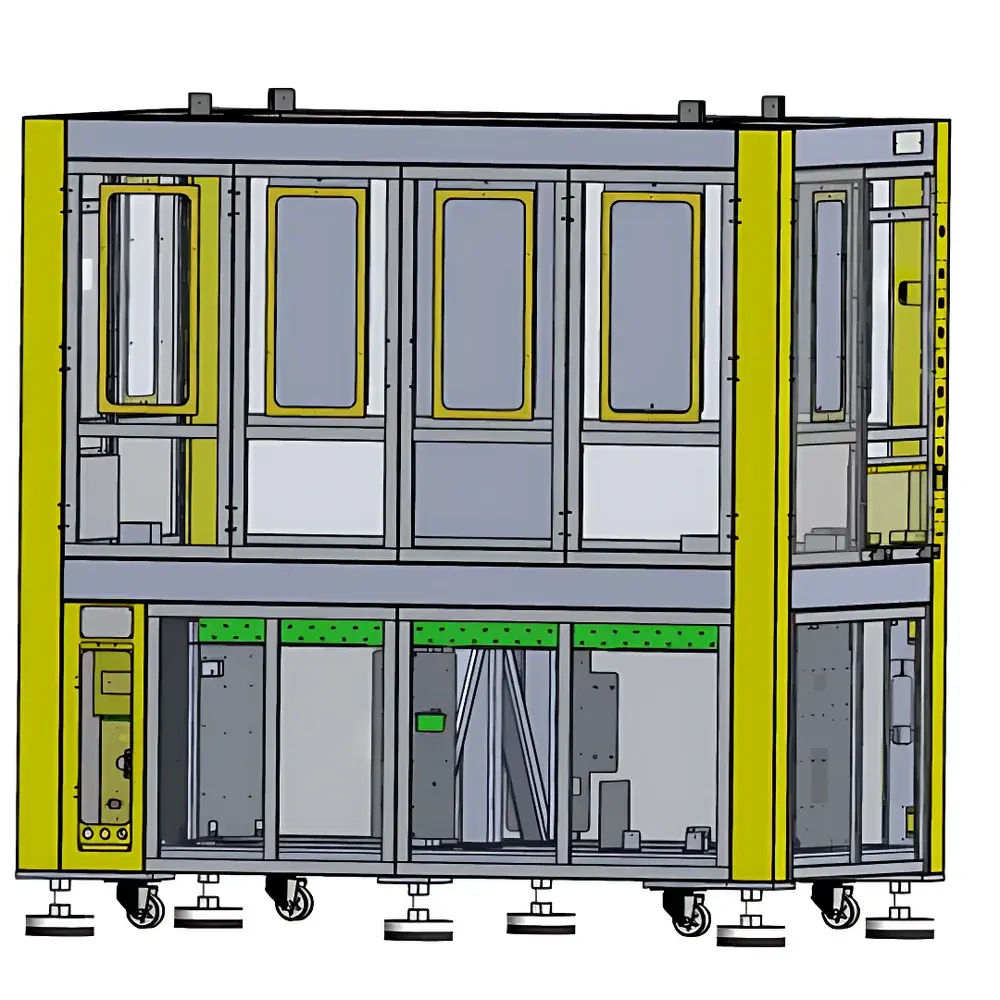
| Dimensions (L×W×H) | 2100 × 1510 × 2100 mm |
| Weight | 2000 kg |
| Power Supply | AC 220 V |
| Power Consumption | 6500 W |
| Pneumatic Supply Pressure | 0.5 MPa |
| Z-axis Repeatability (Loading/Unloading) | ±0.05 mm |
| Z-axis Repeatability (Inspection Transfer) | ±0.02 mm |
| Y-axis Repeatability (Inspection Transfer) | ±0.01 mm |
| X-axis Repeatability (Imaging Module) | ±0.01 mm |
| Z-axis Repeatability (Imaging Module) | ±0.02 mm |
| X/Y-axis Repeatability (Buffer Stage) | ±0.01 mm |
| Y/Z-axis Repeatability (Sorting Transfer) | ±0.01 mm / ±0.02 mm |
| X/Z-axis Repeatability (Sorting Actuator) | ±0.01 mm / ±0.02 mm |
| Compatible Tray Sizes | 76 × 76 mm and 101.6 × 101.6 mm |
| Detectable Component Footprint | ≥4.5 × 4.5 mm |
| Field of View | 15 mm × 20 mm |
| Glass Surface Defect Miss Rate | <500 ppm |
| Orientation Detection Miss Rate | <100 ppm |
| Glass Surface False Call Rate | <5% |
| Orientation False Call Rate | <1% |
| Throughput (UPH) | ≥15,000 (CSP yield = 90%), ≥13,500 (CSP yield = 85%) |
| Applicable Packages | CSP and COM image sensor modules |
Overview
The Sunny Optical MINLMJ-100 CSP Chip Assembly Automated Visual Inspection System is an industrial-grade machine vision platform engineered for high-precision, high-throughput optical inspection of camera module chip-scale packages (CSP) and chip-on-module (COM) assemblies. Built upon a multi-axis precision motion architecture and calibrated monochrome CCD imaging subsystems, the system implements deterministic defect detection via pixel-level grayscale analysis and geometric feature extraction. It operates on the principle of controlled illumination contrast enhancement—leveraging directional LED lighting, telecentric optics, and sub-pixel registration—to resolve surface anomalies as small as 5–10 µm in critical regions including glass cover lens surfaces, die bonding interfaces, and edge contours. Designed for integration into front-end SMT line end-of-line (EOL) test stations or post-assembly packaging cells, the MINLMJ-100 replaces manual microscope-based QA with statistically validated, repeatable pass/fail classification aligned to IPC-A-610 and JEDEC J-STD-020 compliance frameworks.
Key Features
- Modular six-axis gantry system with sub-10 µm repeatability across all critical positioning axes (X/Y/Z for imaging, transfer, buffering, and sorting stages)
- Dual-channel synchronized imaging: top-side and dual-angle oblique illumination for simultaneous detection of surface contaminants, micro-scratches, edge chipping, delamination, and epoxy overflow
- Automated tray stacking/unstacking mechanism supporting standard 76 mm × 76 mm and 101.6 mm × 101.6 mm plastic trays per JEDEC MO-178 specifications
- Programmable vacuum nozzle array with interchangeable tips accommodating CSP components ≥4.5 mm × 4.5 mm footprint
- Real-time binning logic with hardware-accelerated image processing (FPGA + GPU co-processing) enabling ≤120 ms per unit inspection cycle
- Integrated pneumatic handling system compliant with ISO 8573-1 Class 4 air quality standards (0.5 MPa supply pressure, oil-free filtration)
- Thermal-stabilized mechanical frame with vibration-damped granite base and reinforced aluminum extrusion chassis
Sample Compatibility & Compliance
The MINLMJ-100 is validated for CSP and COM packages used in mobile imaging applications—including stacked-die configurations, wafer-level optics (WLO), and hybrid ceramic-plastic substrates. It supports industry-standard carrier formats and accommodates variations in reflectivity, surface roughness, and refractive index commonly encountered in sapphire, borosilicate, and fused silica cover glasses. All detection algorithms are traceable to reference standards verified using calibrated toolmakers’ microscopes (e.g., Mitutoyo FS100, Nikon MM-40) and cross-checked against certified human inspectors under ISO/IEC 17025-accredited procedures. The system meets electromagnetic compatibility requirements per EN 61326-1 and safety standards per IEC 60204-1. Audit-ready log files include timestamped raw image metadata, operator ID, calibration certificate IDs, and version-controlled algorithm parameters—enabling full GLP/GMP traceability where required.
Software & Data Management
- Proprietary inspection software suite with intuitive GUI, recipe-driven workflow configuration, and hierarchical user permission levels (Operator, Technician, Administrator)
- Defect classification engine trained on >2 million annotated CSP images; supports supervised retraining via customer-supplied defect libraries
- Real-time SPC dashboard with Cpk/Ppk trend charts, Pareto analysis of defect types, and automated OCAP (Out-of-Control Action Plan) alerts
- Export-compatible data output: CSV, XML, and SQL database dumps compliant with MES/SCADA protocols (OPC UA, MQTT)
- Audit trail functionality satisfying FDA 21 CFR Part 11 requirements: electronic signatures, immutable event logs, and role-based access control
- Remote diagnostics and firmware update capability via TLS-secured Ethernet interface
Applications
The MINLMJ-100 serves as a dedicated EOL verification station for manufacturers of smartphone camera modules, automotive ADAS sensors, and medical endoscopic imaging systems. Typical use cases include: incoming inspection of CSP wafers after dicing and packaging; post-reflow verification of solder joint integrity and component alignment; post-lens-attach validation of optical axis deviation and adhesive coverage uniformity; and final shipment qualification prior to tray sealing. Its ability to distinguish orientation errors (e.g., 90° rotation misplacement), mixed-material batches (e.g., Si vs. GaAs CSP), and subtle optical interference patterns (e.g., Newton’s rings, Moiré fringes) makes it especially valuable in high-mix, low-volume production environments requiring rapid recipe changeover. Integration with factory automation systems enables closed-loop feedback to upstream pick-and-place or dispensing equipment.
FAQ
What types of defects can the MINLMJ-100 reliably detect on CSP glass surfaces?
It detects white spots, micro-scratches, particulate contamination, edge chipping, epoxy bleed-out, die shift, interfacial delamination, and structured optical artifacts such as rainbow banding—provided sufficient grayscale contrast exists between defect and background.
Does the system support custom defect classification logic?
Yes. Customers may define region-of-interest (ROI) masks, intensity thresholds, morphological filters, and multi-layer decision trees through the embedded script editor, with validation reports generated per ISO/IEC 17025 guidelines.
How is measurement uncertainty quantified for repeatability specifications?
All axis repeatability values (±0.01 mm to ±0.05 mm) are derived from 30 consecutive bidirectional positioning tests at ambient temperature (23 ± 2°C), following ISO 230-2 Annex B methodology and confirmed with laser interferometry.
Can the MINLMJ-100 integrate with existing MES or QMS platforms?
Yes. Native support for OPC UA, RESTful API endpoints, and configurable database connectors (ODBC/JDBC) enables seamless data exchange with Siemens Opcenter, Rockwell FactoryTalk, or custom SQL-based quality management systems.
Is the system suitable for cleanroom environments?
The MINLMJ-100 is rated for ISO Class 7 (10,000) cleanrooms. Optional HEPA-filtered internal airflow and static-dissipative housing materials are available upon request.