
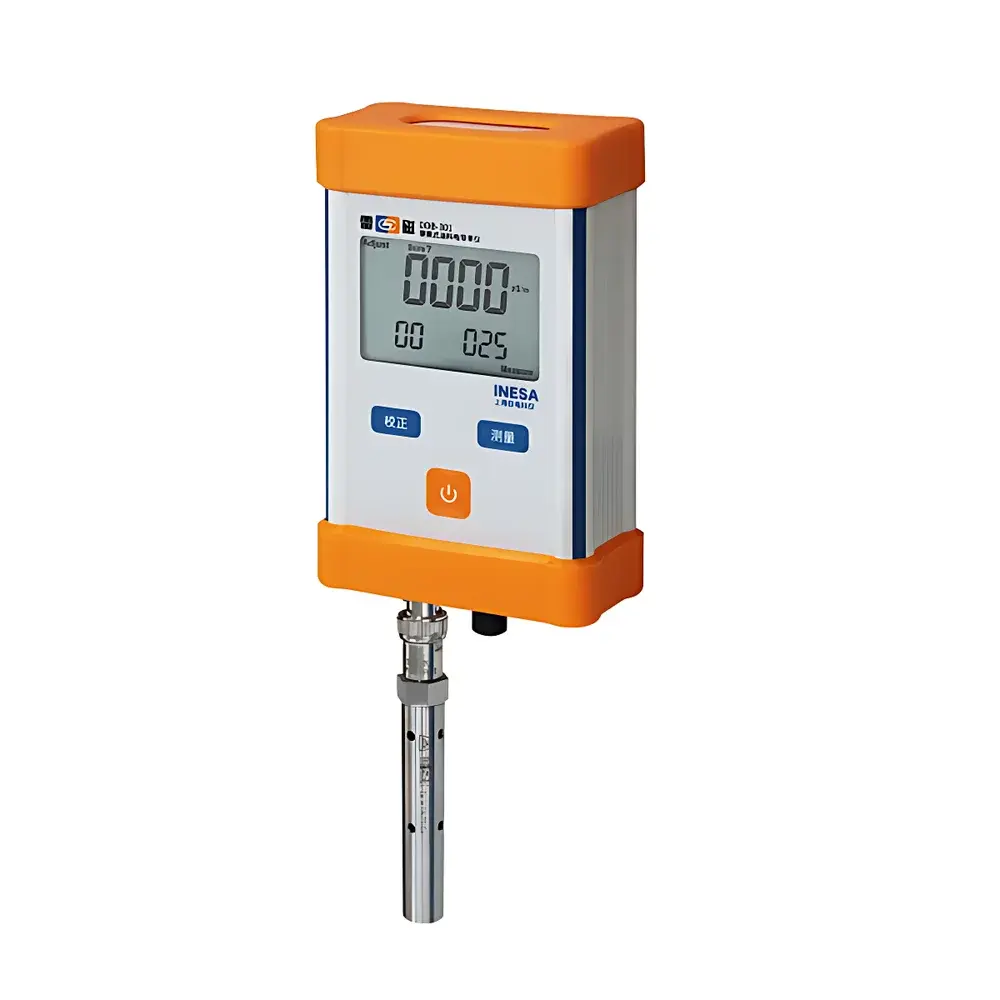
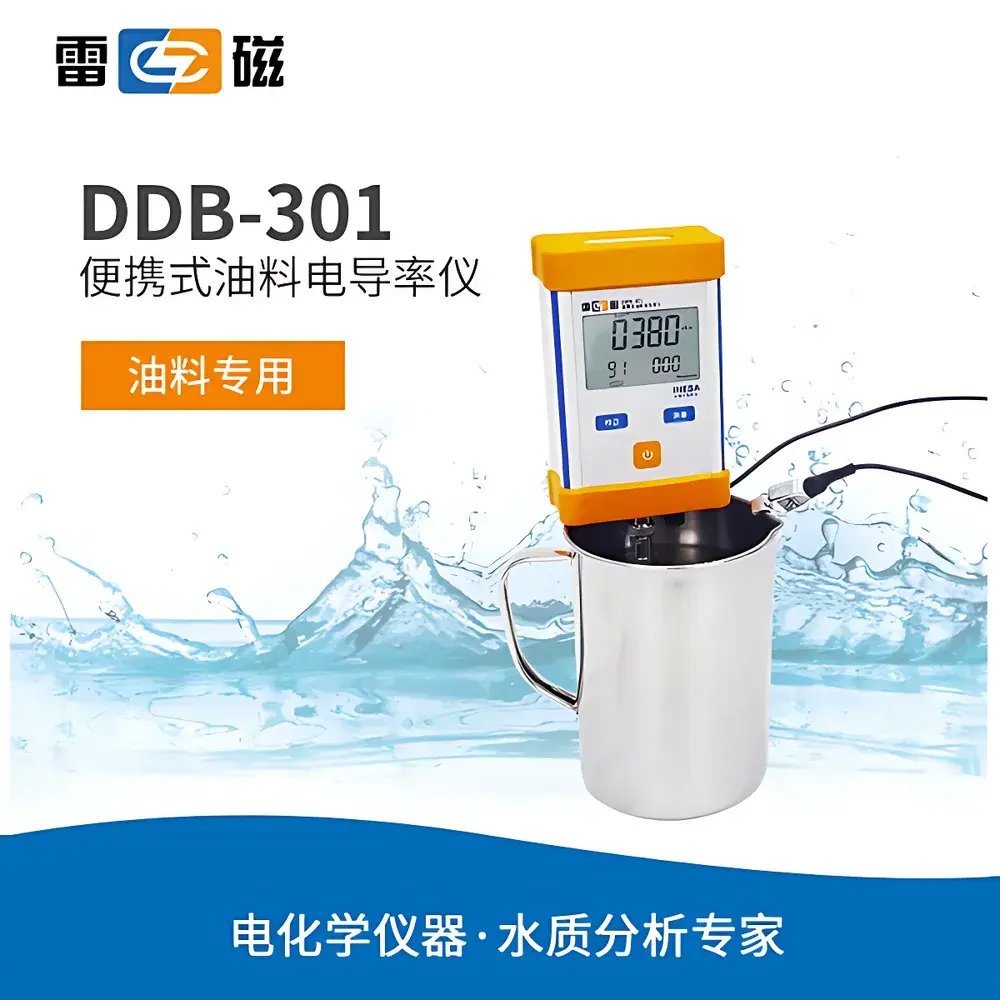
Leici DDB-301 Portable Fuel Conductivity Meter
| Brand | Leici |
|---|---|
| Origin | Shanghai, China |
| Manufacturer Type | Original Equipment Manufacturer (OEM) |
| Country of Origin | China |
| Model | DDB-301 |
| Measurement Parameter | Electrical Conductivity Only |
| Portability | Handheld |
| Intended Use Environment | Laboratory & Field Deployment |
| Minimum Resolution | 1 pS/m |
| Display | LCD with High-Contrast Backlight |
| Power Supply | Two 476A 6 V Alkaline Batteries |
| Operating Temperature | 0–40 °C |
| Relative Humidity | ≤85% RH |
| Dimensions | 85 × 220 × 50 mm |
| Weight | ~350 g |
| Explosion Protection | Ex ia IIA T5 Ga (Certified per GB 3836.1–2021 / IEC 60079-0:2017 and GB 3836.4–2021 / IEC 60079-11:2011) |
| Certified Explosion-Proof Certificate No. | GYB23.2384X |
| Included Accessories | DJSY-0.01 Fuel-Specific Conductivity Sensor, Silicone Protective Sleeve, Metallic Calibration Beaker |
Overview
The Leici DDB-301 Portable Fuel Conductivity Meter is an intrinsically safe, handheld electrochemical instrument engineered for precise measurement of electrical conductivity in hydrocarbon-based fuels—including aviation turbine fuel (Jet A-1, JP-8), diesel, gasoline, and kerosene—under field and laboratory conditions. It operates on the principle of two-electrode AC conductometry, optimized for low-conductivity non-aqueous media (typically 0.1–2000 pS/m), where conventional aqueous conductivity meters fail due to polarization errors and electrode fouling. The DDB-301 employs a dedicated DJSY-0.01 sensor with a cell constant of 0.01 cm⁻¹, specifically calibrated for fuel dielectric properties and optimized for minimal sample volume (≤50 mL) and rapid stabilization (<15 s). Its design conforms to international standards governing static charge accumulation in fuel handling systems, including ASTM D2624 (Standard Test Method for Electrical Conductivity of Aviation Turbine Fuels) and DEF STAN 91-86 (UK MoD specification for fuel conductivity testing). The instrument is not intended for aqueous or high-ionic-strength solutions.
Key Features
- Intrinsically safe construction certified to Ex ia IIA T5 Ga per GB 3836.1/4 and IEC 60079-0/11—enabling safe operation in classified hazardous zones where flammable vapors may be present during aircraft refueling, depot sampling, or pipeline transfer points.
- High-resolution 1 pS/m measurement capability across a full range of 0–1999 pS/m, supporting compliance with minimum conductivity thresholds (e.g., ≥50 pS/m for Jet A-1 per ASTM D2624 and IATA Guidance Material).
- Three-button interface with tactile feedback and LCD display featuring anti-glare, wide-view-angle segment LCD—optimized for readability under ambient lighting, hangar illumination, or outdoor daylight conditions.
- Low-power architecture enabling >200 hours of continuous operation on two 476A 6 V alkaline batteries; includes real-time battery voltage monitoring and audible/visual low-battery alert prior to shutdown.
- Auto-power-off after 10 minutes of inactivity, configurable via hardware jumper; no firmware updates required—ensuring long-term operational consistency without software dependency.
- Compact ergonomic housing (85 × 220 × 50 mm, ~350 g) with integrated silicone sleeve and IP54-rated ingress protection against dust and incidental splashes.
Sample Compatibility & Compliance
The DDB-301 is validated exclusively for non-aqueous, low-polarity hydrocarbon liquids with dielectric constants below εr ≈ 2.5 and viscosity 30 ppm H2O), or solvents such as acetone or methanol. All measurements must be performed at stabilized temperature (±1 °C) using the supplied metallic calibration beaker to minimize stray capacitance. The device meets traceability requirements per ISO/IEC 17025:2017 when used with NIST-traceable reference standards (e.g., custom-certified fuel simulants from PTB or NPL). Its explosion-proof certification supports integration into safety-critical workflows governed by API RP 2003, EI 1529, and NFPA 77.
Software & Data Management
The DDB-301 operates as a standalone, firmware-locked instrument with no Bluetooth, USB, or data logging capability—by design, to maintain intrinsic safety integrity and eliminate electromagnetic interference risks in explosive atmospheres. All calibration and measurement records must be manually documented per GLP-compliant lab notebooks or LIMS-integrated paperless workflows. The unit supports single-point calibration using certified fuel conductivity reference standards (e.g., 50 pS/m and 1000 pS/m simulants); calibration verification is recommended before each shift or after sensor cleaning. No audit trail, electronic signature, or 21 CFR Part 11 compliance is provided—consistent with its role as a field-deployable pass/fail verification tool rather than a regulated analytical endpoint.
Applications
- Pre-flight fuel quality verification at airfield hydrant pits and mobile refuelers.
- Batch release testing in fuel storage depots and blending facilities per MIL-DTL-83133 and DEF STAN 91-86.
- Static dissipation assessment during tanker truck unloading and railcar sampling.
- Root-cause investigation of electrostatic discharge incidents linked to low-conductivity fuel.
- Verification of antistatic additive (e.g., Stadis 450) efficacy and dispersion homogeneity.
- Field support for ISO 8502-9 surface cleanliness validation where residual hydrocarbon films affect conductivity readings.
FAQ
Can the DDB-301 measure conductivity in biodiesel or ethanol-blended gasoline?
No. The sensor and firmware are calibrated only for pure hydrocarbon fuels. Blends exceeding 5% (v/v) bio-component induce significant dielectric and interfacial polarization errors.
Is sensor cleaning required between samples?
Yes. Wipe the DJSY-0.01 electrode with lint-free tissue moistened with dry n-heptane; avoid solvents with polar residues. Air-dry for ≥2 min before reuse.
Does the instrument require annual recalibration by an accredited lab?
Not mandated—but calibration verification using traceable reference standards is required before each use session per ASTM D2624 Annex A1.
What does the “Ga” suffix in the Ex marking signify?
“Ga” denotes Equipment Protection Level (EPL) “Ga”, indicating suitability for Zone 0 (continuous gas hazard presence) under IEC 60079-0, verified via rigorous thermal and spark energy testing.
Can the metallic beaker be substituted with glass or plastic?
No. The supplied aluminum beaker forms part of the defined measurement geometry and grounding path; substitution invalidates calibration and compromises intrinsic safety.





