
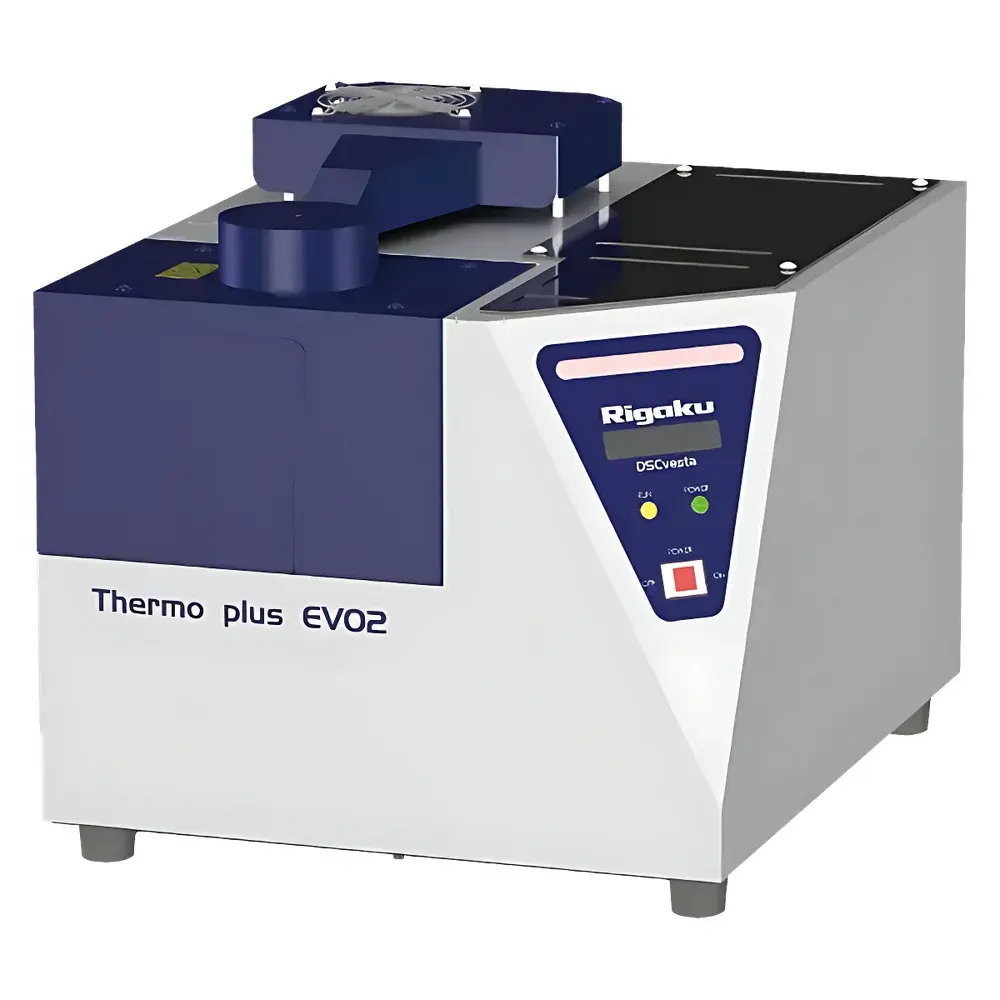
Rigaku DSCvesta Differential Scanning Calorimeter
| Brand | Rigaku |
|---|---|
| Origin | Japan |
| Instrument Type | DSC |
| Temperature Range | −170 °C to 725 °C |
| Configuration | Imported System |
| Distribution Model | Authorized Distributor |
Overview
The Rigaku DSCvesta is a high-performance differential scanning calorimeter engineered for precise quantification of thermal transitions in solid and semi-crystalline materials. It operates on the fundamental principle of heat flux DSC, measuring the difference in heat flow between a sample and an inert reference as both are subjected to identical, controlled temperature programs. This enables accurate determination of endothermic and exothermic events—including glass transitions (Tg), melting points (Tm), crystallization onset (Tc), phase separation, curing kinetics, and oxidative induction time (OIT). Designed for research laboratories, quality control environments, and regulatory-compliant manufacturing settings, the DSCvesta delivers reproducible data across its full operational range—from cryogenic conditions at −170 °C to high-temperature analysis up to 725 °C—making it suitable for polymers, pharmaceuticals, metals, ceramics, and battery electrode materials.
Key Features
- Advanced furnace architecture: A symmetric, low-mass ceramic furnace with optimized thermal shielding ensures exceptional baseline stability, minimal thermal lag, and rapid heating/cooling response—critical for high-resolution detection of overlapping transitions.
- Ultra-low noise detection system: Equipped with a high-sensitivity thermopile sensor and precision analog-to-digital conversion, the instrument achieves sub-microwatt sensitivity, enabling reliable resolution of minute thermal events such as weak secondary relaxations or trace impurity melting.
- Modular expansion capability: Standardized mechanical and electrical interfaces support seamless integration of optional accessories—including liquid nitrogen cooling systems (LN2), Peltier-based low-temperature modules, real-time sample observation kits with integrated optics, and robotic auto-samplers compliant with ASTM E1953 and ISO 11357 standards.
- Robust thermal calibration framework: Supports multi-point calibration using certified reference materials (e.g., indium, zinc, tin, and sapphire) for both temperature and enthalpy accuracy, traceable to NIST and JIS standards.
- Thermally isolated enclosure: Vibration-damped housing with active ambient compensation minimizes external thermal drift, ensuring long-term measurement integrity during extended runs (e.g., 48+ hour OIT or cold-crystallization studies).
Sample Compatibility & Compliance
The DSCvesta accommodates standard hermetic and vented aluminum pans (50–100 µL capacity), platinum crucibles for aggressive or high-temperature applications, and specialized high-pressure cells (up to 10 MPa) for reactive or volatile samples. All sample holders meet ISO 11357-1 requirements for geometry and thermal mass consistency. The system supports GLP/GMP workflows through configurable audit trails, electronic signatures, and user-access controls aligned with FDA 21 CFR Part 11. Data output formats (e.g., .dsc, .txt, .csv) are compatible with third-party statistical analysis platforms and enterprise LIMS integration.
Software & Data Management
Rigaku’s ThermoAnalysis Suite provides intuitive, workflow-driven operation—from method setup and real-time curve monitoring to advanced peak deconvolution and kinetic modeling (e.g., Ozawa-Flynn-Wall, Kissinger, ASTM E698). Raw data files include embedded metadata (operator ID, instrument serial number, calibration date, environmental logs), supporting full traceability. Batch processing, report templating (PDF/HTML), and automated pass/fail criteria evaluation streamline routine QC tasks. Software validation documentation (IQ/OQ/PQ protocols) is available upon request for regulated industries.
Applications
- Pharmaceutical solid-state characterization: Polymorph screening, amorphous content quantification, excipient compatibility assessment, and stability-indicating assay development per ICH Q5A and Q1E guidelines.
- Polymer processing optimization: Crystallinity degree calculation, crosslink density estimation, degradation onset temperature (Td) mapping, and rheological-thermal correlation studies.
- Materials science R&D: Phase diagram construction for metal alloys, intermetallic formation analysis, and thermal expansion coefficient derivation via complementary TMA coupling.
- Battery materials analysis: Solid electrolyte interface (SEI) formation energy, cathode thermal runaway onset, and binder decomposition profiling under controlled atmosphere (N2, Ar, O2).
- Food science: Starch gelatinization enthalpy, fat polymorphism transitions, and moisture migration kinetics during freeze-thaw cycling.
FAQ
What cooling options are supported for sub-ambient operation?
Liquid nitrogen cooling (−170 °C minimum) and mechanical refrigeration units (−50 °C minimum) are both factory-integrated and software-synchronized.
Is the DSCvesta compliant with USP <1163> for thermal analysis of pharmaceuticals?
Yes—the instrument meets all hardware and software requirements for thermal method validation outlined in USP <1163>, including precision, accuracy, and robustness testing protocols.
Can raw DSC data be exported for independent processing in MATLAB or Python?
Yes—time-temperature-heatflow datasets export in ASCII-delimited format with full metadata headers, enabling direct ingestion into scientific computing environments.
How often does the system require recalibration?
Temperature and enthalpy calibration is recommended before each analytical campaign involving critical specifications; annual full-system verification is advised per ISO/IEC 17025 laboratory accreditation requirements.



