
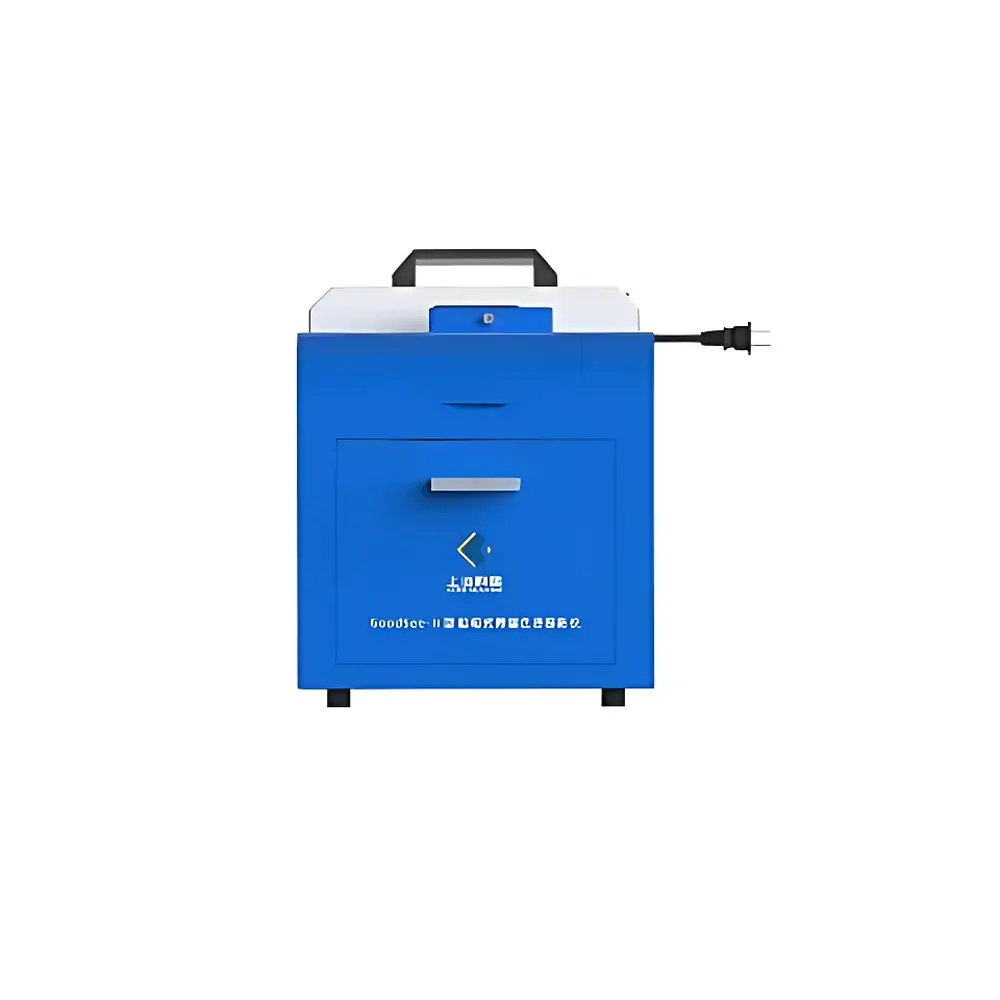
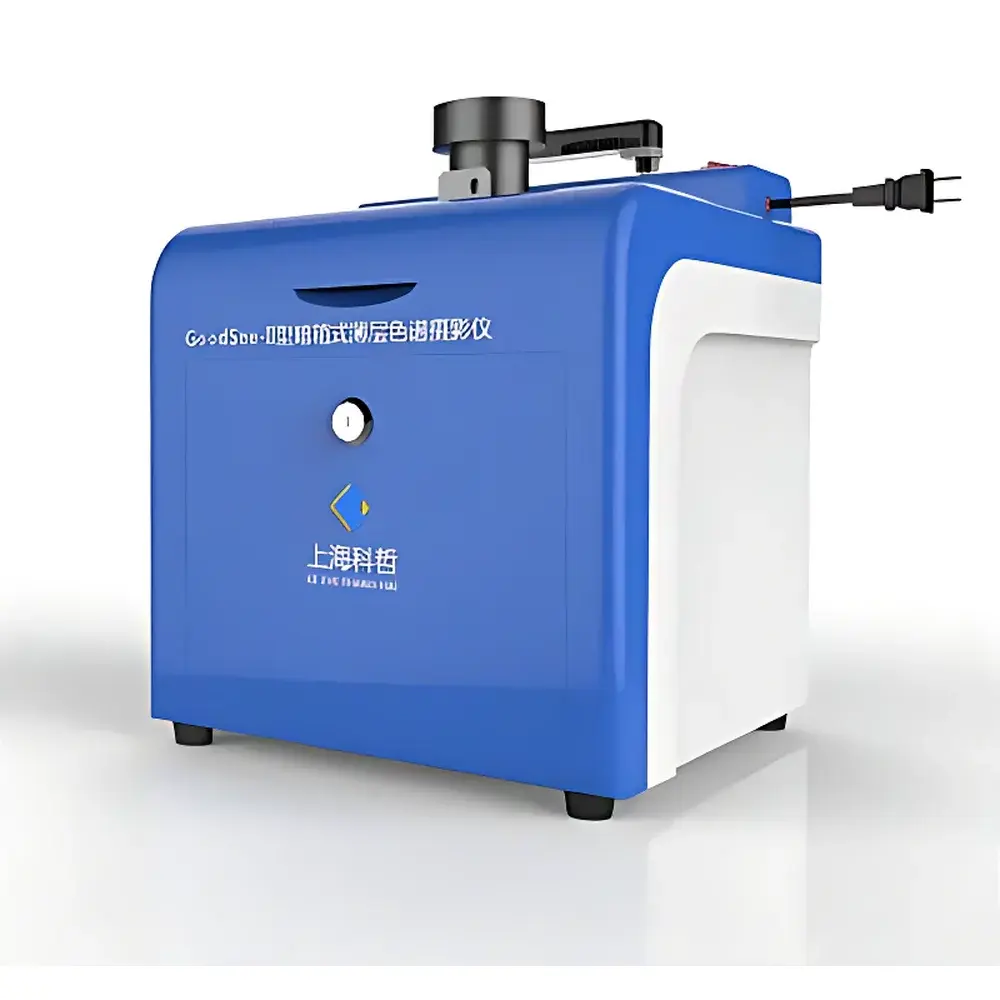
KEZHE GoodSee-II Darkroom Thin-Layer Chromatography Imaging System
| Brand | KEZHE SHANGHAI |
|---|---|
| Origin | Shanghai, China |
| Manufacturer Type | Direct Manufacturer |
| Instrument Type | TLC Imaging System |
| Measurement Modes | Reflectance Absorption, Reflectance Fluorescence, Transmittance Absorption, Transmittance Fluorescence |
| Wavelength Range | 190–800 nm |
| Light Sources | Xenon Lamp, Tungsten-Halogen Lamp, High-Pressure Mercury Lamp |
| Monochromator | Holographic Grating (1200 lines/mm) with Optional Nitrogen Purge |
| Spectral Bandwidth | 5 nm |
| Wavelength Accuracy | < 1 nm |
| Wavelength Repeatability | < 0.2 nm |
| Minimum Spatial Resolution | 25 µm |
| Imaging Wavelengths | 254 nm, 365 nm, White Light |
| Sample Stage Capacity | Up to 200 mm × 200 mm TLC Plates |
| Maximum Scanning Speed | 100 mm/s |
Overview
The KEZHE GoodSee-II Darkroom Thin-Layer Chromatography (TLC) Imaging System is an engineered solution for high-fidelity digital documentation and qualitative analysis of chromatographic separations on planar stationary phases. Designed around a light-tight enclosure architecture, the system eliminates ambient light interference—critical for low-signal detection in UV-absorbing and UV-induced fluorescent analytes. It operates on four fundamental optical measurement modalities: reflectance absorption, reflectance fluorescence, transmittance absorption, and transmittance fluorescence—enabling comprehensive visualization across diverse compound classes, including non-UV-active substances when derivatized or visualized under visible illumination. The instrument integrates a modular optical path with selectable excitation sources and a high-stability monochromator, supporting reproducible spectral acquisition from deep UV (190 nm) through visible (800 nm). Its mechanical scanning platform ensures uniform illumination and pixel-accurate image capture over full-size 200 mm × 200 mm TLC plates—meeting standard dimensions used in pharmacopoeial methods (e.g., USP , EP 2.2.27) and routine QC workflows.
Key Features
- Light-tight darkroom enclosure with zero external light leakage—validated for ISO/IEC 17025-compliant imaging environments.
- Triple-source illumination system: high-intensity xenon lamp (broadband UV–Vis), tungsten-halogen lamp (white light, 400–700 nm), and high-pressure mercury lamp (discrete UV lines at 254 nm and 365 nm).
- Holographic grating monochromator (1200 lines/mm) with nitrogen purge option—minimizes ozone generation and oxygen-induced photobleaching during extended UV exposure.
- Precise wavelength control: accuracy better than ±1 nm and repeatability better than ±0.2 nm—essential for method transfer and regulatory compliance.
- 25 µm minimum spatial resolution enables clear discrimination of closely migrating spots, even on high-Rf or overloaded plates.
- Motorized X–Y scanning stage with programmable speed up to 100 mm/s—ensuring consistent exposure time per pixel across large-format plates.
- Modular camera interface compatible with scientific-grade CCD/CMOS sensors (C-mount), supporting bit-depth ≥12-bit and frame averaging for noise reduction.
Sample Compatibility & Compliance
The GoodSee-II accommodates standard silica gel, alumina, cellulose, and reversed-phase TLC plates—including pre-coated, hand-poured, and derivatized variants. Its 200 mm × 200 mm sample stage supports both single-plate and multi-lane layouts used in parallel screening applications. The system complies with key analytical guidelines requiring documented imaging conditions: it provides traceable wavelength selection, calibrated intensity output, and stable thermal management—facilitating adherence to ICH Q5C (stability-indicating methods), USP , and FDA 21 CFR Part 11 when paired with compliant software (e.g., optional audit-trail-enabled KEZHE TLC ImageSuite). All UV sources are CE-marked and meet IEC 62471 photobiological safety requirements for Class 1 LED/lamp systems.
Software & Data Management
The system interfaces with KEZHE TLC ImageSuite (v4.0+), a Windows-based application supporting image acquisition, spot annotation, Rf calculation, densitometric profiling, and batch report generation. Raw image files are saved in TIFF format with embedded EXIF metadata—including exposure time, wavelength, lamp status, and plate ID. Software features include GLP-compliant user access control, electronic signature support, and full audit trail logging (per 21 CFR Part 11 Annex 11). Export options include PDF reports with embedded chromatograms, CSV data for statistical analysis (e.g., PCA, cluster analysis), and PNG/JPEG for publication-ready figures. Integration with LIMS via HL7 or CSV import/export is supported.
Applications
- Routine identity testing and purity assessment in pharmaceutical QC labs—particularly for herbal extracts, APIs, and finished dosage forms per Chinese Pharmacopoeia (ChP) and European Pharmacopoeia (Ph. Eur.) monographs.
- Method development and validation for stability-indicating TLC assays—leveraging dual-wavelength fluorescence to distinguish degradation products from parent compounds.
- Academic teaching laboratories—where robustness, intuitive operation, and cost-effective imaging replace film-based documentation.
- Food safety screening—e.g., detection of mycotoxins (aflatoxins, ochratoxin A) and pesticide residues using post-chromatographic derivatization and fluorescence enhancement.
- Forensic toxicology—rapid presumptive identification of alkaloids, benzodiazepines, and synthetic cannabinoids on silica plates.
FAQ
Is the GoodSee-II suitable for quantitative densitometry?
Yes—when used with calibrated standards and KEZHE TLC ImageSuite’s integrated calibration curve module, the system supports semi-quantitative and quantitative analysis per ICH Q2(R2) guidelines.
Can nitrogen purge be retrofitted to existing units?
Yes—field-installable nitrogen purge kits (PN: GS-II-N2-KIT) are available and include flow regulator, O-ring seals, and purge port adapter.
What camera models are validated for use with the GoodSee-II?
Validated models include the Basler acA2000-50gm, FLIR Blackfly S BFS-U3-16S2M-C, and Hamamatsu ORCA-Flash4.0 LT—full compatibility matrix provided in the Instrument Qualification Package.
Does the system support GMP audit readiness?
Yes—hardware design includes unique serial-numbered components, firmware version tracking, and optional IQ/OQ/PQ documentation templates aligned with ASTM E2500 and EU GMP Annex 15.
How is wavelength accuracy verified during routine operation?
Users may perform daily verification using NIST-traceable holmium oxide or didymium glass filters—procedures detailed in the SOP-IM-003 calibration protocol included with shipment.





