
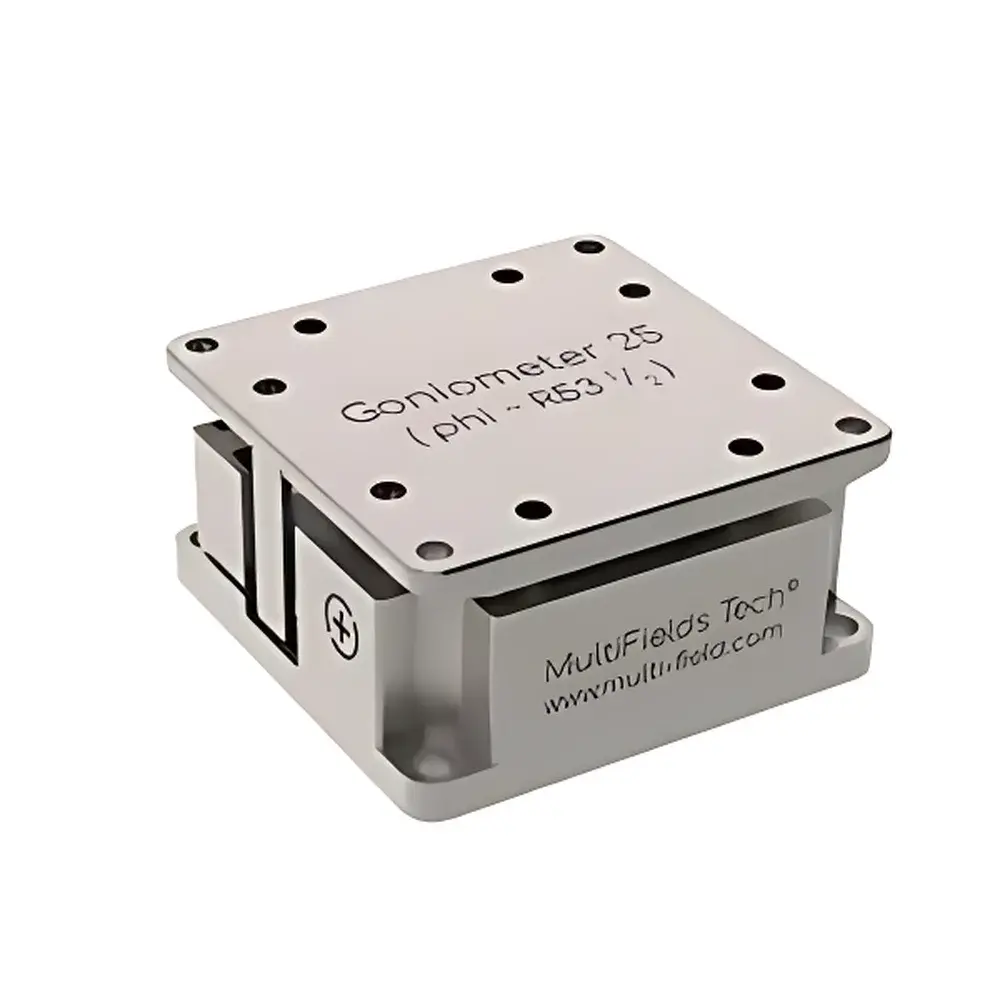
ZOLIX Goniometer25-phi Closed-Loop Piezoelectric Tilting Stage
| Brand | ZOLIX |
|---|---|
| Origin | Beijing, China |
| Manufacturer Type | Direct Manufacturer |
| Product Category | Domestic |
| Model | Goniometer25-phi |
| Product Type | Motorized Translation & Tilting Stage |
| Dimensions | 25 × 25 × 12.5 mm |
| Mass | 20 g |
| Operating Temperature Range | 1.4–400 K (optional down to 30 mK) |
| Vacuum Compatibility | Up to 2 × 10⁻¹¹ mbar (UHV version) |
| Magnetic Field Tolerance | Up to 18 T |
| Construction Materials | Pure Titanium (Ti) body, Beryllium Copper (BeCu) flexures and electrodes |
| Actuation Voltage | ≤ 200 V |
| Angular Range | ±3° (6° total) |
| Maximum Load | 200 g |
| Tip Radius (Pivot Radius) | 53.5 mm |
| Position Sensor | Resistive feedback element |
| Sensor Resolution | 0.2 m° (0.0002°) |
| Max. Speed at 300 K | ~1 °/s |
| Drive Pins | 2, Sensor Pins: 3 |
| Cable | Phosphor Bronze twisted pair, 20 cm |
| Connector Housing | PEEK + glass fiber or BeCu, depending on version |
| Optional Configurations | HV (High Voltage), ULT (Ultra-Low Temperature), UHV (Ultra-High Vacuum) |
Overview
The ZOLIX Goniometer25-phi is a compact, closed-loop piezoelectric tilting stage engineered for precision angular positioning in extreme experimental environments—specifically cryogenic, ultra-high vacuum (UHV), and high magnetic field conditions. Unlike conventional stepper- or servo-driven goniometers, this device employs monolithic piezoelectric actuation with integrated resistive position sensing, enabling sub-millidegree repeatability and drift-free static holding without power consumption. Its core principle relies on electrostrictive deformation of piezoceramic elements coupled with compliant Ti/BeCu flexure mechanisms, eliminating backlash, friction, and wear—critical for long-duration experiments in dilution refrigerators, superconducting magnet systems, or surface science chambers. The 25 × 25 × 12.5 mm footprint and 20 g mass make it suitable for integration into multi-axis cryostat feedthroughs or compact optical interferometry setups where spatial constraints and thermal budget are tightly controlled.
Key Features
- Sub-millidegree angular resolution: 0.2 m° (0.0002°) closed-loop positioning accuracy across full ±3° range
- Extreme environment compatibility: validated operation from 1.4 K to 400 K; optional ULT configuration certified for stable performance at ≤30 mK in He-3 or dilution refrigerator inserts
- Ultra-high vacuum rated: UHV version qualified to ≤2 × 10⁻¹¹ mbar, with non-outgassing materials including pure titanium housing and BeCu electrical contacts
- Magnetic field resilience: fully non-magnetic construction (Ti body, BeCu flexures/electrodes) ensures stable operation up to 18 Tesla without hysteresis shift or torque-induced deviation
- Passive thermal anchoring: low-thermal-conductivity phosphor bronze cabling (20 cm length) and glass-fiber-reinforced PEEK or BeCu pin housings minimize heat load in cryogenic applications
- Integrated resistive position sensor with linear response over full 6° travel—no external encoder alignment required
Sample Compatibility & Compliance
The Goniometer25-phi is designed for mounting optical components—including mirrors, waveplates, fiber couplers, and micro-optical elements—up to 200 g with a mechanical pivot radius of 53.5 mm. Its material selection complies with ASTM F2559 (Standard Practice for Outgassing Measurements of Vacuum Materials) and ISO 14644-1 Class 1 cleanroom handling protocols. All variants meet requirements for GLP-compliant instrumentation when integrated into automated vacuum or cryogenic test benches. The UHV configuration satisfies ESA ECSS-Q-ST-70-02C outgassing limits (<1 × 10⁻¹² g/cm²·s for H₂O, <5 × 10⁻¹³ g/cm²·s for total condensable volatiles). No lubricants, adhesives, or organic coatings are used in structural assembly.
Software & Data Management
The stage interfaces via standard low-noise analog voltage inputs (±10 V or 0–200 V drive range) and three-wire resistive sensor output. It is compatible with third-party motion controllers supporting PID-regulated closed-loop operation—including Newport ESP301, Thorlabs Kinesis, and custom LabVIEW or Python-based DAQ systems using NI PXI or USB-621x platforms. Sensor data supports traceable calibration via NIST-traceable angular reference standards (e.g., NPL Angle Calibration Interferometer). Audit trails, parameter logging, and firmware update history can be maintained in accordance with FDA 21 CFR Part 11 when deployed in regulated QC/QA workflows involving optical alignment validation.
Applications
- Precision beam steering in synchrotron X-ray diffraction endstations operating under UHV and 12–18 T magnetic fields
- Angle-resolved photoemission spectroscopy (ARPES) sample manipulators requiring sub-arcsecond stability at <100 mK
- Cryogenic quantum optics setups: alignment of single-photon sources, superconducting nanowire detectors, or cavity optomechanical resonators
- In-situ ellipsometry during molecular beam epitaxy (MBE), where real-time tilt correction compensates for thermal drift
- Calibration of angular encoders and autocollimators using primary-angle standards traceable to national metrology institutes
FAQ
What vacuum levels does the UHV version support?
The UHV-configured Goniometer25-phi is tested and certified for continuous operation at pressures as low as 2 × 10⁻¹¹ mbar, with bake-out capability up to 150°C.
Can it be operated at base temperature in a dilution refrigerator?
Yes—the ULT variant is specifically qualified for use at temperatures down to 30 mK, with thermal contraction compensation built into the flexure design and sensor calibration.
Is external shielding required for operation in high magnetic fields?
No—its entirely non-magnetic architecture (pure Ti, BeCu, phosphor bronze, and PEEK/glass-fiber composites) eliminates Lorentz-force-induced positioning errors even at 18 Tesla.
What is the maximum allowable cable resistance for closed-loop operation?
For optimal sensor signal integrity, total loop resistance—including cabling and connections—should remain below 50 Ω; twisted-pair phosphor bronze wiring maintains this specification up to 20 cm.
How is angular zero defined and calibrated?
The mechanical zero is factory-set using interferometric alignment against a master optical flat; users may perform secondary calibration using autocollimator-based angle referencing per ISO 230-1 Annex D.




