
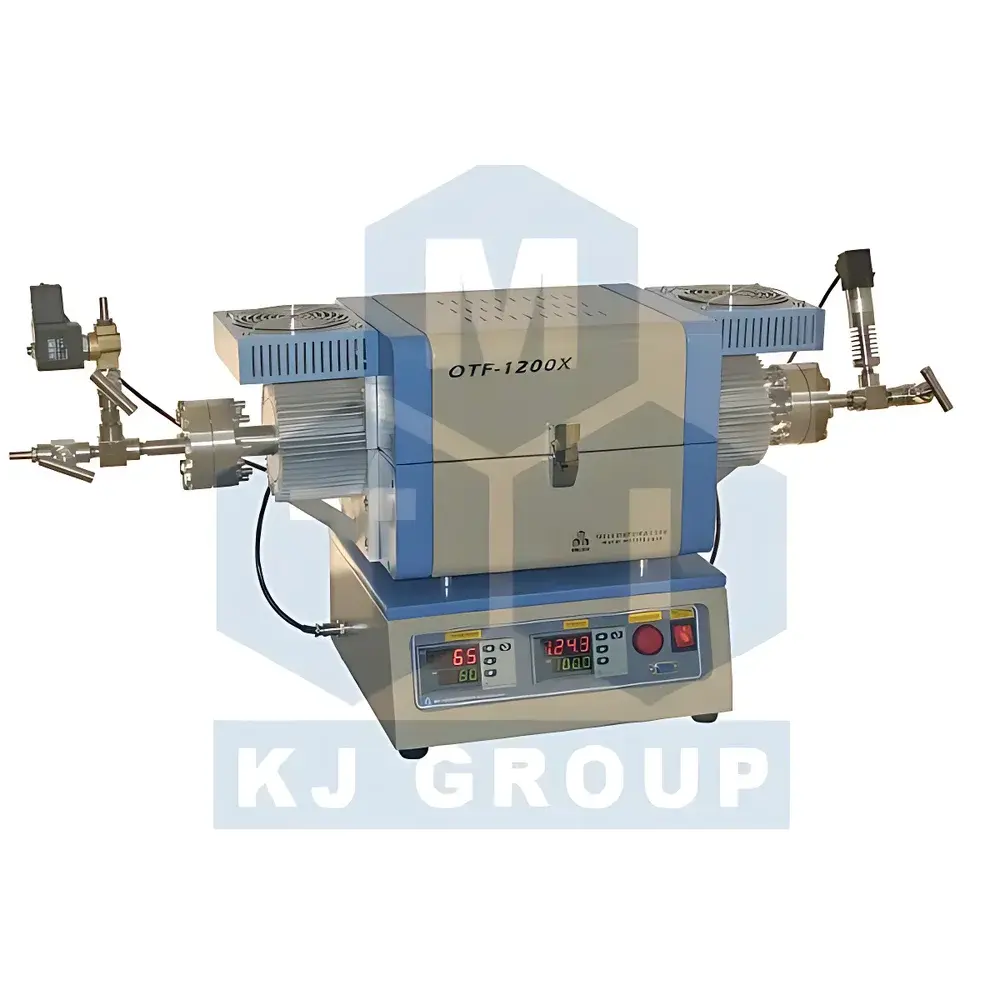
KJG OTF-1200X-HP-12 High-Pressure Tube Furnace with Integrated Pressure Regulation
| Brand | KJG (Hefei Kejing) |
|---|---|
| Origin | Anhui, China |
| Model | OTF-1200X-HP-12 |
| Maximum Operating Temperature | 1100 °C |
| Maximum Pressure | 20 MPa (at ≤800 °C), 12 MPa (at ≤900 °C), 6 MPa (at ≤1000 °C), 4 MPa (at ≤1100 °C) |
| Heating Zone Length | 300 mm |
| Uniform Temperature Zone | 50 mm (±1 °C), 70 mm (±2 °C) |
| Tube Dimensions | 30 mm OD × 12 mm ID × 580 mm L |
| Tube Material | Nickel-based superalloy (Inconel-type) |
| Sealing | Oxygen-free copper gaskets |
| Heating Element | Mo-doped Fe-Cr-Al alloy with Al₂O₃ coating |
| Power | 2.5 kW |
| Voltage | AC 208–240 V, single-phase, 50/60 Hz |
| Cooling | Dual aluminum heat sinks + axial fans |
| Weight | ~35 kg |
| Dimensions (W×L×H) | 340 × 300 × 400 mm |
| Compliance | CE certified |
| Control | 30-segment PID temperature controller with K-type thermocouple, overheat & thermocouple break protection |
| Pressure Control | Integrated piezoresistive pressure sensor + solenoid relief valve (max. 15 MPa rated) |
| Optional Software | MTS-03 PC interface for remote temperature/pressure programming and data logging |
Overview
The KJG OTF-1200X-HP-12 is a compact, benchtop high-pressure tube furnace engineered for controlled thermal processing under elevated gas pressures—up to 20 MPa at temperatures ≤800 °C—within inert or oxidizing atmospheres. Unlike standard tube furnaces, it integrates real-time pressure monitoring and active pressure regulation via a feedback-controlled solenoid relief valve, enabling stable, repeatable conditions essential for materials synthesis, phase stability studies, and kinetic investigations under non-ambient gas environments. Its core design centers on a seamless nickel-based superalloy tube (Inconel-class), selected for exceptional creep resistance, ductility, and oxidation resistance up to 1100 °C. The furnace employs a dual-layer shell with high-purity alumina fiber insulation and forced-air cooling at both flanges to maintain external hardware—including gas fittings and sealing surfaces—below 60 °C during operation. This architecture ensures long-term mechanical integrity of seals and reproducible thermal profiles across the 300 mm heating zone, with a ±1 °C uniformity span of 50 mm. The system operates within defined pressure–temperature envelopes per ISO 14857 and ASTM E2923 guidelines for high-pressure thermal equipment safety.
Key Features
- Integrated pressure regulation: Piezoresistive pressure sensor mounted on the right flange feeds real-time data to a front-panel digital display; user-configurable maximum pressure limit triggers automatic solenoid valve opening for passive pressure relief.
- Nickel-based superalloy tube (30 mm OD × 12 mm ID × 580 mm L) with inherent creep-dominated failure mode—prevents catastrophic rupture under overpressure by gradual bulging and controlled microcrack formation, verified per ASTM E139 tensile creep testing protocols.
- Dual aluminum heat sinks with axial cooling fans ensure flange and gas interface temperatures remain ≤60 °C, preserving copper gasket integrity and minimizing thermal drift in pressure transducer calibration.
- 30-segment programmable PID controller with K-type thermocouple input, ±1 °C accuracy, and built-in overheat/thermocouple-failure protection compliant with IEC 61508 functional safety principles.
- Modular gas handling: 1/4″ NPS female threaded ports on both flanges support direct integration with mass flow controllers, pressure regulators, and gas purification systems for O₂, N₂, Ar, He, or forming gas.
- Optional MTS-03 software enables PC-based remote control, synchronized temperature–pressure profile logging, and audit-trail generation suitable for GLP/GMP-aligned laboratories.
Sample Compatibility & Compliance
The OTF-1200X-HP-12 accommodates samples in high-purity alumina or quartz boats (e.g., 50 × 5 × 5 mm), or sealed in gold/nickel foil wrappers to minimize contamination during high-temperature sintering. Its pressure-rated tube supports solid-state reactions, oxygen stoichiometry tuning in oxides (e.g., cuprates, manganites), and high-pressure annealing of dielectrics and superconductors. All structural and electrical components meet CE marking requirements per Directive 2014/35/EU (Low Voltage) and 2014/30/EU (EMC). The pressure relief system adheres to ASME B31.3 process piping safety margins, and the furnace’s fail-safe behavior—verified through destructive creep testing—aligns with ISO 10418 recommendations for pressure containment integrity in laboratory-scale reactors.
Software & Data Management
The optional MTS-03 control suite provides bidirectional communication via RS485/USB, enabling full remote configuration of temperature ramps, dwell times, and pressure setpoints. It records time-stamped temperature and pressure values at user-defined intervals (1–60 s), exports CSV files compatible with MATLAB, Origin, or Python pandas workflows, and maintains an immutable audit trail including operator ID, parameter changes, and alarm events—meeting FDA 21 CFR Part 11 requirements for electronic records when deployed with validated user authentication. Data synchronization between local panel and PC ensures no loss of critical event timestamps during network interruption.
Applications
- Synthesis and phase stabilization of high-Tc superconductors (e.g., YBCO, Bi-2212) under controlled pO₂ gradients.
- High-pressure annealing of ferroelectric thin films (e.g., BaTiO₃, PZT) to suppress oxygen vacancy formation.
- Kinetic studies of solid–gas redox reactions (e.g., metal oxide reduction, carbothermic processing) under variable pgas.
- Thermal aging tests of nuclear fuel matrix materials (e.g., UO₂, SiC composites) under simulated accident conditions.
- Development of pressure-assisted sintering protocols for ceramic nanocomposites requiring sub-100 MPa consolidation.
FAQ
What is the maximum allowable pressure at 1100 °C?
The tube is rated for 4 MPa at 1100 °C, decreasing progressively to 20 MPa at ≤800 °C, as defined by the material’s creep strength envelope.
Can the solenoid valve be used above 15 MPa?
No—the integrated solenoid valve is rated to 15 MPa maximum; for experiments >15 MPa, the valve must be isolated using the downstream needle valve, and manual pressure release procedures must be implemented.
Is the furnace compatible with oxygen-rich atmospheres?
Yes—both the nickel-based tube and copper gaskets are oxidation-resistant up to 1100 °C in air or pure O₂; however, prolonged exposure >1000 °C in flowing O₂ requires periodic gasket replacement.
How is temperature uniformity verified?
Uniformity is characterized per ASTM E220 using three calibrated K-type thermocouples placed axially across the heating zone; data confirm ±1 °C over 50 mm and ±2 °C over 70 mm.
Does the system support automated pressure ramping?
Not natively—the pressure setpoint is static during a run; dynamic pressure profiling requires external PLC integration via analog 4–20 mA outputs from the MTS-03 interface module.



