
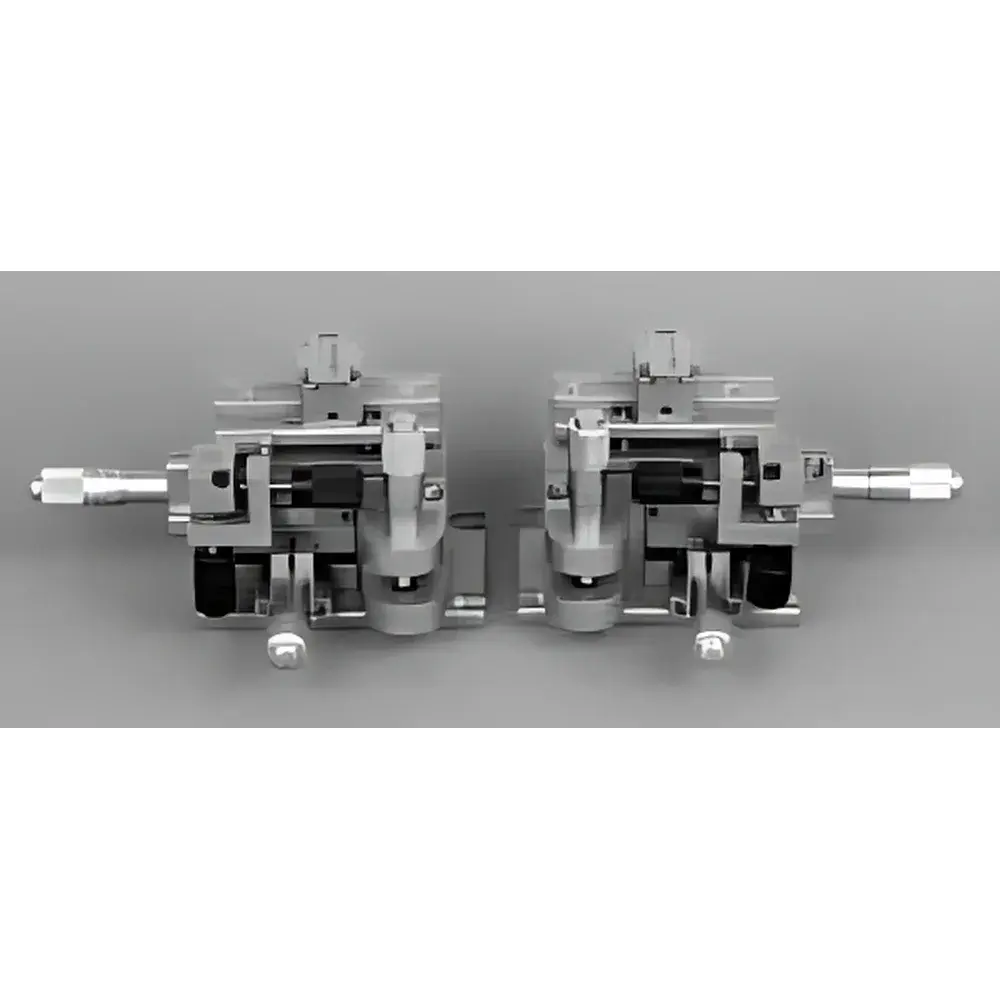
Five-Dimensional Fiber Optic Positioning Mount FP-XYZT
| Brand | ZOLIX |
|---|---|
| Origin | Beijing, China |
| Manufacturer | ZOLIX (OEM/ODM Capable) |
| Type | Integrated 5-Axis Precision Fiber Alignment Stage |
| Model | FP-XYZT |
| Configuration Options | Left-Handed Version Available (FP-XYZTL) |
| Angular Range | θy = ±5°, θz = ±5° |
| Linear Travel | Tx = 13 mm, Ty = 13 mm, Tz = 13 mm |
| Wobble Error | < 30 arcseconds |
| Minimum Graduation | 0.01 mm |
| Construction | Stainless Steel Monolithic Base & Cross-Roller Bearing Guides |
| Compliance | ISO 9001–Certified Manufacturing |
Overview
The ZOLIX FP-XYZT Five-Dimensional Fiber Optic Positioning Mount is an integrated, high-stability alignment solution engineered for demanding optical coupling, fiber-to-fiber splicing, free-space optical interconnects, and photonic device packaging applications. Unlike modular multi-stage assemblies prone to cumulative runout and thermal drift, the FP-XYZT integrates a monolithic TSMW13-XYZ three-axis linear translation platform with a rigid APFP-T two-axis stainless steel tip-tilt stage—achieving true five degrees of freedom (3 linear + 2 angular) in a single compact envelope. Its core mechanical architecture relies on precision-machined stainless steel components and cross-roller bearing guideways, delivering exceptional dimensional stability over time and temperature. The design eliminates flexure-based motion elements, ensuring purely rigid-body displacement with minimal hysteresis and zero elastic deformation under load—critical for maintaining sub-micron optical axis registration during long-term operation or environmental cycling.
Key Features
- Monolithic stainless steel construction for superior thermal stability and long-term zero-drift performance
- Cross-roller bearing linear guides across all three translational axes (X, Y, Z), enabling smooth, backlash-free motion with high load capacity and positional repeatability
- Integrated tip-tilt mechanism with orthogonal θy and θz adjustment (±5° each), independently actuated via differential micrometer drives
- Sub-arcsecond angular stability: wobble error limited to <30 arcseconds across full tilt range, verified via interferometric calibration
- Mechanical resolution of 0.01 mm on all linear axes, with fine-pitch micrometers offering tactile feedback and scale locking capability
- Compact footprint (typical dimensions: 120 × 95 × 75 mm) optimized for integration into OEM photonic modules, benchtop test stations, and automated alignment workcells
- Left-handed configuration available (FP-XYZTL) for mirrored optical layouts without external adapters or reorientation
Sample Compatibility & Compliance
The FP-XYZT accommodates standard Ø1.25 mm, Ø2.5 mm, and Ø5.0 mm ferruled fiber connectors (FC, SC, LC, ST), as well as bare fiber clamping fixtures (optional). Its low-center-of-gravity geometry and rigid base ensure compatibility with high-NA objective lenses, collimators, and photodetectors mounted directly on the platform or adjacent optical rails. All materials comply with RoHS Directive 2011/65/EU and REACH Regulation (EC) No. 1907/2006. Manufacturing adheres to ISO 9001:2015 quality management standards, with traceable metrology records for critical dimensions and angular tolerances. While not inherently certified for cleanroom Class 100 use, the mount’s non-outgassing stainless steel body and absence of lubricants make it suitable for controlled environments when paired with compatible mounting hardware.
Software & Data Management
The FP-XYZT is a manually operated mechanical positioning system and does not incorporate motorized actuators or embedded electronics; therefore, it requires no firmware, drivers, or proprietary software. However, its deterministic kinematics and repeatable graduation scales enable seamless integration with third-party motion control ecosystems. When used with optional encoder-equipped translation stages or vision-guided alignment systems (e.g., Thorlabs Kinesis, Newport ESP300, or custom LabVIEW/Python-based alignment routines), users can log positional metadata—including calibrated XYZ coordinates and θy/θz angles—into audit-ready CSV or HDF5 datasets. For GLP/GMP-regulated environments, manual position entries may be recorded in electronic lab notebooks (ELNs) with timestamped operator signatures, satisfying basic traceability requirements per FDA 21 CFR Part 11 Annex 11 guidelines for non-automated instrumentation.
Applications
- Precision passive alignment of single-mode and multimode fibers in telecom transceiver modules
- Active alignment of laser diodes to silicon photonics waveguides during wafer-level testing
- Optimization of coupling efficiency between fiber pigtails and MEMS mirrors, VOAs, or isolators
- Stabilized beam steering and collimation verification in interferometric sensor development
- Research-grade alignment of quantum dot emitters, NV centers, or superconducting nanowire single-photon detectors (SNSPDs)
- Calibration reference platform for optical axis deviation measurements using autocollimators or position-sensitive detectors (PSDs)
FAQ
Is the FP-XYZT compatible with vacuum environments?
Yes—the all-stainless-steel construction and absence of adhesives, plastics, or volatile lubricants allow operation in medium vacuum (≤10⁻⁴ mbar); bake-out up to 80°C is supported.
Can I retrofit stepper motors to the FP-XYZT?
ZOLIX does not supply motorized versions, but the micrometer shafts are standardized M6×0.75 threads, permitting third-party motor coupling using compatible lead screws and NEMA 8 or 11 motor mounts.
What is the maximum payload capacity?
The stage supports up to 1.2 kg uniformly distributed across the top plate while maintaining specified angular stability and travel accuracy.
Does ZOLIX provide calibration certificates?
Traceable calibration reports (including angular deviation maps and linear travel linearity data) are available upon request at additional cost, compliant with ISO/IEC 17025 procedures through accredited metrology partners.
How is thermal drift minimized in this design?
By eliminating aluminum or brass components—common sources of CTE mismatch—the monolithic stainless steel structure ensures uniform expansion and near-zero relative movement between axes over typical lab temperature ranges (15–25°C).






