
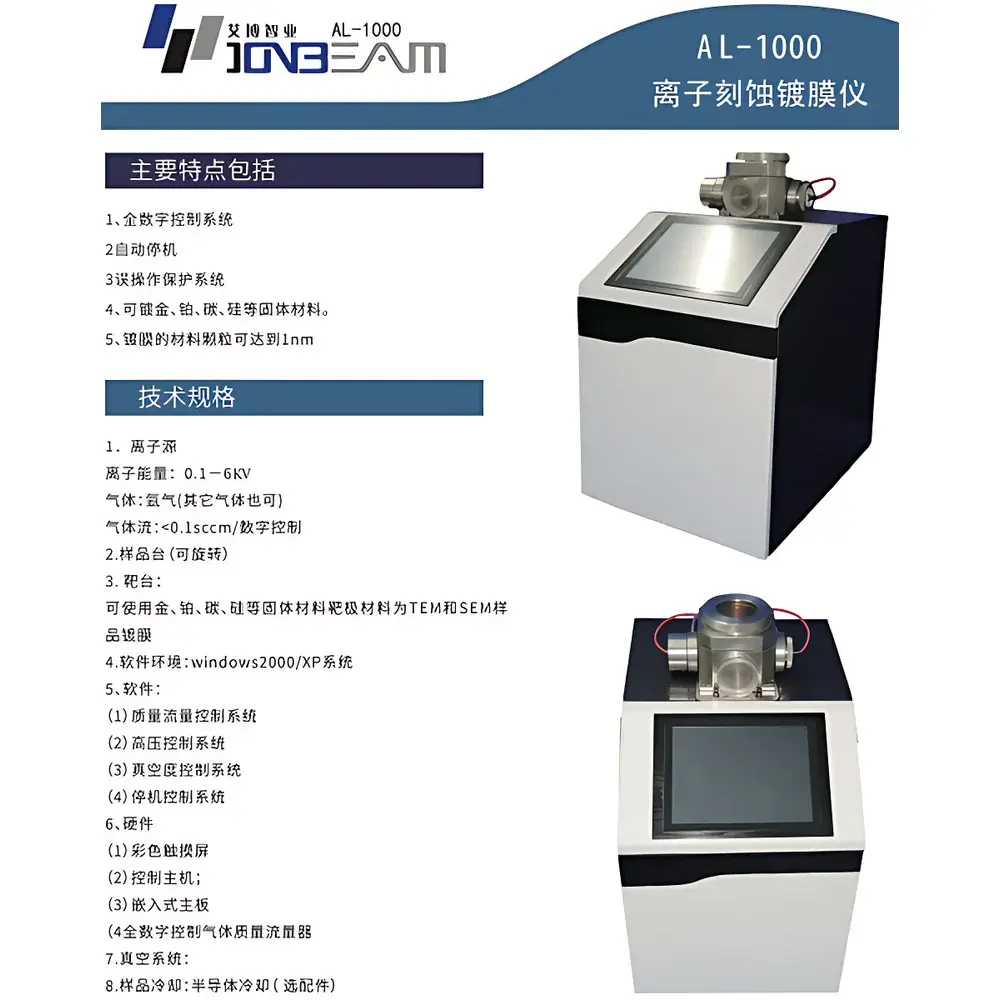
Abel AL-1000 Ion Beam Sputter Coater
| Brand | Abel/Ionbeam |
|---|---|
| Origin | Beijing, China |
| Manufacturer Type | Direct Manufacturer |
| Region Classification | Domestic (China) |
| Model | AL-1000 |
| Pricing | Upon Request |
| Maximum Sample Diameter | Ø25 mm and Ø50 mm |
| Minimum Particle Size | ~3 nm |
| Ion Beam Energy Range | 200–6000 V |
| Base Vacuum | ≤5×10⁻³ Pa (without Ar flow) |
| Sample Stage | Motorized Rotation |
| Cooling Option | Peltier-based Semiconductor Cooling (optional) |
| Integrated Functions | Plasma Cleaning + Ion Beam Sputtering + Reactive Ion Beam Etching (with reactive gas inlet) |
| Control System | Digital Automated Controller with Real-time Parameter Logging |
Overview
The Abel AL-1000 Ion Beam Sputter Coater is a high-precision, dual-function vacuum deposition system engineered for electron microscopy sample preparation. It operates on the principle of broad-beam ion beam sputtering—where inert gas ions (typically argon), accelerated in a controlled electric field, bombard a solid target material to eject atoms that subsequently condense as a conformal, nanoscale-thin film onto a substrate. Unlike thermal evaporation or magnetron sputtering, this technique delivers low-energy, directional particle flux (<60 eV average kinetic energy at the substrate surface), minimizing beam-induced damage and enabling high-fidelity coating of temperature-sensitive, beam-labile, or insulating specimens—including biological tissues, polymers, soft materials, and cryo-prepared samples. The AL-1000 integrates both plasma cleaning and ion beam sputtering within a single vacuum chamber, eliminating cross-contamination risks associated with multi-chamber transfer and ensuring reproducible surface conditioning prior to metallization.
Key Features
- Single broad-beam ion gun with digitally adjustable acceleration voltage (200–6000 V), enabling precise control over sputter yield, film density, and adatom mobility.
- Dual-diameter sample stage accommodating substrates up to Ø50 mm; motorized rotation ensures uniform angular distribution of deposited material and eliminates shadowing effects.
- Base vacuum performance of ≤5×10⁻³ Pa (measured with cold cathode gauge), optimized for stable ion beam operation and reduced residual gas incorporation in films.
- Low-energy ion impact at the sample surface (~3 nm average grain size, confirmed by TEM cross-section analysis), critical for preserving fine ultrastructural detail in SEM/TEM imaging.
- Integrated plasma cleaning mode using the same ion source—enabling in-situ removal of hydrocarbons and native oxides without breaking vacuum.
- Reactive ion beam etching (RIBE) capability via optional gas inlet ports for O₂, N₂, or CF₄, supporting simultaneous or sequential cleaning, etching, and deposition protocols.
- Digital automated controller with programmable recipes, real-time monitoring of pressure, voltage, current, and process duration, and USB data export compliant with GLP documentation standards.
- Optional Peltier-based semiconductor cooling stage (-20 °C to +60 °C range) for cryo-compatible coating of hydrated or volatile specimens.
Sample Compatibility & Compliance
The AL-1000 supports a wide range of solid targets—including Au, Pt, Cr, Ir, C, Ti, Al₂O₃, and SiC—making it suitable for conductive coating (e.g., for SEM charge dissipation), high-resolution TEM grid support films, and functional thin-film fabrication. Its low-damage deposition profile meets ISO 16700:2016 requirements for non-destructive EM sample preparation and aligns with ASTM E1558–22 guidelines for metal-coated biological specimens. The integrated vacuum interlock and over-current/over-voltage protection circuits satisfy IEC 61000-6-2 EMC immunity standards. All operational logs—including vacuum history, voltage ramp profiles, and gas flow timestamps—are timestamped and exportable for FDA 21 CFR Part 11–compliant audit trails when used in regulated QC environments.
Software & Data Management
The AL-1000 employs an embedded Linux-based control interface with a 7-inch capacitive touchscreen. Process parameters are stored as encrypted .cfg files with version-controlled revision history. Software supports up to 99 user-defined protocols, each with multi-step sequences (e.g., 60 s Ar plasma clean → 120 s 2 kV Au sputter → 30 s N₂ RIBE). Raw sensor data (vacuum pressure, beam current, stage temperature) is logged at 10 Hz and exportable in CSV or HDF5 format for post-process statistical analysis (e.g., Cpk calculation per coating batch). Remote monitoring via Ethernet (Modbus TCP) enables integration into centralized lab management systems adhering to IEEE 1451.2 transducer standards.
Applications
- High-resolution SEM imaging of non-conductive specimens (e.g., ceramics, geological sections, plant tissues) requiring sub-5 nm continuous metallic films.
- TEM specimen preparation—depositing ultrathin carbon support films on holey grids with minimal stress-induced buckling.
- In-situ cryo-EM grid coating under controlled thermal conditions for vitrified biological samples.
- Surface functionalization of MEMS devices and biosensors via reactive sputtering (e.g., TiN anti-corrosion layers).
- Reference standard fabrication for X-ray microanalysis (EDS/WDS), where stoichiometric homogeneity and known thickness are essential.
- Failure analysis labs performing RIBE-assisted delayering of IC packages prior to FIB-SEM cross-sectioning.
FAQ
What vacuum pumping configuration is recommended for optimal AL-1000 performance?
A two-stage system is required: a mechanical roughing pump (≤1×10⁻¹ Pa base) followed by a turbomolecular pump (≥300 L/s nominal speed) to achieve and maintain ≤5×10⁻³ Pa during sputtering.
Can the AL-1000 deposit alloys or compound films?
Yes—using composite or co-sputtered targets (e.g., Au:Pd 80:20, Cr:Pt 50:50), or sequential sputtering with shutter control; stoichiometry is verified via RBS or XPS.
Is the digital controller compatible with LabView or Python automation?
Yes—the device exposes a documented ASCII command set over RS232/Ethernet, enabling full script-driven operation via PySerial or NI-VISA.
Does the system meet CE or RoHS certification requirements?
Yes—the AL-1000 carries CE marking (2014/30/EU EMC Directive, 2014/35/EU LVD Directive) and complies with RoHS 2011/65/EU Annex II substance restrictions.
What maintenance intervals are specified for the ion gun and vacuum gauges?
Ion gun filament replacement is recommended every 1,200 operating hours; Bayard-Alpert gauge calibration is advised annually per ISO/IEC 17025 accredited procedures.






