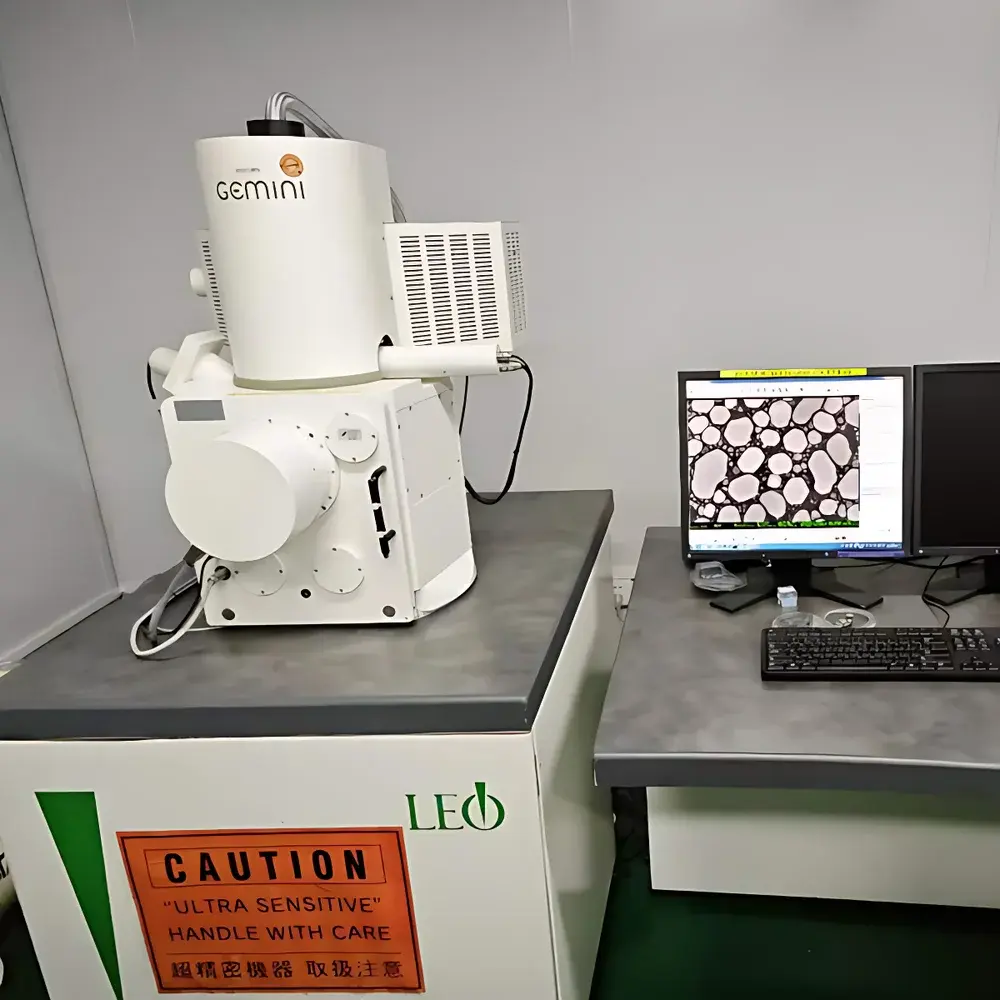
ZEISS SUPRA 1540 Field Emission Scanning Electron Microscope (Used) with Integrated EDS Detector
| Brand | ZEISS |
|---|---|
| Origin | Germany |
| Manufacturer Type | Authorized Distributor |
| Origin Category | Imported Instrument |
| Model | SUPRA 1540 |
| Operational Age | 10 Years |
| Resolution | 2 nm @ 15 kV, 3 nm @ 1 kV |
| Magnification Range | 12× to 2,000,000× |
| Accelerating Voltage | 20 V – 30 kV (continuously adjustable) |
| Probe Current | 5 pA – 20 nA (optional extended range: 12 pA – 100 nA) |
| Chamber Dimensions | Ø330 mm × 270 mm (H) |
| Stage Motion | 5-axis motorized eucentric stage (X = 130 mm, Y = 130 mm, Z = 50 mm, Tilt = –3° to +70°, Rotation = 360° continuous) |
| Control System | SmartSEM software suite on Windows 7 platform, compatible with mouse, keyboard, and dedicated hardware control panel |
Overview
The ZEISS SUPRA 1540 is a high-performance field emission scanning electron microscope (FE-SEM) originally engineered for nanoscale imaging, microstructural analysis, and compositional characterization in academic research laboratories, materials science centers, and industrial quality control environments. This pre-owned instrument retains the core architecture of ZEISS’s third-generation SUPRA platform—featuring a cold field emission gun (CFEG), in-lens detection optics, and a differential pumping system enabling stable high-resolution imaging across a wide voltage range (20 V–30 kV). Its operational design emphasizes signal-to-noise ratio optimization at low accelerating voltages, making it especially suitable for beam-sensitive specimens—including polymers, biological coatings, and uncoated insulators—without compromising topographic fidelity. The integrated energy-dispersive X-ray spectroscopy (EDS) detector enables simultaneous morphological and elemental analysis, supporting semi-quantitative composition mapping with spatial resolution aligned to the SEM’s probe size.
Key Features
- Cold field emission source delivering high brightness and long-term beam stability, essential for high-magnification imaging and analytical reproducibility.
- In-lens secondary electron detector (SED) combined with through-the-lens (TTL) detection geometry for enhanced surface detail at low kV and improved signal collection efficiency.
- Motorized 5-axis eucentric stage with full programmability—enabling automated multi-location imaging, tilt-series acquisition, and precise repositioning for correlative workflows.
- Differential vacuum system with dual turbomolecular pumps ensures rapid sample exchange while maintaining ultra-high vacuum (<1×10⁻⁷ mbar) in the column during operation.
- SmartSEM software platform (Windows 7-based) provides intuitive user interface for acquisition, real-time image processing, measurement annotation, and report generation—all compliant with GLP documentation requirements.
- Full compatibility with standard ZEISS EDS hardware modules (e.g., Oxford X-MaxN or EDAX Octane Elite), including live spectrum acquisition, point-and-click mapping, and standardless quantification routines.
Sample Compatibility & Compliance
The SUPRA 1540 accommodates a broad range of solid-state samples up to Ø100 mm in diameter and 50 mm in height. Its large chamber volume (Ø330 mm × 270 mm H) allows integration of specialized holders—including heating/cooling stages, tensile testers, and in-situ gas cells—subject to mechanical and electrical interface verification. All instruments undergo functional validation prior to resale, including vacuum integrity testing, beam alignment verification, resolution benchmarking per ISO 16700 (using Au/Pd resolution test standard), and EDS spectral calibration using certified reference materials (e.g., NIST SRM 2100). Documentation includes as-delivered performance reports traceable to internal metrology protocols aligned with ISO/IEC 17025 principles.
Software & Data Management
SmartSEM v6.x provides comprehensive control over imaging parameters, stage navigation, and analytical routines. Data files are stored in native .tif/.dat formats with embedded metadata (accelerating voltage, working distance, dwell time, detector configuration), ensuring auditability and traceability. Export options include TIFF, BMP, JPEG, and CSV (for EDS spectra and maps). The software supports batch acquisition scripting, region-of-interest (ROI) based auto-focus, and drift compensation algorithms. For regulated environments, optional audit trail logging and electronic signature modules can be configured to meet FDA 21 CFR Part 11 requirements when deployed on validated IT infrastructure.
Applications
- Failure analysis of microelectronic packages and solder joints via high-resolution cross-sectional imaging and phase identification.
- Particle size distribution and morphology assessment in pharmaceutical excipients and inhalation formulations (aligned with USP <1207> guidance).
- Corrosion product characterization on metallic alloys using backscattered electron (BSE) contrast and EDS line scans.
- Nanoparticle dispersion analysis in composite matrices, including carbon nanotube and graphene-reinforced polymers.
- Geological thin-section evaluation for mineral phase discrimination and textural classification (ASTM D5777).
- Biomedical scaffold porosity and strut thickness quantification under low-kV conditions to minimize charging artifacts.
FAQ
Is this instrument covered by ZEISS factory warranty?
No—this is a pre-owned system sold “as-is, where-is” with full technical documentation and post-sale support available through authorized ZEISS service partners.
Can the system be upgraded to newer SmartSEM versions or Windows 10/11?
Yes—hardware-compatible SmartSEM v7.x upgrades are available; migration to modern OS requires validation per ICH Q5A and may involve controller firmware updates.
What maintenance history is provided?
A complete log of filament replacements, pump oil changes, and calibration events (where recorded by prior owner) is supplied; full preventive maintenance is recommended upon installation.
Does the EDS detector include quantitative analysis software?
Standard package includes qualitative spectrum identification and elemental mapping; full quantification (ZAF/φρz correction) requires optional license and standards-based calibration.
Is installation and commissioning included?
Basic site survey and mechanical/electrical interface verification are included; full commissioning—including resolution verification and EDS calibration—requires separate service engagement.