
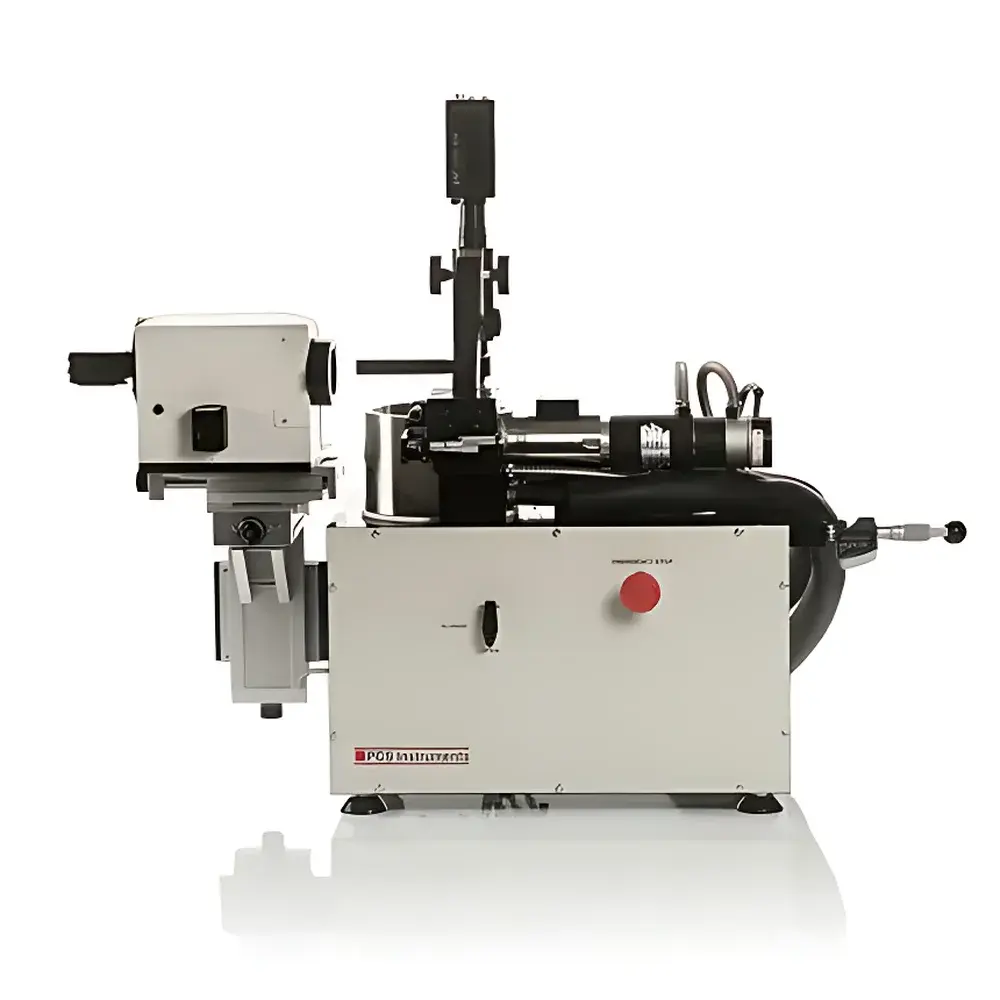
PCS EHD2 Ultra-Thin Oil Film Thickness & Traction Coefficient Analyzer
| Brand | PCS Instruments |
|---|---|
| Origin | United Kingdom |
| Manufacturer Status | Authorized Distributor |
| Origin Category | Imported |
| Model | EHD2 |
| Pricing | Upon Request |
| Product Type | Laboratory Instrument |
| Test Parameters | Oil Film Thickness (1–1000 nm), Traction Coefficient (Friction Coefficient) |
| Load Range | 0–50 N |
| Contact Pressure Range | 0–0.7 GPa (Steel Ball–Glass Disk) / 0–3 GPa (WC Ball–Sapphire Disk) |
| Sliding/Rolling Ratio | 0–100% |
| Linear Speed | 0–4 m/s |
| Temperature Range | Ambient to 150 °C |
| Sample Volume | 120 mL |
Overview
The PCS EHD2 Ultra-Thin Oil Film Thickness & Traction Coefficient Analyzer is a precision laboratory instrument engineered for quantitative characterization of elastohydrodynamic (EHD) lubrication behavior under controlled tribological conditions. Developed in collaboration with Imperial College London and commercialized by PCS Instruments (UK), the EHD2 implements white-light interferometry to resolve oil film thicknesses in the nanoscale regime—specifically from 1 nm to 1000 nm—with sub-nanometer repeatability. It operates on the principle of optical interference between reflected beams from the solid–lubricant and lubricant–counterface interfaces, enabling non-invasive, real-time measurement of film formation dynamics during sliding, rolling, or mixed-motion regimes. Simultaneously, the system integrates high-fidelity torque and normal load transducers to compute traction coefficient (μ = tangential force / normal force) across a continuously variable sliding-to-rolling ratio (0–100%). This dual-parameter capability makes the EHD2 indispensable for fundamental research and formulation development in advanced lubricant engineering, particularly for gear oils, engine oils, hydraulic fluids, and next-generation low-viscosity synthetic blends.
Key Features
- White-light interferometric optics calibrated for nanoscale film thickness resolution (1–1000 nm) with <1 nm RMS repeatability
- Modular tribological contact configuration supporting steel ball–glass disk (up to 0.7 GPa) and WC ball–sapphire disk (up to 3 GPa) geometries
- Programmable linear velocity control (0–4 m/s) with closed-loop feedback for stable shear rate application
- Integrated temperature-controlled stage (ambient to 150 °C) with PID regulation and ±0.5 °C stability
- Full sliding/rolling ratio sweep capability (0–100%) with independent control of entrainment and spin velocities
- High-precision load actuation (0–50 N) and torque sensing (<0.01 N·m resolution) for traction coefficient derivation
- Compact benchtop design optimized for integration into ISO 17025-accredited laboratories and university tribology facilities
Sample Compatibility & Compliance
The EHD2 accommodates standard lubricant samples requiring only 120 mL per test—compatible with mineral oils, PAOs, esters, bio-based lubricants, and nanoparticle-enhanced formulations. Its optical path and contact geometry comply with ASTM D5001 (Standard Test Method for Apparent Viscosity of Used Engine Oils at High Shear Rate and High Temperature) and ISO 12156-1 (Lubricants—Determination of the Frictional Properties of Lubricating Oils Using a High-Frequency Reciprocating Rig). Data acquisition meets GLP and GMP documentation requirements, with optional 21 CFR Part 11-compliant software modules available for regulated environments. All mechanical and thermal subsystems conform to CE and UKCA directives for laboratory instrumentation safety and electromagnetic compatibility.
Software & Data Management
The EHD2 is operated via PCS’s proprietary EHD Control Suite—a Windows-based application delivering synchronized acquisition of film thickness, traction coefficient, temperature, load, and velocity data at up to 1 kHz sampling rate. The software supports automated test sequences (e.g., speed ramps, pressure sweeps, temperature step tests), real-time interferogram visualization, and export of raw interferometric phase data for third-party spectral analysis. Calibration files are digitally signed and version-controlled; audit trails record user actions, parameter changes, and calibration events in accordance with ISO/IEC 17025:2017 clause 7.7. Data output formats include CSV, HDF5, and MATLAB-compatible .mat files—enabling direct integration with MATLAB, Python (NumPy/Pandas), or commercial rheology modeling platforms such as COMSOL Multiphysics®.
Applications
- Quantification of film-forming efficacy of anti-wear (AW) and extreme-pressure (EP) additives under transient EHD conditions
- Correlation of traction coefficient trends with molecular architecture (e.g., branching density, polar group distribution)
- Validation of numerical EHL models (e.g., Grubin, Hamrock–Dowson, full-film numerical solvers) against experimental film thickness profiles
- Screening of biodegradable lubricants for railway traction applications where low μ and robust film persistence are critical
- Supporting OEM qualification protocols for electric vehicle (EV) gearbox lubricants operating at elevated temperatures and low viscosity
- Academic research in boundary/EHD transition regimes, including starvation effects and thermal–viscoelastic coupling
FAQ
What is the minimum measurable oil film thickness?
The EHD2 achieves reliable detection down to 1 nm under optimal optical alignment and low-noise environmental conditions.
Can the instrument operate under vacuum or inert gas environments?
Yes—the sample chamber is compatible with sealed glovebox integration or custom vacuum enclosures (down to 10⁻² mbar) upon request.
Is calibration traceable to national standards?
All optical and mechanical calibrations are traceable to NPL (UK) and PTB (Germany) reference standards, with full calibration certificates provided.
Does the system support custom contact geometries beyond standard ball-on-disk?
Custom fixtures—including line contact (roller-on-flat) and elliptical contact configurations—are available as OEM options.
How is data integrity ensured during long-duration tests (e.g., >24 h)?
The firmware implements cyclic memory buffering, automatic file segmentation, and checksum validation to prevent data corruption during extended acquisitions.






