
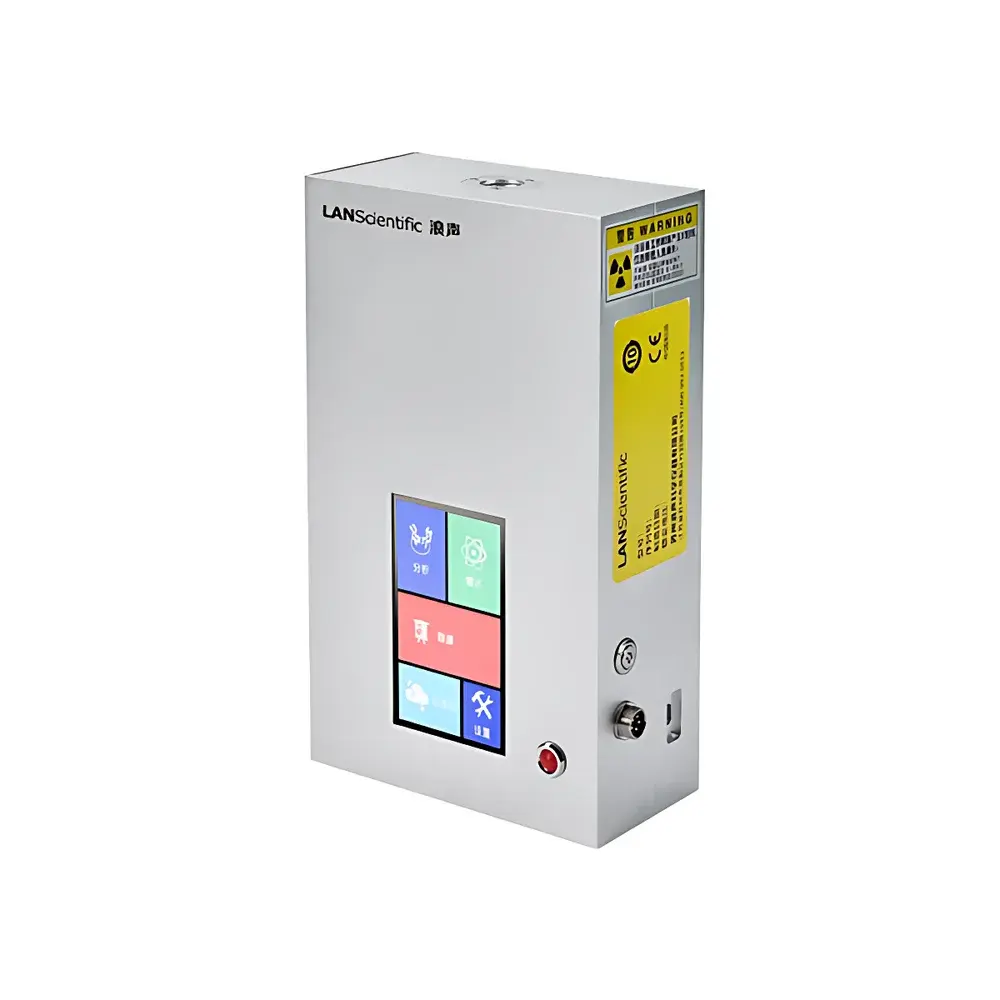
SpeBOX-1 Energy Dispersive X-Ray Fluorescence Spectrometer by LANScientific
| Brand | LANScientific |
|---|---|
| Origin | Jiangsu, China |
| Manufacturer Type | Manufacturer |
| Regional Classification | Domestic |
| Model | SpeBOX-1 |
| Form Factor | Benchtop/Floor-standing |
| Instrument Type | Conventional EDXRF |
| Application Scope | Universal |
| Elemental Range | Mg (12) to U (92) |
| Detection Limit | ppm-level |
Overview
The SpeBOX-1 Energy Dispersive X-Ray Fluorescence (EDXRF) Spectrometer is a compact, high-stability benchtop/floor-standing elemental analyzer engineered for rapid, non-destructive qualitative and quantitative analysis of solid, powder, and irregularly shaped samples. Based on the fundamental principle of X-ray fluorescence—where primary X-rays excite atoms in the sample, causing emission of characteristic secondary (fluorescent) X-rays—the SpeBOX-1 enables precise identification and concentration determination of elements from magnesium (atomic number 12) to uranium (92). Its integrated detector architecture, optimized X-ray tube optics, and real-time spectral processing deliver consistent ppm-level detection limits across diverse matrices without sample digestion or vacuum requirements. Designed for industrial environments demanding reliability under continuous operation, the system meets mechanical and thermal stability criteria essential for long-term reproducibility in QC/QA, recycling, and resource evaluation workflows.
Key Features
- Non-destructive, direct analysis of solids, powders, and coated materials with minimal or no sample preparation
- Dual-form factor design: configurable as benchtop unit for lab-based screening or floor-standing configuration for integration into production lines
- Optimized Rh-anode X-ray tube with adjustable voltage/current settings to balance excitation efficiency and spectral resolution
- Silicon drift detector (SDD) with Peltier cooling, delivering high count-rate capability and energy resolution <145 eV at Mn Kα
- Automated collimation and filter selection to enhance signal-to-background ratio for light- and heavy-element analysis
- Robust mechanical housing with radiation shielding compliant with IEC 61000-6-3 and IEC 61000-6-4 electromagnetic compatibility standards
- Integrated safety interlocks, beam shutter control, and real-time dose monitoring per IEC 61010-1 requirements
Sample Compatibility & Compliance
The SpeBOX-1 accommodates heterogeneous samples up to 300 mm × 300 mm × 100 mm (L×W×H), including scrap metal fragments, soil cores, ore pellets, consumer electronics components, and polymer-coated substrates. Sample positioning is facilitated via motorized XYZ stage (optional) or manual stage with calibrated alignment markers. The instrument supports ASTM E1621–22 (Standard Guide for XRF Analysis of Waste Materials), ISO 22081:2021 (Soil quality — Determination of elemental composition by EDXRF), and RoHS Directive 2011/65/EU Annex II compliance testing. Data acquisition and reporting adhere to GLP/GMP-aligned audit trails, with optional 21 CFR Part 11-compliant software modules available for regulated laboratories.
Software & Data Management
Control and analysis are performed using LANScientific’s proprietary SpectraSuite™ v4.x software, featuring intuitive workflow-driven interface, multi-layered calibration management (empirical, fundamental parameters, and standardless modes), and customizable method templates. Quantitative results are traceable to NIST SRM reference materials (e.g., SRM 2710a, 2783). Reports export directly to PDF and Excel formats with embedded metadata—including measurement date/time, operator ID, instrument serial number, and full spectral snapshots. Batch processing supports up to 999 samples per session; data files are stored in vendor-neutral .spc and .csv formats. Optional API integration enables bidirectional communication with LIMS, MES, and PLC systems for automated pass/fail decision routing to sorting actuators or conveyor controls.
Applications
- Recycling & Scrap Sorting: Real-time alloy identification (e.g., Al-, Cu-, Fe-, Zn-based), Pb/Cd/Hg/Cr6+/Br screening in WEEE streams, and purity verification of recovered plastics
- Mining & Exploration: In-field grade control of ores (Cu, Ni, Zn, Au-associated elements), geochemical mapping of drill core chips, and tailings characterization
- Environmental Monitoring: Soil and sediment screening for As, Cd, Cr, Cu, Hg, Ni, Pb, Zn per EPA Method 6200 and China GB 15618–2018
- Consumer Goods Compliance: RoHS, POPs, and CPSIA-constrained substance verification in toys, packaging, and electrical housings
- Manufacturing QA: Coating thickness and composition validation (e.g., Zn/Ni plating, Sn-Pb solder), incoming raw material verification, and batch homogeneity assessment
FAQ
Does the SpeBOX-1 require helium purge or vacuum for light-element analysis?
No. The instrument performs reliable Mg–Al–Si analysis in air mode; optional He flush accessory is available for enhanced Na–F sensitivity in specialized applications.
Can it be integrated with robotic arms or conveyor-based sorting systems?
Yes. Digital I/O ports (RS-232, Ethernet TCP/IP, opto-isolated TTL) support hardware triggering, pass/fail signal output, and synchronization with PLCs, vision systems, and pneumatic diverters.
What calibration standards are recommended for routine use?
Certified reference materials matching sample matrix (e.g., BCR-482 for soils, NIST 1275 for electronics, JIS F0801 for alloys) are advised. Factory-installed FP libraries serve as starting point for standardless screening.
Is remote diagnostics and firmware updates supported?
Yes. Secure SSH-enabled remote access allows authorized service engineers to perform health checks, log analysis, and over-the-air firmware upgrades without onsite visits.
Related Products





