
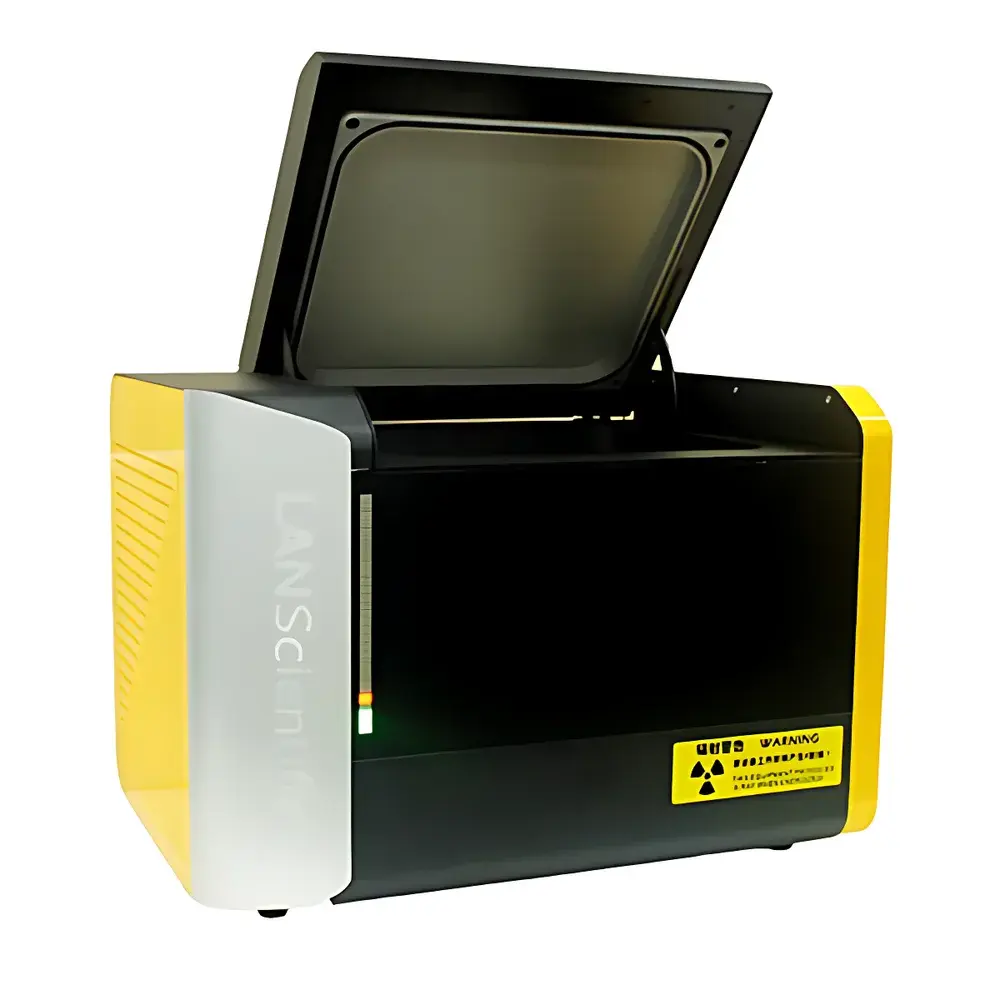
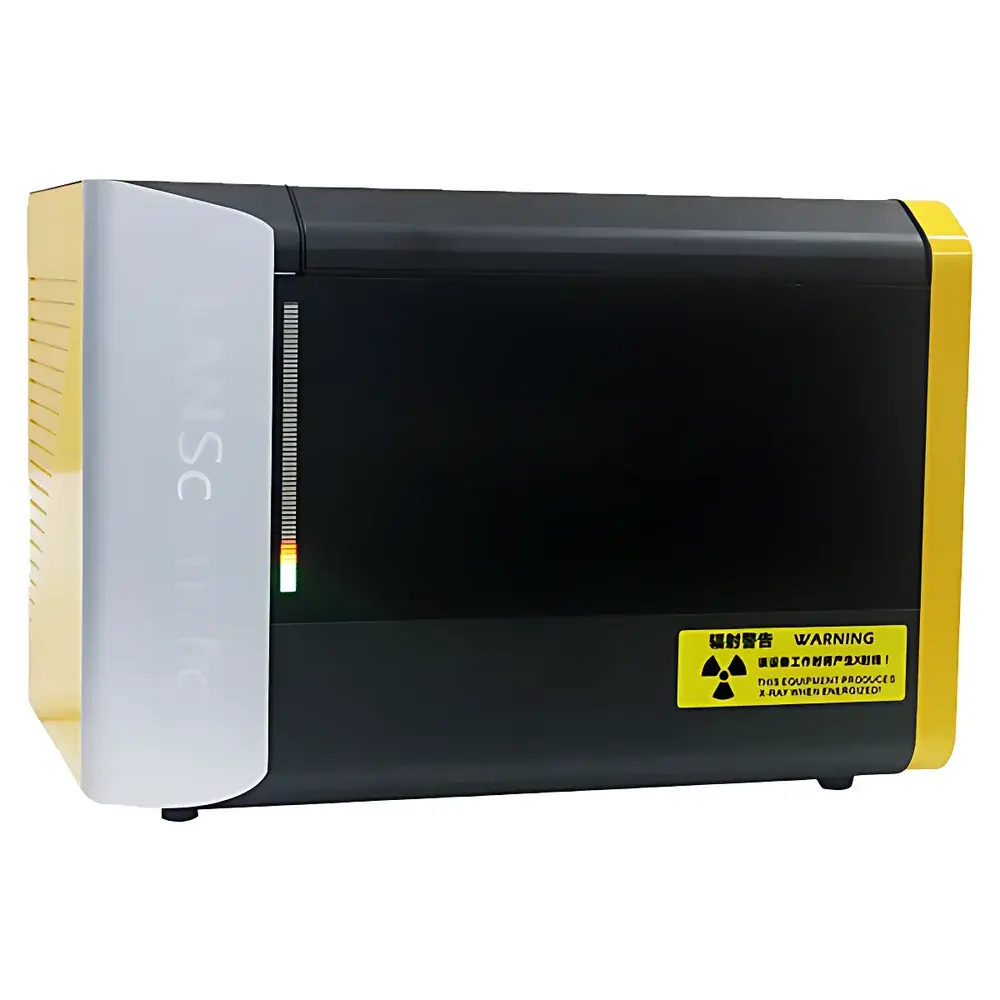
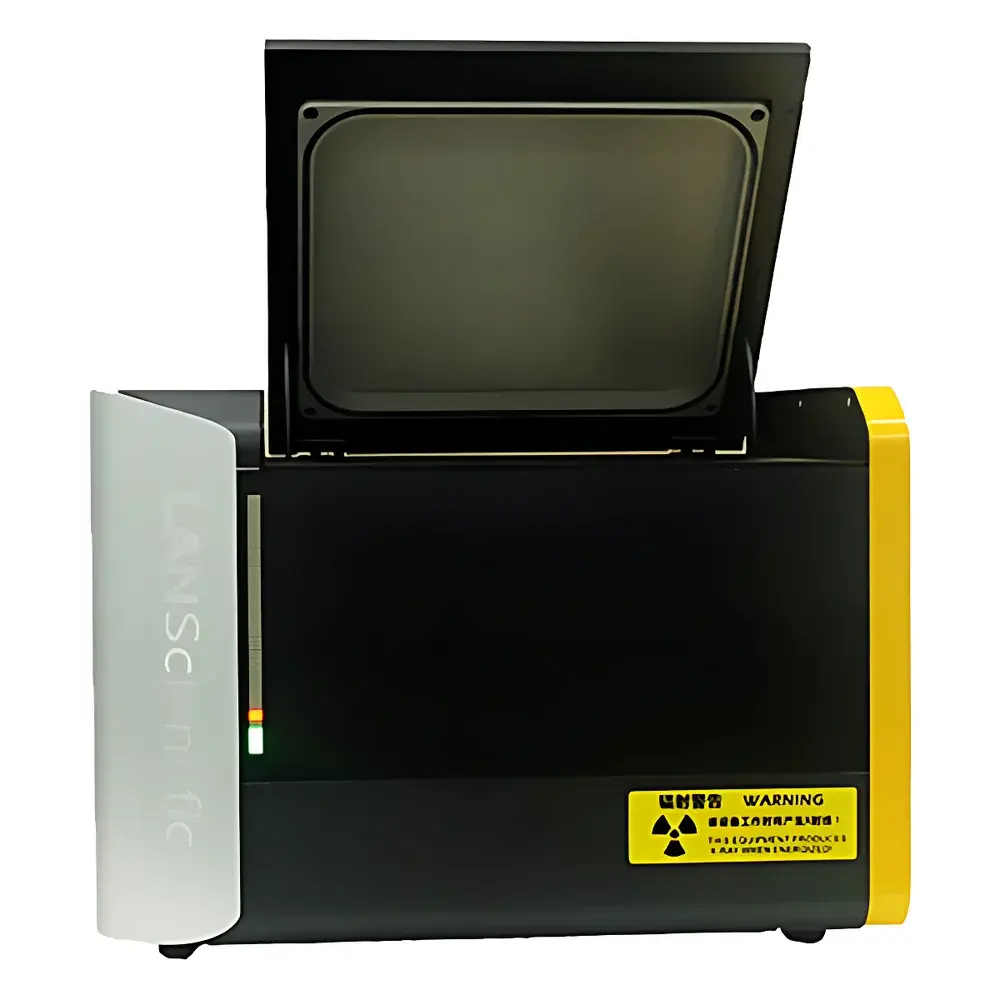
LANScientific ScopeX Desktop Energy Dispersive X-Ray Fluorescence Spectrometer
| Brand | LANScientific |
|---|---|
| Origin | Jiangsu, China |
| Manufacturer Type | Manufacturer |
| Origin Category | Domestic |
| Model | ScopeX Industrial Silicon Analyzer |
| Form Factor | Benchtop |
| Instrument Type | Conventional ED-XRF |
| Application Scope | General-Purpose |
| Elemental Range | Na (11) to U (92) |
| Detection Limit | 1 ppm |
| Energy Resolution | <125 eV (Mn Kα) |
| Repeatability | ≤0.1% RSD |
| Detector | Peltier-cooled Silicon Drift Detector (SDD) |
Overview
The LANScientific ScopeX Desktop Energy Dispersive X-Ray Fluorescence (ED-XRF) Spectrometer is an engineered solution for rapid, non-destructive elemental analysis of industrial silicon and related materials. Based on fundamental X-ray fluorescence physics, the instrument irradiates solid, liquid, or thin-film samples with a high-stability X-ray tube, inducing characteristic secondary X-ray emission from atoms in the sample. These emitted photons—each with energy uniquely corresponding to a specific element’s electronic transition—are resolved by a high-resolution silicon drift detector (SDD). The resulting spectrum enables quantitative and qualitative determination of elemental composition from sodium (Na) to uranium (U), independent of chemical bonding state. Designed for routine industrial use, the ScopeX integrates optimized excitation geometry, intelligent vacuum control, and robust mechanical architecture to deliver consistent analytical performance across diverse production and quality assurance environments.
Key Features
- Non-destructive analysis: No sample digestion, coating, or physical alteration required; preserves sample integrity for downstream testing or archival.
- Peltier-cooled SDD detector: Eliminates reliance on liquid nitrogen while maintaining <125 eV energy resolution at Mn Kα, ensuring precise peak separation for overlapping light-element lines (e.g., Si Kα, P Kα, S Kα).
- Intelligent vacuum system: Automatically engages during light-element analysis (Na–Cl), enabling reliable detection down to 1 ppm for critical impurities in metallurgical-grade silicon, solar-grade silicon, and ferrosilicon alloys.
- Motorized multi-aperture collimation: Four selectable collimators (5 mm, 3 mm, 1 mm, and 0.5 mm) and programmable filter set are controlled via software, allowing real-time optimization of sensitivity, spatial resolution, and background suppression per application.
- Benchtop ergonomics: Compact footprint with enlarged sample chamber accommodates irregular geometries—including wafers, ingots, granules, powders in cups, and coated substrates—without repositioning or custom fixtures.
- Radiation safety compliance: Fully shielded steel enclosure with interlocked door mechanism and hardware-based beam cutoff satisfies GB18871-2002 (Basic Standards for Radiation Protection) and GBZ115-2002 (X-Ray Fluorescence Analyzers Safety Requirements).
Sample Compatibility & Compliance
The ScopeX supports heterogeneous sample types without matrix-specific calibration: bulk solids (metals, ceramics, ores), pressed pellets, loose powders, liquids (oil, electrolytes), thin films (electroplated layers, PV coatings), and fused beads. It meets essential regulatory expectations for industrial QA/QC workflows, including alignment with ISO 17025 documentation practices and compatibility with GLP/GMP audit trails when paired with optional secure user authentication and electronic signature modules. While not pre-certified for FDA 21 CFR Part 11, its data export structure (CSV, PDF, spectral XML) and full audit log capability enable validation under internal quality systems for regulated manufacturing sectors such as semiconductor feedstock supply and photovoltaic material certification.
Software & Data Management
The proprietary ScopeX Analysis Suite provides intuitive method setup, spectrum acquisition, peak deconvolution (using fundamental parameters and empirical calibrations), and quantification reporting. Users define custom report templates in Excel or PDF format—embedding company logos, measurement metadata, spectral overlays, and pass/fail flags against specification limits. Data transfer options include USB 3.0, Wi-Fi (IEEE 802.11ac), and Bluetooth 5.0, facilitating integration into factory MES or LIMS platforms. All raw spectra, processing parameters, and operator logs are timestamped and stored locally with optional network backup; no cloud dependency ensures data sovereignty and IT policy adherence.
Applications
- Industrial silicon purity verification: Quantification of trace metallic contaminants (Fe, Al, Ca, Ti) and light-element residuals (B, P, C) in silicon metal used for aluminum alloying or polysilicon precursor production.
- Process control in metallurgy: Real-time batch screening of ferrosilicon, silicomanganese, and calcium silicide for compositional consistency prior to furnace charging.
- Coating thickness & composition: Simultaneous measurement of plating layer mass per unit area (e.g., Ni/Cu/Sn on PCBs) and substrate alloy composition.
- Cement and mineral raw material analysis: Rapid assessment of SiO₂, Al₂O₃, Fe₂O₃, CaO, MgO, SO₃, and alkali content in clinker and limestone blends.
- Recycled material sorting: Identification and grading of silicon-containing scrap (e.g., end-of-life PV panels, electronic waste) based on elemental fingerprint.
FAQ
Does the ScopeX require liquid nitrogen cooling?
No. It employs thermoelectric (Peltier) cooling for the SDD detector, eliminating cryogenic handling, refills, and associated downtime.
Can it analyze sodium in glass or ceramic matrices?
Yes—when operated under vacuum mode with appropriate calibration standards and excitation conditions, detection of Na at sub-100 ppm levels is achievable.
Is method transfer possible between different ScopeX units?
Yes. Calibration files, spectral libraries, and acquisition protocols are fully portable across instruments of the same model generation, supporting multi-site harmonization.
What sample preparation is required for silicon metal ingots?
Minimal: Surface cleaning followed by flat polishing (optional) is sufficient. No dissolution or bead fusion is needed for bulk analysis.
How is data integrity ensured during long-term operation?
Instrument firmware logs all operational events—including tube voltage/current, detector temperature, vacuum status, and user actions—with SHA-256 checksums applied to exported reports.
Related Products





