
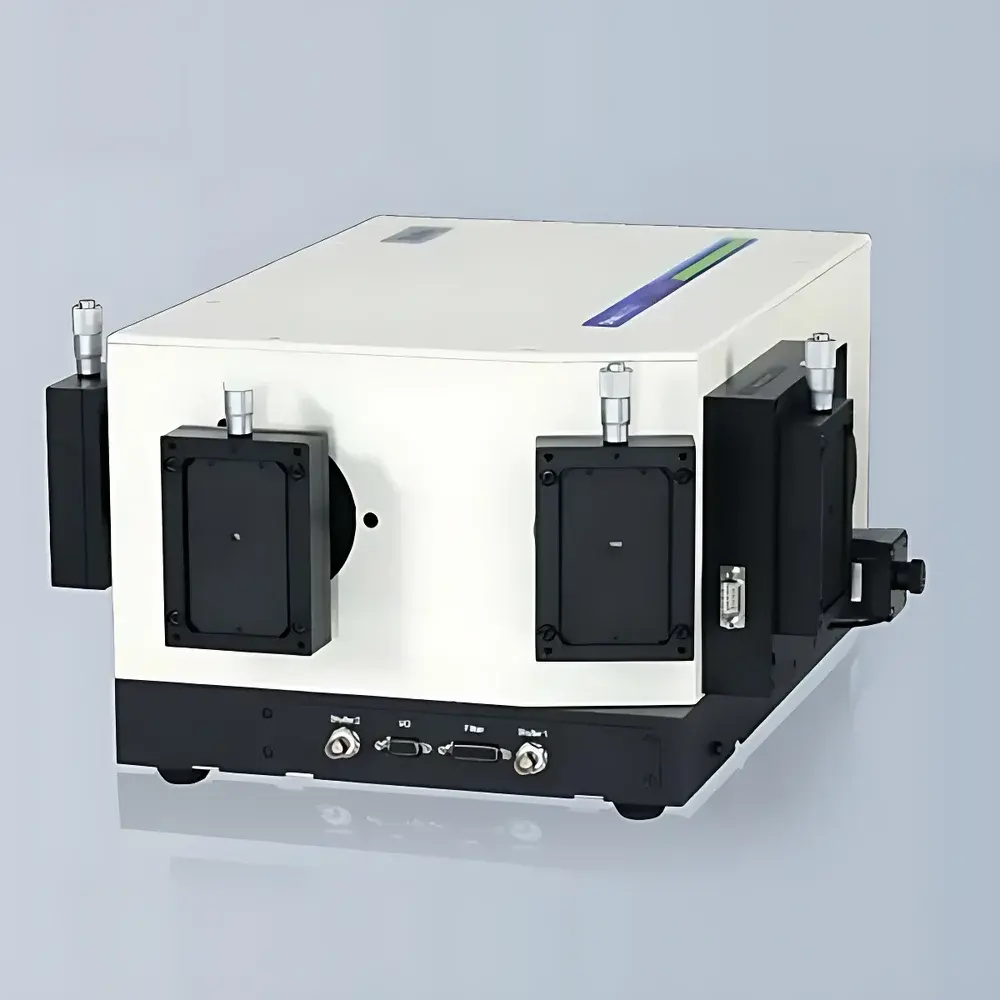
ZOLIX Omni-λ300i Imaging-Corrected Czerny-Turner Grating Spectrometer Monochromator
| Brand | ZOLIX |
|---|---|
| Origin | Beijing, China |
| Manufacturer Type | Original Equipment Manufacturer (OEM) |
| Model | Omni-λ300i |
| Application System | Universal |
| Grating Capacity | Triple-Grating Turret |
| Focal Length | 320 mm |
| Optical Design | Czerny-Turner with Toroidal Imaging Correction |
| Stray Light Rejection | 1×10⁻⁵ |
| Grating Size | 68×68 mm (or 68×84 mm optional) |
| Entrance/Exit Options | Side or Dual Input/Output Configurable |
| Slit | Manual (0.01–3 mm width, 2/4/14 mm height), Motorized Slit Optional |
| Detector Interface | Dual CCD Output Standard |
| Control Interface | USB 2.0 (RS-232 Optional) |
| Wavelength Accuracy | ±0.1–±3.2 nm (dependent on grating) |
| Wavelength Reproducibility | 0.015–0.8 nm |
| Spectral Resolution (PMT) | 0.04–1.28 nm |
| Spectral Resolution (15 µm-pixel CCD) | 0.069–3.05 nm |
| Linear Dispersion (@435.83 nm) | 0.91–40.43 nm/mm |
| Scan Range | 0–19,200 nm (grating-dependent) |
| Scan Step | 0.0025–0.08 nm |
| F/# | f/4.2 |
| Image Plane Dimensions | 30 mm (W) × 14 mm (H) |
| Optical Axis Height | 146 mm |
| Dimensions | 420 × 295 × 232 mm |
| Weight | 16 kg |
| Max Power Consumption | 100 W @ 24 V DC |
Overview
The ZOLIX Omni-λ300i is an imaging-corrected, triple-grating Czerny-Turner spectrometer monochromator engineered for high-fidelity spectral acquisition across the ultraviolet (UV), visible (VIS), and near-to-mid infrared (NIR/MIR) ranges (190 nm – 16 µm). Its optical architecture integrates toroidal mirror-based aberration correction to minimize astigmatism and coma at the focal plane—critical for maintaining spatial integrity when coupling to array detectors such as scientific-grade CCDs or CMOS sensors. Unlike conventional monochromators, the Omni-λ300i delivers diffraction-limited image quality across its entire 30 mm wide × 14 mm high focal plane, enabling simultaneous multi-channel detection without spectral distortion or pixel misregistration. The instrument operates on a robust mechanical platform with precision-ground kinematic mounts, ensuring long-term alignment stability under thermal and mechanical stress typical in laboratory and industrial environments.
Key Features
- Triple-grating turret with motorized selection, supporting rapid, software-controlled switching between gratings optimized for UV, VIS, NIR, or MIR bands.
- Large-format 68 × 68 mm (or 68 × 84 mm) ruled or holographic gratings—maximizing light throughput and signal-to-noise ratio, especially in low-flux applications such as Raman or fluorescence spectroscopy.
- Gold-coated optics option (Omni-λ3015i/3017i variants) for enhanced reflectivity (>95%) beyond 1 µm, critical for FTIR-compatible configurations and quantum cascade laser (QCL) characterization.
- Dual-output configuration standard: one port for CCD array detection, another for PMT or fiber-coupled single-point detectors—enabling real-time reference monitoring or synchronous multi-modal acquisition.
- Side-entry port compatible with electronic shutters (e.g., Uniblitz VS series), facilitating time-resolved measurements including pump-probe and lifetime decay analysis.
- DSP-based motion control system with sub-nanometer wavelength step resolution (down to 0.0025 nm), integrated with USB 2.0 interface for deterministic latency and high-speed data streaming—eliminating legacy RS-232 bottlenecks.
- Modular mechanical design accommodating custom entrance optics, filter wheels, polarization rotators, and motorized slit assemblies—fully compliant with ISO 17025-aligned calibration workflows.
Sample Compatibility & Compliance
The Omni-λ300i supports diverse sample interfaces—including free-space beam paths, fiber-optic couplings (SMA905, FC/PC), and vacuum-compatible flanges (CF35, KF40)—making it suitable for ambient, purged, or evacuated measurement environments. Its optical train meets ISO 10110 surface quality standards for all reflective components, and gold-coated variants conform to ASTM E131-22 definitions for infrared reflectance instrumentation. When integrated into regulated analytical systems (e.g., pharmaceutical QC labs), the instrument’s deterministic USB control architecture supports audit-trail-capable software integration per FDA 21 CFR Part 11 requirements—provided the host application implements electronic signatures, user access controls, and immutable data logging. Mechanical repeatability (±0.015 nm minimum) and traceable wavelength calibration (using Hg/Ne/Ar emission lines) support GLP/GMP validation protocols.
Software & Data Management
ZOLIX provides SDKs for Windows (C++, C#, LabVIEW, Python) and Linux (C/C++) enabling full programmatic control of grating selection, slit positioning, wavelength scanning, and detector synchronization. The included SpectraMaster™ software offers real-time spectrum visualization, multi-curve overlay, peak integration (Gaussian/Lorentzian fitting), and batch processing with CSV/HDF5 export. All wavelength commands are timestamped and logged with encoder feedback—ensuring metrological traceability. For enterprise deployment, the spectrometer supports OPC UA server integration via third-party middleware, allowing centralized orchestration within SCADA or LIMS environments. Firmware updates preserve backward compatibility and include built-in self-diagnostic routines for grating homing accuracy, slit calibration drift, and motor current profiling.
Applications
The Omni-λ300i serves as the spectral core in configurable systems for photoluminescence quantum yield (PLQY) measurement (per CIE 127:2019), micro-Raman mapping (532/785 nm excitation), tunable laser linewidth characterization, synchrotron beamline monochromation, LED/CVLED spectral radiance profiling (per CIE S 025/E:2015), and gas-phase absorption spectroscopy (e.g., NH₃, CH₄, CO₂ in environmental monitoring). Its dual-output capability enables concurrent broadband acquisition and narrowband monitoring—for instance, capturing full Raman fingerprints while tracking a specific phonon mode intensity in real time. In materials science, the instrument couples with variable-temperature stages and magnetic fields for magneto-optical Kerr effect (MOKE) studies, where imaging fidelity ensures accurate polarization-resolved line shape analysis.
FAQ
What wavelength calibration standards are supported?
The Omni-λ300i is factory-calibrated using NIST-traceable Hg, Ne, and Ar emission lamps. Users may perform field recalibration using any known line source; calibration coefficients are stored per grating in non-volatile memory.
Can the instrument operate under vacuum or inert gas purge?
Yes—standard housing includes CF35 and KF40 ports for vacuum (<10⁻⁴ mbar) or nitrogen purge. Optional quartz or CaF₂ windows extend transmission to 180 nm or 120 nm respectively.
Is motorized slit control available as a retrofit?
Yes—motorized slits (0.01–3 mm, 1 µm step resolution) are field-upgradable and fully integrated into SpectraMaster™ and SDK APIs.
How is stray light performance verified?
Stray light ratio (1×10⁻⁵) is measured per ISO/DIS 14809:2023 Annex B using a double-monochromator reference method with 546.1 nm excitation and deep-notch filtering.
Are OEM integration services available?
ZOLIX provides mechanical CAD models (STEP/IGES), electrical schematics, and firmware documentation under NDA for turnkey system integrators building OEM spectrometers, ellipsometers, or hyperspectral imagers.
Related Products





