
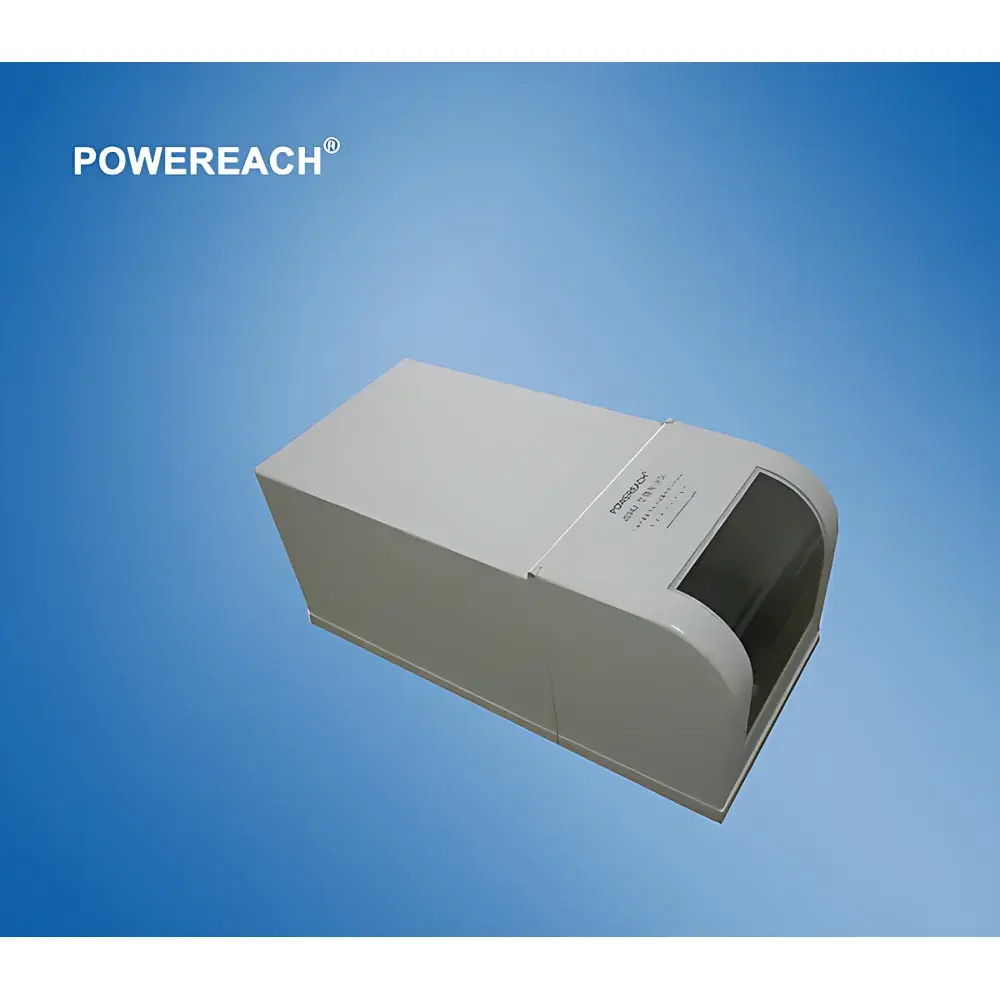
POWEREACH JS94H2-3H10X Microelectrophoresis Zeta Potential Analyzer
| Brand | POWEREACH |
|---|---|
| Origin | Shanghai, China |
| Model | JS94H2-3H10X |
| Zeta Potential Range | ±200 mV (typical, dependent on sample conductivity) |
| pH Range | 1.6–13.0 (optimal 2.0–12.0) |
| Operating Temperature | 20–35 °C |
| Temperature Resolution | 0.1 °C |
| Optical Resolution | 3 pixel/µm |
| Particle Size Range | 0.5–20 µm |
| Power Consumption | <150 W |
| Input Voltage | 220 V, 50 Hz |
| Compliance | GB/T 32668–2016 |
Overview
The POWEREACH JS94H2-3H10X Microelectrophoresis Zeta Potential Analyzer is a precision optical-electrophoretic instrument engineered for direct visualization and quantitative measurement of electrophoretic mobility in colloidal dispersions. It implements the microelectrophoresis method—defined in the Chinese National Standard GB/T 32668–2016, “General Rules for Zeta Potential Analysis of Colloidal Particles by Electrophoresis”—where charged particles are observed in real time under high-magnification microscopy while subjected to a precisely controlled, low-frequency alternating electric field. Unlike laser Doppler electrophoresis (LDE), this method provides direct spatial tracking of individual particles or droplets within an open-cell configuration, eliminating assumptions about scattering volume homogeneity and enabling unambiguous determination of zeta potential in heterogeneous, polydisperse, or low-conductivity systems—including emulsions, biological suspensions, and functionalized nanoparticles. The instrument’s core architecture integrates a semiconductor-based near-field optical illumination system (blue/green wavelength), a thermally stable open-cell electrophoresis chamber with integrated electrodes, and synchronized digital image acquisition at 1200× optical magnification.
Key Features
- Open-cell microelectrophoresis chamber with 0.5 mm-thick borosilicate glass walls and built-in Ag, Pt, and POM electrodes—designed via microfluidic field simulation to minimize edge effects and electro-osmotic flow;
- High-resolution optical path: 3 pixels per micrometer resolution, 7 mm working distance, and adjustable three-axis platform with calibrated crosshair (micrometer grid) for precise focal positioning and elimination of stationary layer artifacts;
- Low-power (<100 µW) semiconductor light source operating at short wavelengths (450–520 nm), minimizing thermal perturbation to the sample environment and enhancing contrast for sub-micron particle visibility;
- Programmable bipolar voltage supply with polarity reversal timing adjustable from 0.30 s to 1.20 s; enables suppression of electrode polarization and supports rapid data acquisition (3–10 s per measurement cycle);
- Integrated temperature probe with continuous ambient sampling; real-time thermal feedback automatically corrects electrophoretic mobility calculations per the Henry equation and Smoluchowski approximation;
- USB-connected digital CCD camera capturing grayscale sequences at user-defined frame rates; software performs centroid-based particle trajectory analysis across four consecutive bidirectional frames;
- Unified firmware and application suite compatible across the JS94 series—no retraining required when upgrading or switching between models.
Sample Compatibility & Compliance
The JS94H2-3H10X accommodates aqueous and organic dispersion media (e.g., ethanol, isopropanol, chloroform) within conductivity ranges typical of colloids, emulsions, and biological suspensions. It supports particles and droplets sized between 0.5 µm and 20 µm, including polymer latexes, silica, metal oxides, liposomes, and protein aggregates. Its operational pH range spans 1.6 to 13.0, validated per GB/T 32668–2016 Annex B for buffer compatibility and electrode stability. While not certified to ISO 13099 or ASTM D7827, its methodology aligns with the physical principles underlying those standards and has been adopted in academic and industrial labs for GLP-compliant formulation development. All measurements include timestamped metadata (temperature, pH, voltage, frame rate), supporting traceability requirements for internal quality documentation.
Software & Data Management
The proprietary Windows-based application provides full control over hardware parameters, real-time video preview, automated particle tracking, and batch-mode zeta potential calculation using the Helmholtz–Smoluchowski relation with optional Henry correction. Raw image sequences (TIFF/AVI), processed trajectories (CSV), and summary reports (PDF) are stored with embedded instrument configuration logs. Software enforces user-level access control, audit trail logging for parameter changes, and export-ready formatting for inclusion in regulatory submissions. Firmware updates are delivered free of charge for the instrument’s lifetime, and raw data formats remain backward-compatible across all JS94-series releases. No cloud dependency or third-party licensing is required—data remains fully resident on the included Dell workstation.
Applications
This instrument serves as a primary tool for surface charge characterization in R&D and QC environments across multiple sectors. In cosmetics and pharmaceuticals, it quantifies stabilization efficacy of surfactants and polymers in nanoemulsions and liposomal drug carriers. In mineral processing and papermaking, it evaluates flocculant adsorption and pulp fiber surface modification. In battery materials research, it monitors zeta potential shifts during cathode/anode slurry formulation and binder interactions. Academic users apply it to teach interfacial electrokinetics, isoelectric point determination, and surface reaction kinetics—particularly where particle heterogeneity or low signal-to-noise precludes LDE use. Its direct imaging capability also supports method validation studies comparing microelectrophoresis against dynamic light scattering (DLS)-based zeta potential instruments.
FAQ
What sample volume is required per measurement?
Each analysis uses only 0.5 mL of dispersion, minimizing reagent consumption and waste generation.
Is the instrument compatible with non-aqueous solvents?
Yes—validated for common organic media including ethanol, acetone, and toluene, provided conductivity remains within operational limits (typically 10−4–10−1 S/m).
Does the system support isoelectric point (IEP) determination?
Yes—automated pH titration mode allows sequential zeta potential measurements across a defined pH gradient, with IEP calculated as the pH at which mean zeta potential crosses zero.
What calibration standards are recommended?
NIST-traceable polystyrene latex standards (e.g., Duke Scientific 3000A series) are advised for velocity calibration; pH and temperature sensors are factory-calibrated and user-verifiable.
Can the instrument be integrated into a LIMS or ELN environment?
Raw data exports (CSV, TIFF, PDF) are structured for manual ingestion; API integration is not natively supported but can be enabled via custom scripting using documented file I/O protocols.



