
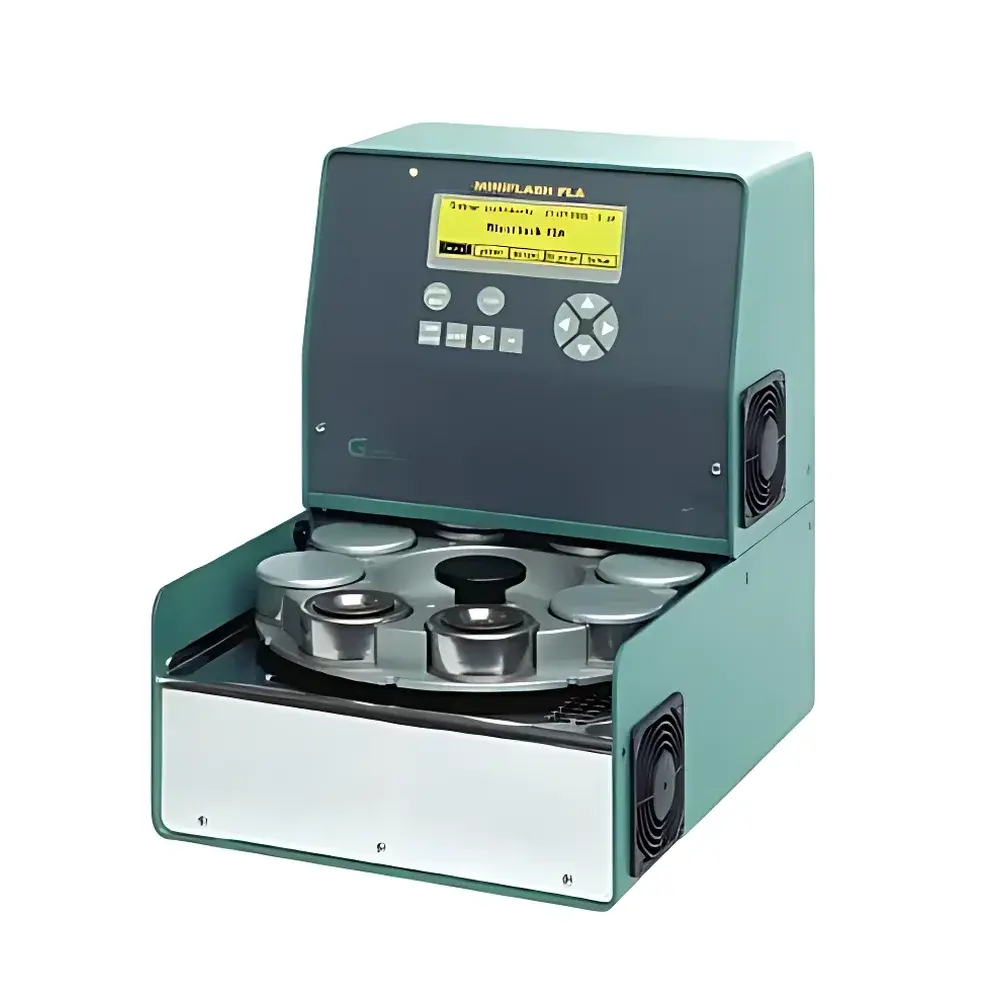
Grabner MiniFlash FLAH 8-Position Automatic Sample Handler for Flash Point Testing
| Brand | Grabner |
|---|---|
| Origin | Austria |
| Model | MiniFlash FLAH |
| Detection Method | Closed-Cup |
| Operation Mode | Fully Automatic |
| Compliant Standards | ASTM D6450 (SH/T 0768) & D7094 |
| Temperature Range | 10 to 400°C |
| Dimensions (W×H×D) | 312 × 402 × 390 mm |
| Weight | 20 kg |
Overview
The Grabner MiniFlash FLAH is an 8-position fully automatic sample handler engineered exclusively for integration with the MiniFlash series of closed-cup flash point analyzers. It operates on the principle of equilibrium closed-cup testing—where sample vapor concentration is allowed to equilibrate above the liquid phase at controlled, incrementally increasing temperatures until ignition occurs upon introduction of an electric arc. This thermodynamically rigorous methodology ensures high reproducibility and alignment with internationally recognized test protocols. Designed for laboratories requiring unattended throughput without compromising measurement integrity, the FLAH eliminates manual pipetting, cup loading, and positional alignment—reducing operator variability and enabling consistent adherence to ASTM D6450 (equivalent to SH/T 0768) and ASTM D7094 methodologies. Its seamless interface with the MiniFlash main unit allows pre-programmed sequence execution, including temperature ramping, ignition timing, and pass/fail GO/NOGO logic—making it suitable for routine QC, regulatory compliance, and forensic fuel contamination analysis.
Key Features
- Fully automated 8-position carousel with precision robotic sample positioning and cup sealing mechanism
- Throughput capacity of up to 80 samples per 24-hour cycle under continuous operation
- Complete sample preparation time <2 minutes prior to first measurement; average cycle time per 8-sample batch <45 minutes
- Integrated thermal management system ensuring stable temperature control across full 10–400°C operating range
- Minimal sample consumption: only 2 mL required per test—critical for high-value or limited-availability samples (e.g., fragrance concentrates, pharmaceutical intermediates)
- Robust mechanical architecture with IP20-rated enclosure and CE/UL-certified electrical safety compliance
Sample Compatibility & Compliance
The MiniFlash FLAH supports a broad spectrum of sample matrices—including petroleum distillates (jet fuel, diesel, kerosene), used lubricants, biodiesel blends, solvent-based coatings, pharmaceutical excipients (e.g., ethanol-, IPA-, or glycerol-containing formulations), aromatic concentrates, and heterogeneous waste streams (e.g., filter cakes, emulsified hydrocarbon mixtures). Its closed-cup design inherently mitigates volatility loss and oxidation artifacts during handling. All measurements conform to ASTM D6450 (low-flash, high-precision mode) and ASTM D7094 (high-temperature, high-boiling residue mode), both referenced in global transportation regulations (UN TDG, IMDG Code), occupational health standards (OSHA 1910.1200), and product specification frameworks (ISO 2719, EN ISO 3679). The system supports audit-ready GLP/GMP workflows via optional 21 CFR Part 11-compliant software modules with electronic signatures and immutable audit trails.
Software & Data Management
Controlled via Grabner’s proprietary FlashPoint Suite v5.x, the FLAH enables method-driven automation: users define multi-step sequences—including pre-conditioning holds, dynamic temperature ramps, adaptive ignition thresholds, and programmable dilution curves (e.g., diesel-in-lubricant or natural gas condensate adulteration profiling). Raw data (vapor pressure vs. temperature, ignition event timestamp, flash point derivation algorithm output) are stored in vendor-neutral CSV and XML formats. Integrated reporting templates support direct export to LIMS environments and generate compliant certificates of analysis (CoA) with embedded metadata (operator ID, instrument serial number, calibration status, environmental ambient log). Optional networked deployment allows centralized fleet monitoring and remote diagnostics across distributed laboratory networks.
Applications
- Used Oil Analysis: Quantitative detection of fuel dilution in engine oils via programmed flash point depression curves—correlating directly with % contaminant load and enabling predictive maintenance scheduling
- Petroleum Refining & Distribution: Rapid screening of low-flash impurities in jet fuel (ASTM D1655 Annex A1) and diesel (EN 590) to prevent catastrophic in-service ignition events
- Pharmaceutical Manufacturing: Flash point verification of active pharmaceutical ingredient (API) solutions and cleaning validation solvents per ICH Q5C and USP analytical instrument qualification guidelines
- Hazardous Materials Transport: UN classification testing (Class 3 Flammable Liquids) per UN Manual of Tests and Criteria, Part III, Section 32.3
- Coatings & Adhesives R&D: Safety assessment of solvent-borne paint formulations during formulation development and shelf-life stability studies
- Waste Characterization: Determination of ignitability (EPA SW-846 Method 1010B) for RCRA-regulated aqueous and non-aqueous industrial waste streams
FAQ
Does the FLAH require recalibration when switching between ASTM D6450 and D7094 methods?
No—method-specific calibration is embedded within each test protocol; only periodic verification using NIST-traceable reference standards (e.g., hexadecane, decalin) is required per ISO/IEC 17025 clause 7.7.
Can the FLAH handle viscous or semi-solid samples such as bitumen or heavy fuel oil?
Yes—when paired with the MiniFlash HT module and heated sample probe option, the system accommodates samples up to 10,000 cSt viscosity at test temperature; optional pre-heating station maintains homogeneity prior to dispensing.
Is remote monitoring and alarm notification supported?
Yes—via Ethernet-connected FlashPoint Suite with SNMP v3 integration, enabling real-time status alerts (e.g., sample depletion, temperature deviation, cup seal failure) through enterprise IT infrastructure.
What is the maintenance interval for the robotic arm and cup handling mechanism?
Scheduled maintenance is recommended every 12 months or after 10,000 cycles, including lubrication of stepper motor gears and verification of positional repeatability (±0.1 mm tolerance).
How does the system ensure data integrity for FDA-regulated environments?
With 21 CFR Part 11 add-on license, the FLAH provides role-based access control, biometric or PKI-based electronic signatures, and immutable audit logs recording all user actions, parameter changes, and measurement events—with timestamps traceable to UTC-synced NTP servers.
Related Products





