
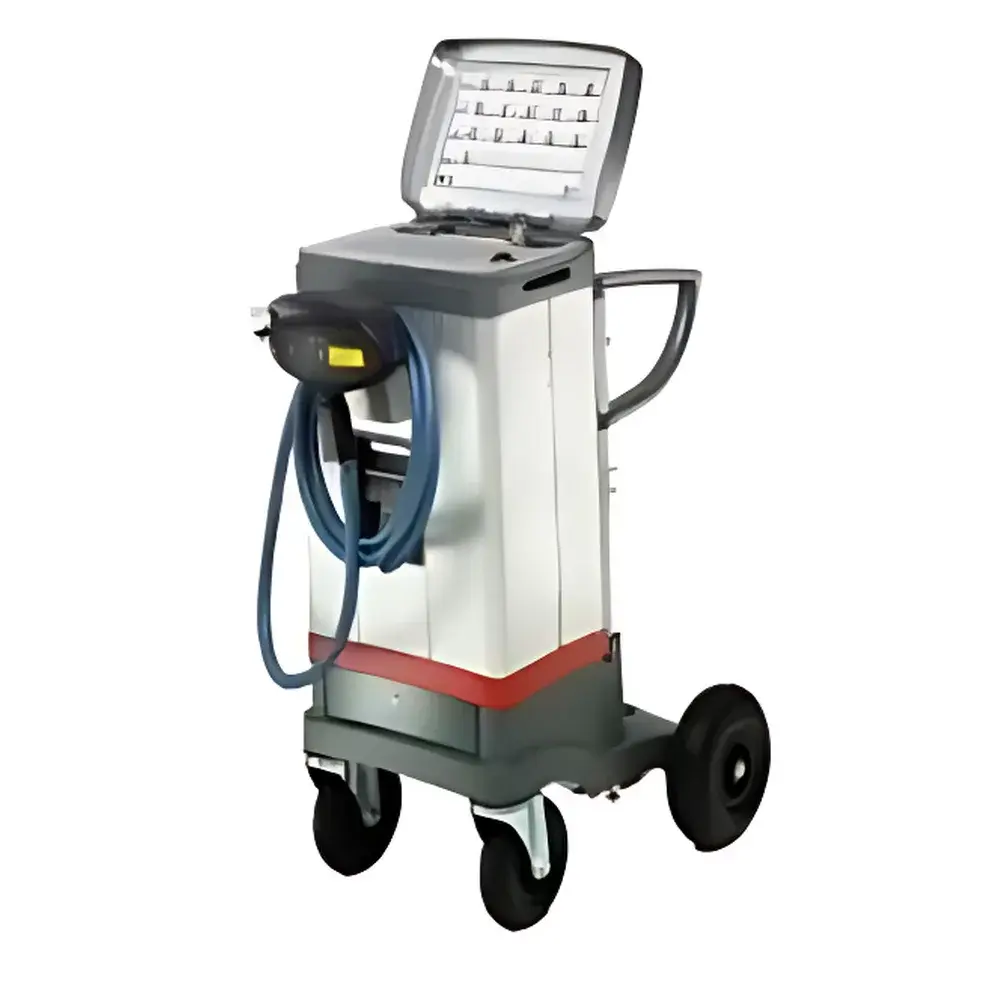
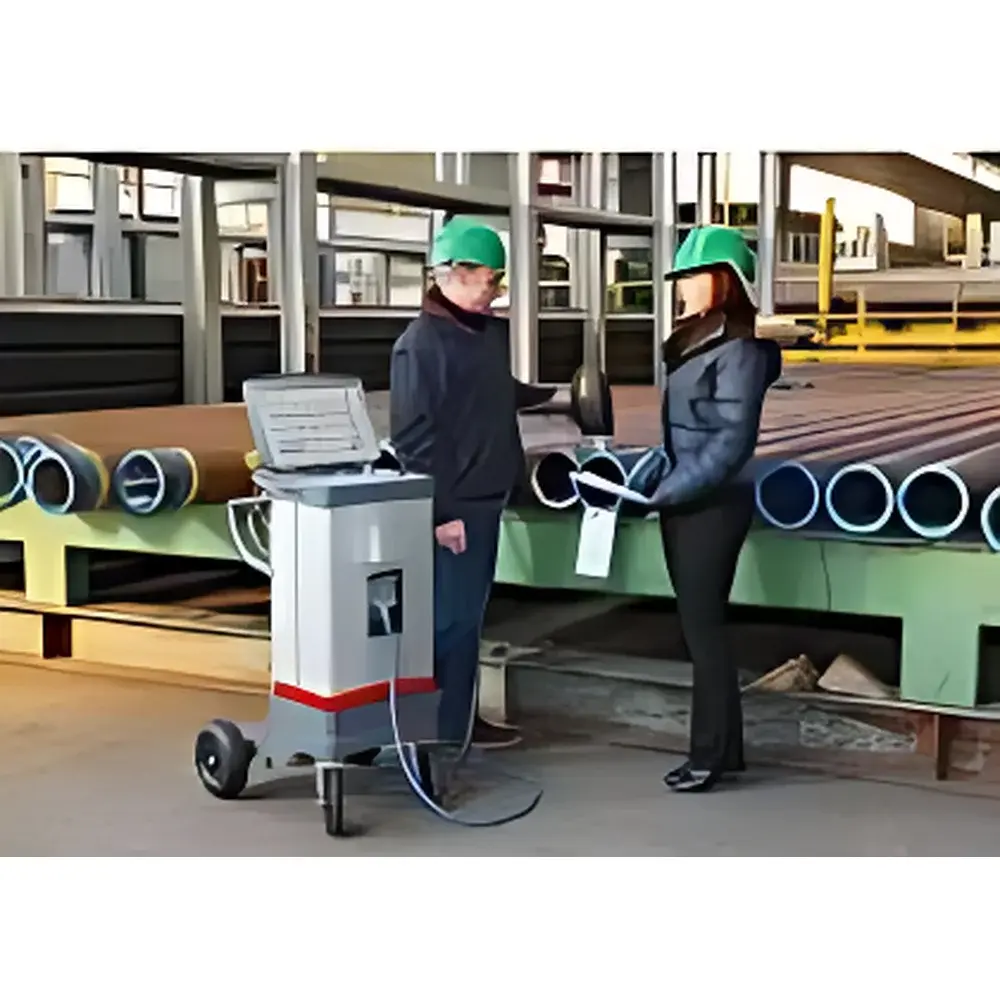
SPECTRO TEST Portable Arc/Spark Optical Emission Spectrometer
| Brand | SPECTRO |
|---|---|
| Origin | Germany |
| Manufacturer Type | Authorized Distributor |
| Origin Category | Imported |
| Model | SPECTRO TEST |
| Instrument Type | Portable/Mobile |
| Excitation Method | Spark & Arc |
| Detector Type | CCD (Charge-Coupled Device) |
| Focal Length | 400 mm |
| Grating Groove Density | 3600 lines/mm |
| Wavelength Range | 174–670 nm |
| Spectral Coverage | Full-Spectrum (Echelle + Prism Cross-Dispersion) |
| Price Range | USD 52,000–65,000 (FOB Hamburg) |
Overview
The SPECTRO TEST is a field-deployable, battery-powered arc/spark optical emission spectrometer (OES) engineered for high-precision elemental analysis of metallic materials in situ. Based on the fundamental principle of atomic emission spectroscopy, the instrument excites sample surfaces via controlled electrical discharge—either spark (for conductive alloys requiring quantitative C, P, S, and N determination) or arc (for rapid qualitative/semi-quantitative screening, including low-alloy steels and trace elements such as Li, Na, and N). Its compact echelle optical system—featuring a 400 mm focal length and 3600 lines/mm holographic grating—delivers high spectral resolution across a broad UV-VIS range (174–670 nm), enabling simultaneous detection of all relevant metallic and non-metallic elements without mechanical channel selection. Unlike fixed-laboratory OES systems, the SPECTRO TEST integrates a modular, ergonomically optimized excitation gun with swappable electrodes and integrated UV optics, allowing seamless transition between spark and arc modes without recalibration.
Key Features
- True full-spectrum CCD detection architecture—no pre-defined analytical channels; all wavelengths recorded simultaneously for retrospective re-analysis and method expansion
- iCAL (intelligent Calibration) single-standard normalization—reduces daily standardization time by ~30 minutes while maintaining traceability to certified reference materials (CRMs)
- Battery-operated operation—up to 800 sparks or arcs per charge (Li-ion, hot-swappable), eliminating dependence on external power sources during plant audits or scrap yard inspections
- Integrated UV-capable excitation gun—enables reliable nitrogen measurement down to 0.005 wt% in duplex stainless steels and low-carbon steels
- Ergonomic, lightweight design (total system weight < 15 kg)—optimized for extended handheld use and vertical/horizontal surface analysis without support fixtures
- Robust IP54-rated enclosure—designed for operation in industrial environments including foundries, fabrication shops, and recycling facilities
Sample Compatibility & Compliance
The SPECTRO TEST supports direct analysis of flat, curved, or irregularly shaped conductive metal samples—including ferrous and non-ferrous alloys (e.g., carbon steels, stainless steels, Al-, Mg-, Cu-, Ni-, Ti-based alloys) with minimal surface preparation (grinding or milling required only for oxide-rich or heavily contaminated surfaces). It complies with ASTM E415 (Standard Test Method for Analysis of Carbon and Low-Alloy Steel by Spark Atomic Emission Spectrometry), ISO 11577 (Metallic materials — Spark discharge atomic emission spectrometry), and EN 10315 (Chemical analysis of steel—General requirements). All calibration models are traceable to NIST SRMs and BCS/CEN-certified reference materials. Data integrity meets GLP/GMP expectations with optional 21 CFR Part 11-compliant software modules supporting electronic signatures, audit trails, and secure user access control.
Software & Data Management
The instrument operates with SPECTRO’s proprietary WinWAS software, providing real-time spectral visualization, multi-element quantification, grade identification (including UNS, EN, ASTM, and JIS databases), and statistical process control (SPC) charting. Raw spectral data (.spc binary format) is stored with full metadata (operator ID, timestamp, GPS coordinates if enabled, environmental parameters). Export options include CSV, XML, and PDF reports compliant with internal QA/QC templates. Remote firmware updates and method library synchronization are supported via encrypted cloud interface (optional SPECTRO Connect subscription). All software modules undergo annual validation per ICH Q9 and ISO/IEC 17025 requirements.
Applications
- Positive Material Identification (PMI) in petrochemical, power generation, and pharmaceutical piping systems
- Rapid alloy sorting and scrap verification in metal recycling centers
- In-process quality control during welding, heat treatment, and casting operations
- Field verification of material certifications prior to commissioning or maintenance shutdowns
- Carbon equivalency (CEV) and pitting resistance equivalent number (PREN) calculation for stainless steel grades
- Nitrogen content verification in duplex and super-duplex stainless steels for corrosion resistance assessment
FAQ
Does the SPECTRO TEST require external argon purging for UV-range measurements?
Yes—argon flush is mandatory for stable detection below 190 nm (e.g., C, P, S, N); the system includes an integrated argon regulator and consumes ≤3 L/min during spark analysis.
Can the instrument analyze coated or painted metals?
No—surface coatings must be mechanically removed to expose bare metal; paint, plating, or heavy oxides inhibit reproducible plasma formation and bias results.
Is method transfer possible from laboratory OES systems?
Yes—calibration models developed on SPECTROLAB or SPECTRO MAXx platforms can be adapted using WinWAS’s cross-platform regression tools, subject to matrix-matching and excitation parameter alignment.
What is the typical detection limit for carbon in low-alloy steel using spark mode?
Under optimal conditions (polished surface, argon purge, 30-second integration), the practical LOD is 0.003–0.005 wt%, validated against CRM 112a and 114a.
How often does the optical system require cleaning or alignment?
The sealed echelle spectrometer requires no routine optical alignment; periodic inspection of entrance slit and CCD window is recommended every 6 months under continuous field use.




