
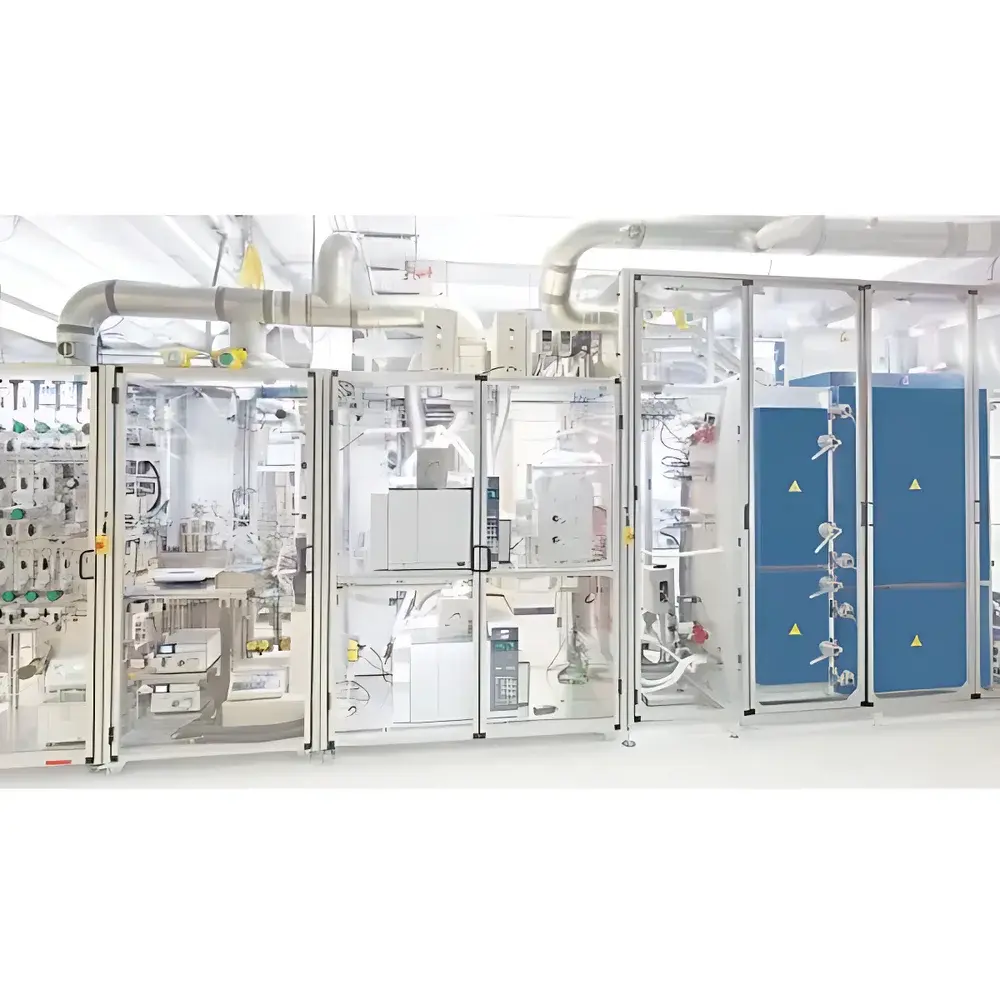
hte X2000 Series High-Throughput Gas-Phase Catalyst Evaluation System
| Brand | hte |
|---|---|
| Origin | Germany |
| Manufacturer Type | Authorized Distributor |
| Origin Category | Imported |
| Model | X2000 |
| Price Range | USD 1,500 – 150,000 (FOB Hamburg) |
Overview
The hte X2000 Series High-Throughput Gas-Phase Catalyst Evaluation System is an engineered laboratory platform designed for parallel, quantitative assessment of heterogeneous catalysts under industrially relevant gas-phase reaction conditions. Built upon Couette-type fixed-bed reactor architecture and integrated process analytics, the system enables precise control of temperature (up to 900 °C), pressure (0.2–100 bar), and stoichiometric feed composition across 16 independent reaction channels. Its core measurement principle relies on mass-balanced, time-resolved effluent analysis—primarily via online GC and IR—to deliver kinetic, selectivity, and deactivation profiles with high reproducibility. Validated against ASTM D3226 (catalyst activity testing), ISO 17025-accredited operation protocols, and FDA 21 CFR Part 11-compliant data governance, the X2000 serves as a bridge between discovery-phase screening and pilot-scale process development in refinery, petrochemical, and CO₂ utilization research.
Key Features
- 16-channel parallel fixed-bed reactor array with individual PID-controlled heating zones; inter-reactor temperature uniformity < ±0.8 °C within isothermal zones
- Multi-phase feed delivery: Coriolis mass flow controllers for liquids (including high-boiling naphtha and LPG), thermal mass flow controllers for gases (H₂, CO, CH₄, CO₂, O₂, N₂), and supercritical CO₂-compatible injection modules
- Integrated online analytical suite: Configurable GC-FID/TCD, FTIR, UV-VIS, and quadrupole MS—each channel equipped with dedicated sampling valves, heated transfer lines, and automated calibration sequences
- Full automation via hteControl™ software: Synchronized control of feed rates, temperature ramps, pressure regulation, valve sequencing, and analytical cycle triggering
- Robust safety architecture: CE-marked per Machinery Directive 2006/42/EC and Pressure Equipment Directive 2014/68/EU; UL 61010-1 and Japan’s High-Pressure Gas Safety Act compliance; real-time monitoring of toxic gas (H₂S, NH₃), smoke, exhaust flow, and liquid level sensors
- Modular reactor tube design: Interchangeable stainless-steel or Inconel reactors with internal diameters from 4 mm to 12 mm; compatible with powder, extrudates, pellets, and monoliths (bed volumes 1–15 mL)
Sample Compatibility & Compliance
The X2000 accommodates diverse catalyst morphologies—including unsupported nanoparticles, supported metal oxides, zeolites, and structured monoliths—across reaction classes such as catalytic reforming, steam methane reforming, CO₂ hydrogenation, selective dehydrogenation, partial oxidation, and aromatic isomerization. All wetted components meet NACE MR0175/ISO 15156 standards for sour service environments. Reactor pressure containment is certified to PED Category IV; vacuum capability extends to 0.2 bar absolute for low-conversion kinetics studies. System validation reports include IQ/OQ documentation aligned with GLP and GMP expectations, supporting regulatory submissions for catalyst licensing and process safety reviews.
Software & Data Management
hteControl™ provides deterministic, event-driven experiment orchestration with sub-second timing resolution. myhte™—the proprietary data management platform—enforces audit-trail logging, electronic signatures, role-based access control, and automated metadata tagging (catalyst ID, batch number, TOS, WHSV, P, T). Raw chromatograms, spectral files, and sensor logs are stored in vendor-neutral HDF5 format. Export options include CSV, ASTM E1394-compliant .csv, and direct integration with MATLAB, Python (via hteAPI), and LIMS systems. All data workflows comply with 21 CFR Part 11 requirements for electronic records and signatures.
Applications
- Naphtha reforming catalyst screening for high-octane gasoline production
- Methane activation and C–H bond functionalization under mild conditions
- Aromatic transalkylation and disproportionation kinetics mapping
- CO₂-to-methanol and CO₂-to-olefins conversion efficiency benchmarking
- Dehydrogenation of alkanes (e.g., propane → propylene) with rapid deactivation profiling
- Low-pressure oxidative coupling and selective partial oxidation of light hydrocarbons
- Regeneration cycle testing under controlled O₂/steam co-feed conditions
FAQ
What is the minimum achievable pressure range, and how is sub-atmospheric operation maintained?
The system supports continuous operation from 0.2 bar (absolute) to 100 bar, using dual-stage back-pressure regulation with active vacuum compensation to ensure stable residence time and avoid condensation artifacts.
Can the X2000 accommodate catalysts requiring strict oxygen-free handling?
Yes—integrated glovebox interface ports and inert gas purging protocols (N₂/Ar) enable loading of air-sensitive catalysts; all reactor manifolds feature double-seal valves and leak-tightness verified to ≤1×10⁻⁹ mbar·L/s He.
Is remote monitoring and alarm notification supported?
The enhanced X2000 variant includes cellular and SMTP-enabled alerting (SMS/email) for critical events—reactor overtemperature, feed interruption, GC column failure, or safety interlock activation.
How is temperature uniformity across 16 reactors validated?
Each reactor zone undergoes independent thermal mapping using calibrated Pt100 probes at three axial positions; full validation report includes uncertainty budget per ISO/IEC 17025 Annex A.
What infrastructure modifications are required prior to installation?
A dedicated 230/400 VAC, 3-phase + N + PE supply (10 kVA nominal), HVAC-controlled lab (20–25 °C, <60% RH), floor loading ≥500 kg/m², and compressed instrument air (6.5 bar) are mandatory. Exhaust ducting must accommodate 100 L/min total vent flow.



