
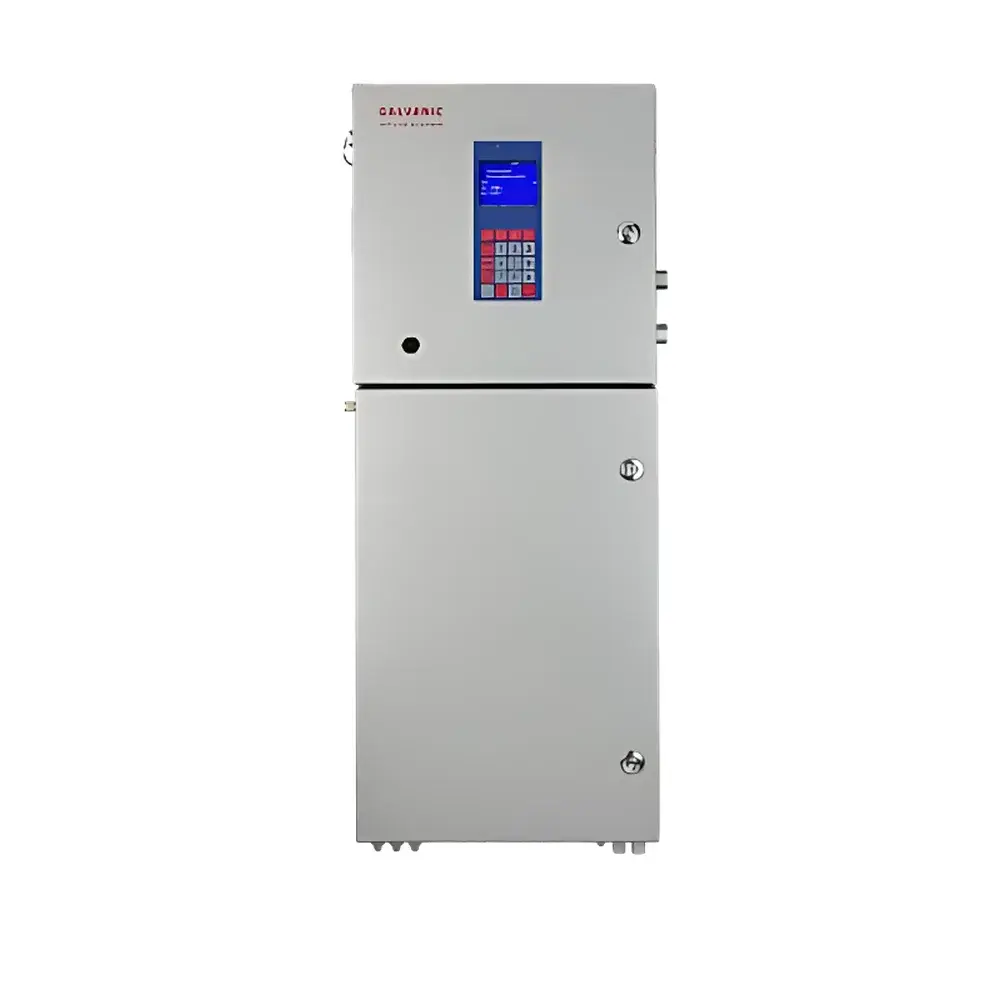
Galvanic Accuseries Online Ion Analyzer
| Brand | Galvanic |
|---|---|
| Origin | USA |
| Model | Accuseries |
| Type | Online Multi-Ion Analyzer |
| Measurement Accuracy | ±1% FS |
| Linearity | ±1% FS |
| Repeatability | ±1% FS |
| Response Time | 8–12 min |
| Operating Temperature Range | −20 °C to +60 °C |
| Dimensions | 1016 mm × 406 mm × 241 mm |
| Weight | 45.3 kg |
| Power Supply | 10–32 VDC or 90–240 VAC |
| Power Consumption | 300 W |
| Analog Outputs | up to eight 4–20 mA |
| Communication Protocols | Modbus RTU (RS-232/RS-485), Modbus TCP/IP |
Overview
The Galvanic Accuseries Online Ion Analyzer is an industrial-grade, multi-parameter water quality monitoring platform engineered for continuous, unattended measurement of inorganic ions and related water chemistry parameters in process and environmental applications. Utilizing modular, application-specific analytical modules—including colorimetric titration, potentiometric titration, ORP-based endpoints, and ion-selective electrode (ISE) detection—the system delivers trace-level quantification across diverse matrices. Its core architecture follows a segmented flow-through design with precision fluid handling: a high-accuracy piston pump delivers reagents; peristaltic pumps manage standards and cleaning solutions; and a wide-bore sample inlet minimizes clogging in high-turbidity or particulate-laden streams. The instrument operates on a fixed-volume sampling principle (5–30 mL), enabling both ppm- and sub-ppb-level detection depending on the configured method and sensor. All measurements are performed under controlled magnetic stirring to ensure homogeneous reaction kinetics and reproducible endpoint determination.
Key Features
- Modular analytical architecture supporting up to six independent analysis streams—enabling simultaneous monitoring of multiple ions or concentration ranges within a single chassis.
- Automated calibration and self-cleaning routines, including programmable probe and reaction cell purging to maintain long-term stability in harsh environments.
- Configurable method library with user-defined protocols for dilution, digestion, separation, and extraction—compatible with external pretreatment units (e.g., UV digesters, filtration modules).
- Explosion-proof and intrinsically safe variants available for hazardous area deployment (Class I, Div 1/Zone 1 compliant configurations).
- Full integration capability with distributed control systems (DCS) and SCADA platforms via native Modbus RTU and TCP/IP protocols.
- Ruggedized enclosure rated for ambient operation from −20 °C to +60 °C, with IP65-rated front panel and corrosion-resistant internal wetted materials (e.g., PTFE, PVDF, 316 stainless steel).
- Embedded data logging with timestamped calibration records, fault diagnostics, and audit-trail metadata—supporting GLP/GMP-aligned operational documentation.
Sample Compatibility & Compliance
The Accuseries analyzer accommodates raw, filtered, digested, or pre-treated aqueous samples—including wastewater, boiler feedwater, brine, cooling tower effluent, and semiconductor process rinse water. It complies with key regulatory frameworks governing environmental and industrial water testing: EPA Methods 300.0, 300.1, and 350.1 for anions; ASTM D859 and D4192 for hardness and alkalinity; ISO 7888 for conductivity-correlated ion estimation; and USP for purified water conductivity mapping. When deployed in pharmaceutical or food-grade applications, the system supports 21 CFR Part 11-compliant electronic signatures and audit trail retention for calibration and maintenance events. Sensor modules are certified to NIST-traceable reference standards, and factory calibration reports include uncertainty budgets per ISO/IEC 17025 requirements.
Software & Data Management
The embedded firmware provides a guided, menu-driven interface with contextual help—designed for operators with minimal analytical chemistry training. Configuration, method selection, calibration curve definition (dual-range high/low curves supported), and cleaning schedule programming are all accessible through intuitive navigation. Raw measurement data, QC flags, and diagnostic logs are stored internally for ≥30 days and exportable via USB or network transfer in CSV or XML format. Optional cloud-connected gateway enables remote monitoring, predictive maintenance alerts, and over-the-air firmware updates. All data exports include ISO 8601 timestamps, instrument ID, sensor serial numbers, and operator login identifiers—ensuring full traceability for compliance audits.
Applications
- Chemical & Chlor-Alkali: Real-time monitoring of Ca²⁺/Mg²⁺ in brine purification, Fe²⁺/Fe³⁺ in caustic recovery loops, and Cl⁻ in chlorine gas scrubbers.
- Power Generation: Boiler water alkalinity, phosphate residual, silica, and hydrazine tracking per ASME PTC 19.11 guidelines.
- Pharmaceutical & Biotech: Conductivity and TOC-correlated ion monitoring in WFI and PW distribution systems.
- Food & Beverage: Free chlorine, nitrate, and fluoride verification in municipal intake and post-treatment lines.
- Mining & Metallurgy: Cyanide (free and total), Cu²⁺, Ni²⁺, and Co²⁺ in leachate and tailings pond discharge.
- Semiconductor Manufacturing: HF, HCl, and HBr concentration control in etch bath recirculation; F⁻ and Cl⁻ in ultrapure rinse water.
- Oil & Gas: Amine concentration, sulfide loading, and total acid gas (H₂S + CO₂) in sweetening units.
FAQ
What analytical methods does the Accuseries support?
It supports colorimetric titration (AccuColor), potentiometric titration (AccuSense), ORP-based titration, and direct ISE measurement—each selectable per channel.
Can it handle high-turbidity wastewater without filtration?
Yes—the wide-bore inlet and integrated magnetic stirring allow reliable operation with suspended solids up to 100 mg/L; however, >50 NTU samples are recommended to undergo coarse pre-filtration for optimal sensor longevity.
Is remote access and cybersecurity supported?
Modbus TCP/IP enables secure read-only access through firewalled network segments; optional TLS 1.2 encryption and role-based authentication are available via the Galvanic SecureLink gateway module.
How often does calibration need to be performed?
Factory-recommended interval is every 7–14 days depending on matrix fouling potential; automated drift compensation algorithms extend effective calibration stability by up to 40% in low-dynamic applications.
Does it meet FDA or EU Annex 11 requirements?
When configured with audit-trail logging, electronic signature enforcement, and change control workflows, it satisfies Annex 11 and 21 CFR Part 11 data integrity criteria for regulated environments.







