
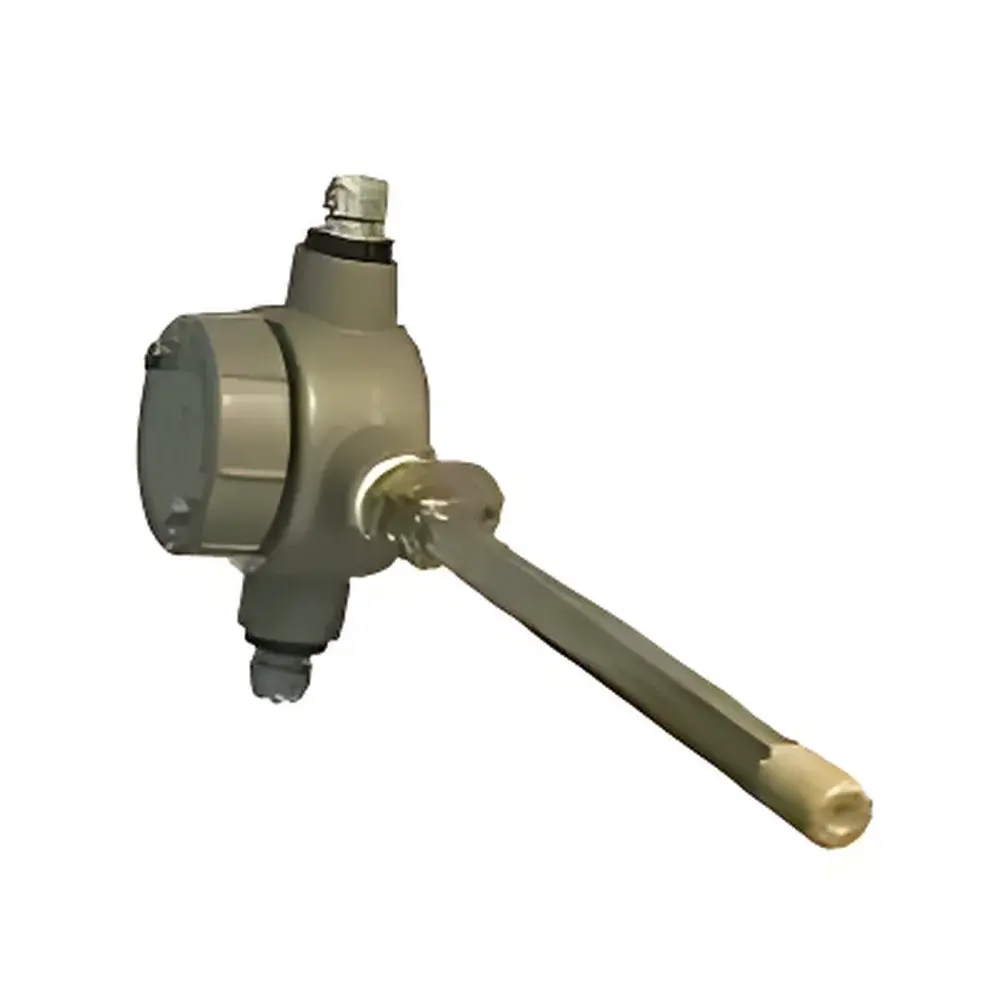
AS3 Online Ultrasonic Particle Turbidimeter
| Origin | Imported |
|---|---|
| Manufacturer Type | Authorized Distributor |
| Model | AS3 |
| Price | Upon Request |
| Operating Pressure | Up to 20 bar |
| Sensor Max Temp | 90°C (110°C with air cooling) |
| Hazardous Area Options | ATEX Zone 1 & Zone 2 / UL Class I Div 1 |
| Sensor Length | ~300 mm (custom lengths available) |
| Measurement Range | 0–5 NTU to 0–5,000 NTU |
| Accuracy | ±1% of reading |
| Transducer Frequencies | 5 MHz and 15 MHz |
| Enclosure Rating | NEMA 4X / IP65 |
| Process Integration | Ball-valve-mounted insertion probe |
| Compatibility | AT3 interface |
Overview
The AS3 Online Ultrasonic Particle Turbidimeter is an industrial-grade process analytical instrument engineered for continuous, real-time quantification of suspended particulate concentration in liquids—without reliance on optical transmission or scattering. Unlike conventional turbidimeters based on nephelometric or absorption principles, the AS3 employs high-frequency ultrasonic pulse-echo technology: a piezoelectric transducer emits short-duration acoustic pulses (at 5 MHz or 15 MHz) into the process stream; particles within the liquid medium reflect these pulses proportionally to their size distribution, concentration, and acoustic impedance contrast relative to the carrier fluid. The reflected signal amplitude and time-of-flight characteristics are digitally processed to derive a robust turbidity-equivalent output, calibrated in NTU (Nephelometric Turbidity Units). This physical principle renders the measurement inherently insensitive to liquid color, UV/visible absorbance, fluorescence, or opacity—making the AS3 uniquely suited for applications where optical sensors fail due to fouling, emulsion interference, or photolabile media.
Key Features
- Ultrasonic reflection-based measurement eliminates dependency on light path integrity—ideal for dark, viscous, or optically opaque fluids including oil-in-water emulsions and pigment suspensions.
- Dual-frequency transducer configuration (5 MHz for coarse particle detection; 15 MHz for fine particle resolution) enables adaptive range optimization across diverse suspension types.
- Hot-tap insertion design with integrated ball valve allows sensor deployment or removal under full process pressure (up to 5 bar) without shutdown—ensuring uninterrupted production continuity.
- Self-cleaning mechanism: periodic high-energy ultrasonic pulsing disrupts weakly adhered deposits on the transducer face, significantly extending maintenance intervals.
- Ruggedized stainless-steel probe housing rated to IP65/NEMA 4X, with optional ATEX-certified variants for Zone 1 (gas group IIA–IIB, T4) and Zone 2, as well as UL Class I Division 1 environments.
- Thermal resilience: standard operation up to 90°C; air-cooled variants support continuous exposure to 110°C process temperatures.
- No consumables, no optical windows, no alignment-sensitive optics—reducing total cost of ownership and validation burden in regulated settings.
Sample Compatibility & Compliance
The AS3 maintains measurement fidelity across chemically aggressive, thermally variable, and biologically active streams—including chlorinated potable water, anaerobic digester effluent, caustic pulp stock, fermentation broths, and hydrocarbon-phase condensates. Its immunity to chromophore interference satisfies ASTM D7315 and ISO 7027-1 requirements for turbidity equivalence while avoiding the calibration drift common in photometric systems exposed to biofilm or scaling. For pharmaceutical and food-grade applications, the wetted materials (316L SS, FKM seals) comply with USP Class VI and FDA 21 CFR 177.2600. Data integrity features—including configurable audit trails, user access levels, and electronic signature support—align with ALCOA+ principles and facilitate compliance with 21 CFR Part 11, EU Annex 11, and GMP/GLP documentation standards.
Software & Data Management
The AS3 integrates seamlessly via its native AT3 digital interface (RS-485 Modbus RTU or optional HART 7) into distributed control systems (DCS), SCADA platforms, and MES environments. Local display provides real-time NTU values, signal quality metrics (e.g., echo amplitude SNR, damping coefficient), and diagnostic flags (e.g., coupling loss, temperature deviation). Firmware supports configurable averaging windows (1–60 s), linear/logarithmic output scaling, and dual-range switching (e.g., low-range 0–50 NTU for clarity monitoring; high-range 0–5,000 NTU for slurry concentration control). All configuration changes are timestamped and logged with operator ID—enabling traceability during QA investigations or regulatory audits.
Applications
- Drinking water treatment: rapid detection of filter breakthrough or coagulant dosing anomalies.
- Wastewater clarification: monitoring secondary clarifier effluent turbidity and return activated sludge consistency.
- Chemical process control: endpoint detection in precipitation reactions, crystallization, and catalyst recovery loops.
- Pulp & paper: consistency monitoring in whitewater circuits and coating slip preparation.
- Biopharmaceutical manufacturing: real-time tracking of cell culture density, harvest clarity, and ultrafiltration/diafiltration performance.
- Food & beverage: verification of juice pasteurization efficacy, beer filtration completeness, and dairy whey separation efficiency.
- Oil & gas: detection of water-in-oil or oil-in-water phase inversion in produced water treatment trains.
FAQ
How does ultrasonic turbidity differ from optical turbidity measurement?
Ultrasonic turbidity relies on acoustic impedance mismatch between particles and liquid—measuring reflected pulse energy—whereas optical methods depend on light scattering or attenuation. This makes ultrasonic measurement immune to color, fluorescence, and window fouling.
Can the AS3 be used in explosive atmospheres?
Yes—ATEX-certified versions are available for Zone 1 (IIA–IIB, T4) and Zone 2, as well as UL Class I Division 1 hazardous locations.
Is calibration required, and how often?
Factory calibration is traceable to NIST standards. Field verification using reference slurries (e.g., Formazin or AMCO AEPA standards) is recommended quarterly; however, long-term stability typically exceeds 12 months under stable process conditions.
What maintenance does the AS3 require?
No routine optical cleaning or lamp replacement. Annual inspection of O-rings and verification of transducer coupling integrity are advised. The self-cleaning ultrasonic pulse minimizes buildup between inspections.
Does the AS3 support 4–20 mA analog output alongside digital communication?
Yes—standard 4–20 mA output with HART 7 overlay is available; Modbus RTU over RS-485 is default for AT3 interface integration.




