
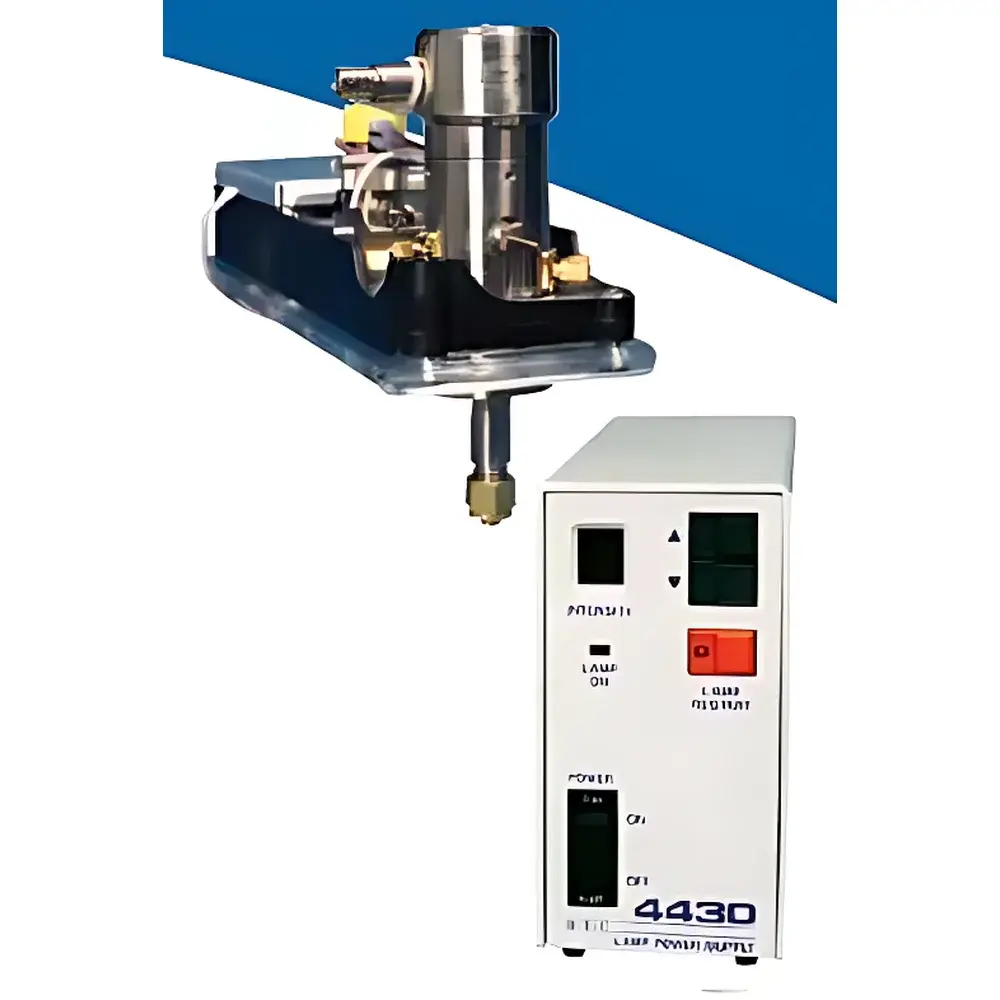
OI Analytical 5390 PID-XSD Tandem Chromatographic Detector
| Brand | OI Analytical |
|---|---|
| Origin | USA |
| Model | 5390 PID-XSD Tandem Detector |
| Detector Type | Photoionization Detector (PID) + Halogen-Specific Detector (XSD) |
| Configuration | In-series dual-detector module with single column outlet interface |
| Regulatory Compliance | Designed for ASTM D7622, EPA Method 8021B, and USP <621> chromatographic system suitability requirements |
| Software Integration | Compatible with standard GC data systems via analog voltage output (0–1 V) and TTL trigger signals |
Overview
The OI Analytical 5390 PID-XSD Tandem Chromatographic Detector is an engineered solution for simultaneous, selective detection of aromatic hydrocarbons and halogenated organic compounds in gas chromatography (GC) applications. Unlike conventional sequential or parallel detector configurations, the 5390 integrates a photoionization detector (PID) and a halogen-specific detector (XSD) in a true in-series arrangement—where effluent from the GC column passes first through the PID sensing zone and then directly into the XSD reaction chamber without intermediate transfer lines, splitters, or flow re-routing. This architecture preserves chromatographic integrity, minimizes band broadening, and eliminates retention time shifts between detectors. The PID operates on vacuum ultraviolet (VUV) photon ionization (typically 10.6 eV lamp), enabling sensitive, non-destructive detection of unsaturated and aromatic species with ionization potentials below the lamp energy. The downstream XSD employs a thermally modulated catalytic conversion principle specific to carbon–halogen bond cleavage, delivering high selectivity for chlorinated, brominated, and fluorinated compounds—distinct from electron capture detection (ECD) in both mechanism and interference profile.
Key Features
- In-series dual-detection architecture: Single-column outlet interface eliminates need for flow splitting, reducing dead volume and preserving peak shape fidelity.
- Independent operational modes: PID and XSD modules can be operated simultaneously in tandem or isolated individually via internal valving—enabling method flexibility without hardware reconfiguration.
- Reduced maintenance footprint: XSD design omits radioactive sources and complex gas-purging manifolds typical of ECDs; instead utilizes stable, solid-state catalytic surfaces with extended service life.
- Enhanced selectivity profile: XSD demonstrates >100× greater response ratio for halogenated analytes versus non-halogenated isomers (e.g., chlorobenzene vs. benzene), significantly lowering false-positive incidence in complex matrices.
- Analog + digital output compatibility: Dual-channel voltage output (0–1 V full scale per detector) with synchronized TTL pulse triggering supports legacy and modern GC data systems—including Agilent ChemStation, Thermo Chromeleon, and Shimadzu GC Solutions.
Sample Compatibility & Compliance
The 5390 PID-XSD is validated for use with capillary GC columns (0.1–0.53 mm ID) operating under standard temperature-programmed conditions (40–300 °C oven range). It accommodates common carrier gases (He, H₂, N₂) and is compatible with split/splitless, on-column, and PTV injection techniques. Its detection performance meets specified criteria in EPA Method 8021B for volatile halogenated organics in soil and water extracts, ASTM D7622 for aromatic content in reformulated gasoline, and USP system suitability requirements for resolution and sensitivity in pharmaceutical residual solvent analysis. No radioactive components are present, eliminating licensing, disposal, and transport restrictions associated with ECD-based systems. The detector housing conforms to IEC 61010-1 safety standards for laboratory electrical equipment.
Software & Data Management
While the 5390 operates as a hardware-integrated analog detector, its dual-output architecture enables synchronized signal acquisition in any compliant GC data system. Peak identification and quantitation rely on co-elution correlation—retention time alignment between PID and XSD signals permits unambiguous assignment of halogenated aromatics (e.g., chlorotoluenes) versus non-halogenated analogs (e.g., xylenes). Audit-trail functionality is maintained when used with 21 CFR Part 11-compliant software platforms, where raw voltage traces, calibration logs, and detector status flags (lamp intensity, catalyst temperature, baseline drift) are archived with user-defined metadata. Optional firmware updates support enhanced baseline stability algorithms and real-time signal subtraction routines for background correction.
Applications
- Environmental monitoring: Simultaneous quantification of BTEX (benzene, toluene, ethylbenzene, xylenes) and chlorinated solvents (e.g., PCE, TCE, vinyl chloride) in groundwater and soil vapor samples.
- Petrochemical QA/QC: Rapid screening of aromatic content and halogen impurities in reformulated gasoline, jet fuel, and naphtha streams per ASTM D1319 and D525.
- Pharmaceutical manufacturing: Residual solvent analysis in active pharmaceutical ingredients (APIs), particularly where chlorinated processing agents (e.g., DCM, chloroform) co-occur with aromatic excipients.
- Forensic toxicology: Differentiation of halogenated flame retardants (PBDEs, HBCDs) from structurally similar polycyclic aromatic hydrocarbons (PAHs) in fire debris analysis.
FAQ
Can the PID and XSD operate independently without modifying the GC hardware?
Yes—the 5390 includes internal three-way pneumatic valves that allow either detector to be placed in bypass mode while maintaining column flow continuity and thermal equilibrium.
What is the typical linear dynamic range for each detection channel?
PID: 10⁴ (0.1–1000 ppb for benzene); XSD: 10³ (1–1000 ppb for chloroform), both referenced to 100:1 signal-to-noise ratio.
Is the XSD susceptible to quenching by common matrix components such as water or CO₂?
No—unlike ECD, the XSD’s catalytic detection mechanism exhibits minimal response suppression from water vapor (<5% signal loss at 10,000 ppm H₂O) and is inert toward CO₂, methane, and nitrogen.
Does the detector require routine lamp replacement or catalyst regeneration?
PID lamps have a rated lifetime of ≥2000 hours under continuous operation; XSD catalyst cartridges are field-replaceable with a nominal service interval of 12 months under typical environmental lab usage.
Is GLP-compliant calibration documentation available?
Yes—OI Analytical provides NIST-traceable calibration certificates, including multi-point linearity verification, limit-of-detection (LOD) validation per ICH Q2(R2), and system suitability test reports aligned with ISO/IEC 17025 requirements.






