
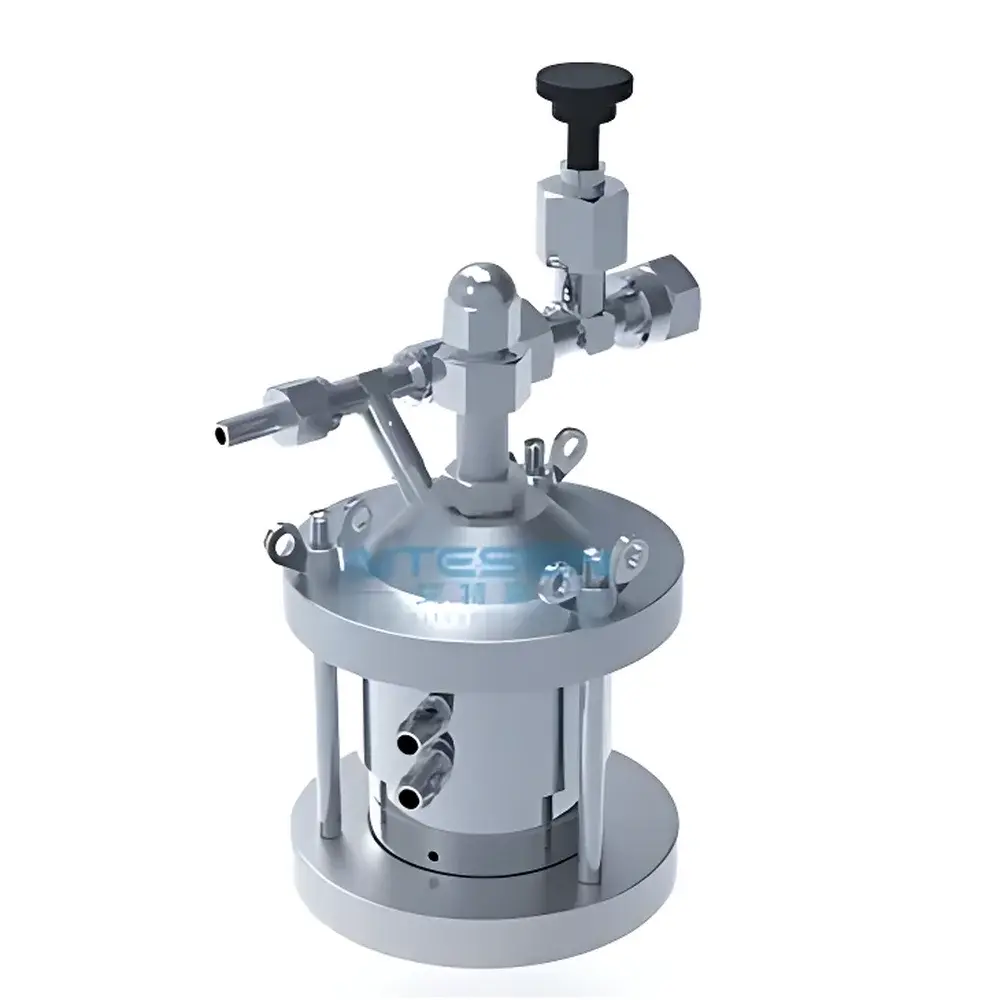
Aitesen TLEx-100 Cartridge-Style Liposome Extruder
| Brand | Aitesen |
|---|---|
| Model | TLEx-100 |
| Type | Nitrogen-Driven Membrane Extrusion System |
| Max. Sample Volume | 100 mL |
| Dimensions (W×D×H) | 80 × 140 × 60 mm |
| Construction Materials | SS316L Support/Filter Plates, Polycarbonate (PC) Track-Etched Membranes, FDA-Certified PU/PTFE Seals |
| Temperature Control | Jacketed Heating (up to 70 °C) |
| Pressure Source | Regulated Compressed Nitrogen |
| Sterilization Compatibility | Autoclavable Components (121 °C, 20 min) |
| Compliance | GMP-Aligned Design, Suitable for ISO Class 5–7 Cleanrooms |
| Particle Size Output | Typically <100 nm, PDI <0.1 (with appropriate membrane pore size and cycling protocol) |
Overview
The Aitesen TLEx-100 Cartridge-Style Liposome Extruder is an engineered benchtop system designed for reproducible, scalable, and GMP-aligned production of uniform nanoscale lipid-based vesicles. It operates on the principle of controlled membrane extrusion—where pre-hydrated or partially homogenized liposomal dispersions are forced under regulated nitrogen pressure through precisely defined polycarbonate track-etched membranes. Unlike high-shear methods such as sonication or microfluidization, extrusion delivers deterministic size reduction governed by membrane pore geometry, enabling tight control over hydrodynamic diameter and polydispersity index (PDI). The TLEx-100 integrates a thermostatically jacketed housing to maintain phospholipid bilayer fluidity during processing—critical for achieving consistent extrusion efficiency across temperature-sensitive formulations including DSPC-, DPPC-, or HSPC-based systems. Its compact footprint and modular architecture make it suitable for early-stage formulation development, process transfer, and quality control laboratories operating under GLP or cGMP frameworks.
Key Features
- Stainless steel (SS316L) support and filter plates ensure mechanical rigidity, corrosion resistance, and compatibility with autoclave sterilization (121 °C, 20 min).
- Interchangeable polycarbonate (PC) track-etched membranes—available in standard pore sizes (e.g., 100 nm, 80 nm, 50 nm, 30 nm)—enable stepwise size refinement and batch-to-batch consistency.
- Jacketed temperature control system allows precise thermal conditioning (up to 70 °C), essential for maintaining lipid phase transition states during extrusion.
- FDA-certified PU and PTFE sealing components eliminate leachables and meet USP Class VI biocompatibility requirements for pharmaceutical-grade processing.
- Integrated pressure relief valve safeguards against over-pressurization; maximum operating pressure is compatible with standard laboratory nitrogen supply lines (typically ≤10 bar).
- Tool-free cartridge assembly enables rapid membrane replacement, cleaning, and reconfiguration between batches—reducing cross-contamination risk and downtime.
- Designed for cleanroom integration: smooth surface finishes (Ra ≤ 0.8 µm), absence of dead-leg volumes, and full disassembly capability support routine SIP/CIP protocols.
Sample Compatibility & Compliance
The TLEx-100 accommodates a broad spectrum of lipid nanoparticle (LNP) and liposomal formulations—including doxorubicin, amphotericin B, paclitaxel, oxaliplatin, and irinotecan encapsulated liposomes—as well as siRNA/mRNA-LNPs and albumin-bound nanotherapeutics. Its inert wetted path (SS316L, PC, PTFE, PU) ensures minimal adsorption or degradation of sensitive payloads. All elastomeric components comply with FDA 21 CFR §177.2600 and ISO 10993-5 cytotoxicity standards. The system aligns with ICH Q5A(R2) guidance on viral clearance validation and supports documentation required for regulatory submissions (e.g., IND, IMPD). While not a certified Class A device per ISO 13485, its design intent and material traceability conform to Annex 1 (EU GMP) expectations for sterile product manufacturing environments.
Software & Data Management
The TLEx-100 is a manually operated, non-electronic system—intentionally omitting embedded controllers to maximize operational transparency, reduce qualification burden, and avoid software validation requirements under FDA 21 CFR Part 11. Process parameters—including extrusion temperature, nitrogen pressure, number of passes, and membrane pore size—are recorded manually in batch records or integrated into electronic lab notebooks (ELNs) such as LabArchives or Benchling. Optional digital pressure gauges (calibrated to NIST-traceable standards) and calibrated thermocouple probes may be added externally to support audit-ready data capture. This analog-first architecture facilitates straightforward IQ/OQ/PQ execution and simplifies change control within regulated QC and pilot-scale manufacturing settings.
Applications
- Preclinical and clinical-grade liposome sizing for oncology and antifungal therapeutics.
- Final-step size homogenization of mRNA-LNPs prior to fill-finish operations.
- Reproducible generation of reference standards for DLS, NTA, and TEM method development.
- Process optimization studies evaluating membrane cycling effects on encapsulation efficiency and PDI.
- Supporting DOE-driven formulation development where thermal stability and shear sensitivity must be preserved.
- Cleanroom-compatible scale-down modeling for tech transfer to industrial extrusion platforms (e.g., Avanti Polar Lipids Mini-Extruder or high-throughput tangential flow systems).
FAQ
What membrane pore sizes are compatible with the TLEx-100?
Standard PC membranes ranging from 30 nm to 200 nm are supported; custom pore sizes may be sourced upon request.
Can the TLEx-100 be used with organic solvents or high-viscosity buffers?
Yes—provided solvent compatibility is confirmed for PC membranes and PU/PTFE seals (e.g., ethanol, isopropanol, and phosphate-buffered saline are fully compatible; chloroform and DMSO require evaluation).
Is the system suitable for sterile filtration validation?
No—it is not a sterilizing-grade filter; however, it is compatible with pre-sterilized membranes and aseptic handling workflows in ISO Class 5 environments.
How many extrusion cycles are typically required to achieve sub-100 nm PDI <0.1?
For most saturated phospholipid formulations at optimal temperature, 11–15 passes through 100 nm membranes yield consistent results; cycling protocols should be qualified per formulation.
Does the TLEx-100 require electrical power or compressed air?
No electrical input is needed; only regulated compressed nitrogen (or argon) is required as the driving force—eliminating spark hazards in flammable solvent environments.



