
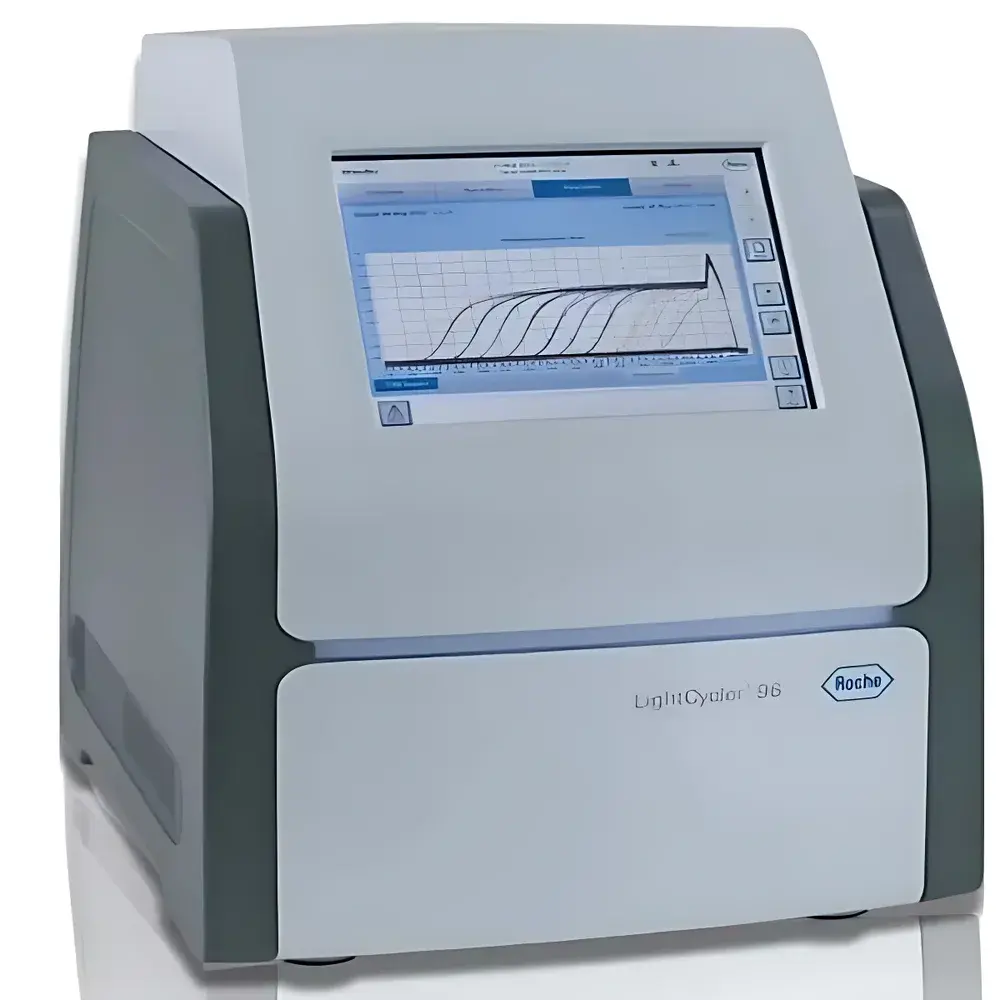
Roche LightCycler® 96 Real-Time PCR System
| Brand | Roche Diagnostics |
|---|---|
| Origin | Switzerland |
| Model | LightCycler® 96 |
| Instrument Type | Real-Time Quantitative PCR System |
| Sample Throughput | 96-well plate or 8-tube strip |
| Heating Rate | 6.8 °C/s |
| Temperature Accuracy | ±0.2 °C (37–98 °C) |
| Well-to-Well Temperature Uniformity | ±0.2 °C (37–98 °C) |
| Excitation Source | High-Stability White LED (Lifespan >20,000 h) |
| Optical Architecture | Dual 96-channel Fiber-Optic Detection System |
| Cycle Time | <60 min for 40 cycles |
Overview
The Roche LightCycler® 96 Real-Time PCR System is a benchtop real-time quantitative polymerase chain reaction (qPCR) instrument engineered for precision, reproducibility, and workflow efficiency in molecular biology laboratories. Based on the principle of fluorescence-based nucleic acid amplification monitoring—where sequence-specific probes (e.g., hydrolysis probes, hybridization probes) or intercalating dyes emit wavelength-resolved signals during each thermal cycle—the system delivers quantitative target DNA/RNA measurement via threshold cycle (Ct) analysis. Designed and manufactured in Switzerland by Roche Diagnostics, the LightCycler® 96 integrates a robust thermocycling architecture with high-fidelity optical detection to support both absolute and relative quantification across research, clinical diagnostics, and regulatory-compliant environments.
Key Features
- High-performance thermal control: Peltier-based heating/cooling modules deliver a maximum ramp rate of 6.8 °C/s and maintain temperature accuracy within ±0.2 °C across the full operational range (37–98 °C), ensuring consistent denaturation, annealing, and extension kinetics.
- Uniform thermal field: Well-to-well temperature variation remains ≤±0.2 °C over the entire 96-well plate surface, minimizing inter-well variability and supporting high-reproducibility replicate analysis required for low-abundance target detection.
- Dual 96-channel fiber-optic detection: Two independent optical paths—each with 96 dedicated excitation/emission channels—enable simultaneous, non-crosstalk detection across all wells without mechanical movement or scanning delays.
- Stable white LED excitation source: Engineered for >20,000 hours of operational life, the solid-state LED array provides consistent spectral output across UV–visible wavelengths (ex. 450–640 nm; em. 500–700 nm), eliminating lamp degradation-related signal drift and reducing calibration frequency.
- Compact, low-footprint design: Optimized for space-constrained labs, the system operates without external chillers or compressed air, and supports standard 96-well plates and 8-tube strips—compatible with most commercial qPCR master mixes and assay formats.
Sample Compatibility & Compliance
The LightCycler® 96 accepts standard skirted and semi-skirted 96-well PCR plates (including transparent, white, and optical-grade variants) as well as 8-tube strips with caps. It supports all major probe chemistries (TaqMan®, HybProbe®, SimpleProbe®, ResoLight®) and dye-based assays (SYBR® Green I, EvaGreen®). From a regulatory perspective, the system’s firmware architecture supports audit-trail-enabled operation per FDA 21 CFR Part 11 requirements when used with compliant software configurations. Its performance aligns with ISO/IEC 17025 method validation expectations for nucleic acid quantification and meets essential criteria outlined in CLSI EP17-A2 for limit-of-detection studies and USP for assay precision in pharmaceutical QC settings.
Software & Data Management
Instrument control, data acquisition, and analysis are performed using the LightCycler® 96 Software v1.1 or later—a Windows-based application validated for GxP environments. The software enables Ct determination, melting curve analysis, second-derivative peak calling, relative quantification (ΔΔCt), and multiplate normalization. Raw fluorescence data (RFU vs. cycle) and metadata (instrument ID, user, date/time, protocol parameters) are stored in encrypted .lcs format. Export options include CSV, Excel, and PDF reports compatible with LIMS integration. Audit trail functionality logs all user actions—including parameter changes, result edits, and file deletions—with timestamps and operator IDs, fulfilling GLP/GMP documentation requirements.
Applications
The LightCycler® 96 serves as a core platform for gene expression profiling (e.g., cytokine panels, stem cell differentiation markers), pathogen load quantification (viral/bacterial/fungal targets in clinical specimens), SNP genotyping via allelic discrimination, miRNA expression analysis, and verification of RNA-seq or microarray results. In translational research, it supports biomarker validation workflows requiring high inter-run reproducibility. In food safety and environmental testing labs, it enables rapid detection and quantification of foodborne pathogens (e.g., Salmonella, Listeria monocytogenes) per ISO 22118 and AOAC guidelines. Its speed (<60 min for 40 cycles) and precision make it suitable for time-sensitive applications such as intraoperative margin assessment or outbreak response testing.
FAQ
Is the LightCycler® 96 compliant with FDA 21 CFR Part 11 for electronic records and signatures?
Yes—when operated with validated software versions and appropriate administrative controls (e.g., role-based access, password policies, and audit trail review procedures), the system supports Part 11 compliance.
Can the system perform high-resolution melting (HRM) analysis?
Yes—the dual-channel optical system and precise temperature ramping (0.01–0.5 °C/s in HRM mode) enable robust post-PCR melting curve acquisition for genotyping and methylation screening.
What types of consumables are certified for use with the LightCycler® 96?
Roche-certified 96-well plates (e.g., LightCycler® 480 Multiwell Plate 96, white or clear), 8-tube strips, and cap strips are fully validated; third-party plates may be used but require user qualification per ISO/IEC 17025.
Does the instrument require routine optical calibration?
No—LED stability and fixed optical path eliminate the need for daily or weekly photometric calibration; optional annual performance verification is recommended per laboratory SOPs.
Is remote monitoring or network connectivity supported?
The system supports Ethernet-based local network connection for file transfer and remote desktop-assisted troubleshooting; however, cloud-based data hosting or real-time remote control is not natively implemented.





