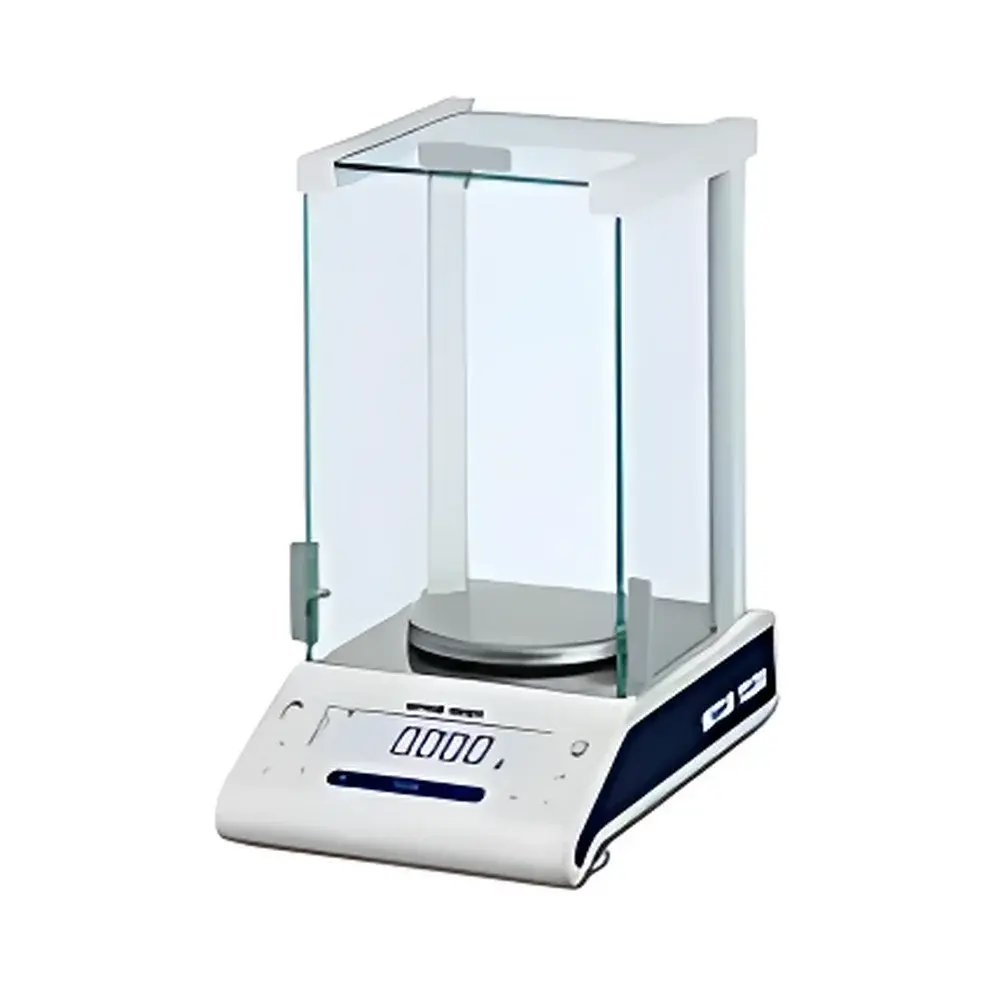
METTLER TOLEDO MS105 Semi-Micro Analytical Balance
| Brand | METTLER TOLEDO |
|---|---|
| Origin | Switzerland |
| Model | MS105 |
| Maximum Capacity | 120 g |
| Readability | 0.01 mg |
| Repeatability | 1 mg |
| Calibration | Internal FACT (Fully Automatic Calibration Technology) |
| Sensor Technology | MonoBloc Single-Module Weighing Cell |
| Processor | 280 MIPS CPU with 72 MHz Bus Speed |
| Display | High-Contrast Display (HCD) with SmartTrac Dynamic Range Indicator |
| Keypad | Three Programmable SmartKeys + Oversized Tare Key |
| Readability Adjustment | 1/10d Mode for Rapid Stabilization |
| Environmental Compensation | Real-Time Dynamic Temperature Compensation & Multi-Stage Digital Filtering |
| Built-in Diagnostics | Keyboard Test, Repeatability Test, and Self-Maintenance Routines |
| Compliance | Designed to Support GLP/GMP Documentation Requirements, ASTM E899, ISO/IEC 17025 Traceability Framework |
Overview
The METTLER TOLEDO MS105 Semi-Micro Analytical Balance is an ISO/IEC 17025-aligned precision weighing instrument engineered for laboratories requiring high-resolution mass determination in the 100–120 g range. Operating on the fundamental principle of electromagnetic force compensation, the MS105 employs a patented MonoBloc single-module weighing cell — a monolithic sensor architecture that eliminates mechanical joints and thermal expansion mismatches between components. This design delivers exceptional resistance to mechanical shock and overload events while maintaining long-term stability under variable environmental conditions. The balance achieves a readability of 0.01 mg (10 µg), making it suitable for applications demanding sub-milligram accuracy, including quantitative gravimetric analysis, reference standard preparation, and small-scale formulation development. Its internal FACT (Fully Automatic Calibration Technology) system initiates calibration automatically upon detection of temperature drift exceeding ±1.5 °C or at user-defined time intervals, ensuring continuous metrological traceability without manual intervention.
Key Features
- Monolithic MonoBloc weighing cell with integrated electronics — minimizes hysteresis, creep, and sensitivity to lateral forces
- 280 MIPS central processing unit with 72 MHz system bus — reduces stabilization time to ≤2 seconds for most loads within specification
- High-Contrast Display (HCD) with SmartTrac graphical indicator — visually represents current load as a percentage of full scale, supporting intuitive process control
- Three programmable SmartKeys — enable one-touch access to preconfigured workflows such as % weighing, density determination, or net/gross/tare sequencing
- Oversized tare key with tactile feedback — optimized for gloved-hand operation in regulated cleanroom or fume hood environments
- 1/10d readability mode — temporarily displays results at 0.1 mg resolution to accelerate settling confirmation during dynamic weighing tasks
- Multi-stage digital filtering algorithm — dynamically adjusts response damping based on ambient vibration profiles and sample volatility
- Real-time dynamic temperature compensation — continuously corrects zero point and sensitivity coefficients using embedded thermal sensors at critical node locations
- Onboard self-diagnostics suite — includes keyboard functionality test, repeatability verification protocol, and sensor health monitoring logs
Sample Compatibility & Compliance
The MS105 accommodates samples up to 120 g with a pan diameter of 90 mm, compatible with standard analytical weighing boats, crucibles, and low-profile vials. Its draft shield configuration (sold separately) meets ISO 9001 and USP requirements for static and dynamic weighing uncertainty management. The balance supports audit-trail-capable operation when connected to METTLER TOLEDO LabX software, fulfilling FDA 21 CFR Part 11 data integrity criteria through electronic signatures, immutable event logging, and role-based access control. All factory calibrations are traceable to national standards via DKD/DAkkS-accredited laboratories, and the instrument’s performance verification documentation aligns with ASTM E899-22 (Standard Practice for Verification of Analytical Balances).
Software & Data Management
When interfaced with LabX laboratory software, the MS105 enables centralized method deployment, automated report generation (PDF/CSV), and integration into enterprise LIMS or ELN platforms via ODBC or RESTful API. Raw weighing data — including timestamp, operator ID, environmental metadata (if external sensors are connected), and calibration history — is stored with cryptographic hashing to prevent post-acquisition modification. The balance firmware supports configurable data export protocols compliant with ISO/IEC 17025 clause 7.7 (result reporting) and supports GLP-compliant signature workflows for release-critical measurements.
Applications
- Preparation and verification of certified reference materials (CRMs) in metrology labs
- Gravimetric titration and volumetric standard solution preparation per ISO 6497
- Weighing of active pharmaceutical ingredients (APIs) during early-phase drug development
- Residue-on-ignition (ROI) and loss-on-drying (LOD) determinations per USP
- Calibration of pipettes and dispensers using gravimetric verification protocols (ISO 8655-6)
- Micro-sample ash content analysis in geological and environmental testing labs
- Quality control of catalysts, nanomaterials, and specialty chemicals where batch-to-batch mass consistency is critical
FAQ
What is the difference between readability and repeatability on the MS105?
Readability refers to the smallest increment displayed (0.01 mg), while repeatability (1 mg) defines the maximum standard deviation observed across ten consecutive weighings of the same test weight under identical conditions.
Does the MS105 support external calibration weights?
No — the MS105 relies exclusively on internal FACT calibration; no external weights are required or supported for routine operation.
Can the MS105 be integrated into a networked laboratory environment?
Yes — via RS232, USB Device, or optional Ethernet interface, enabling remote monitoring, firmware updates, and centralized configuration management through LabX or third-party middleware.
Is the MonoBloc sensor repairable in the field?
No — the MonoBloc is a sealed, non-user-serviceable component; sensor replacement requires factory-level recalibration and certification.
How does dynamic temperature compensation differ from standard temperature compensation?
Unlike fixed-coefficient compensation, the MS105 uses real-time thermal gradient mapping across the sensor substrate to adjust both zero and sensitivity parameters independently, reducing temperature-induced error by up to 60% compared to conventional systems.