
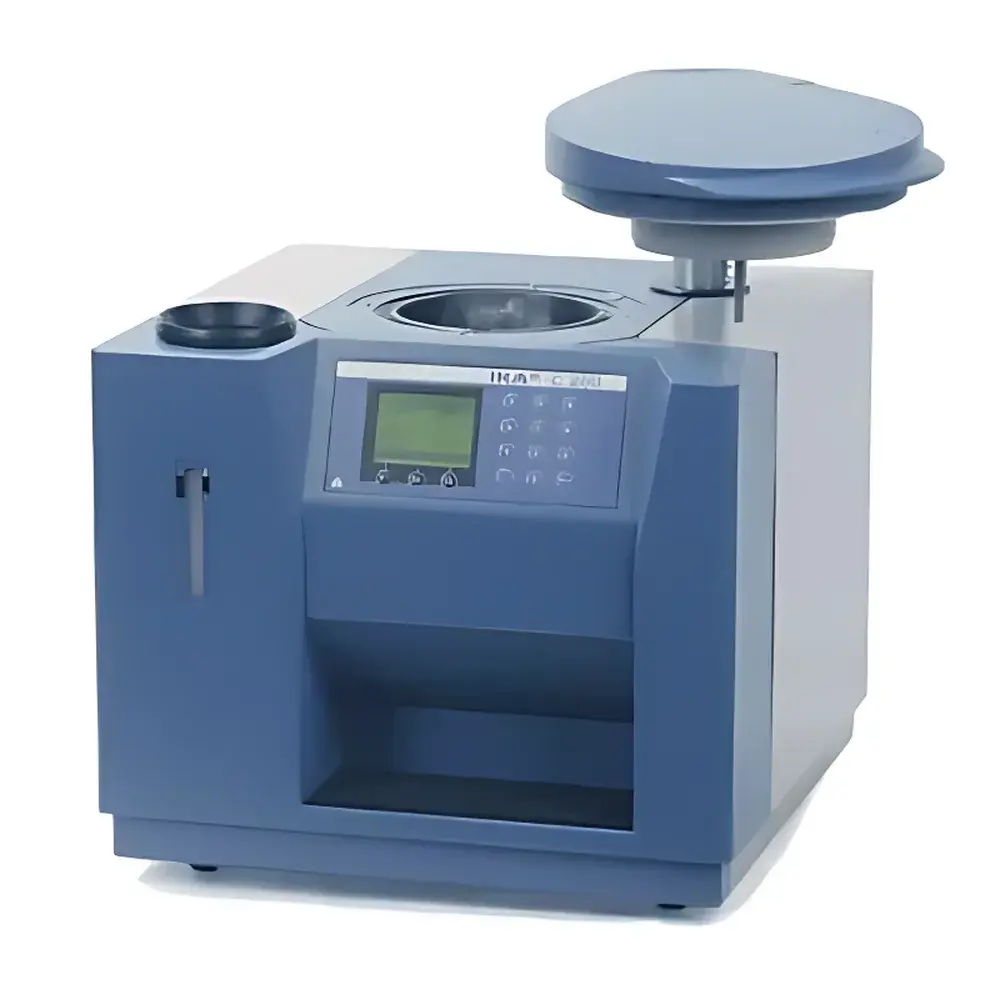
IKA C200 Oxygen Bomb Calorimeter
| Brand | IKA |
|---|---|
| Origin | Germany |
| Model | C200 |
| Measurement Modes | Isothermal, Fast Dynamic, Manual, Time-Controlled |
| Standards Compliance | DIN 51900, ISO 1928, ASTM D240, ASTM D4809, ASTM D5865, ASTM D1989, ASTM D5468, ASTM E711 |
| Max Energy Range | 40,000 J |
| Operating Voltage | 24 V DC (instrument), 100–240 V AC / 50–60 Hz (external power supply) |
| Power Consumption | ≤100 W (calorimeter), ≤120 W (system) |
| Dimensions (W×D×H) | 400 × 400 × 400 mm |
| Weight | 21 kg |
| Protection Class | IP21, Class III |
| Ambient Conditions | 20–25 °C, ≤80 % RH, up to 2,000 m altitude |
| Interfaces | 1× RS-232, 1× Centronics parallel port |
| Software | Calwin C 5040 (real-time monitoring, data export to Excel/Word) |
Overview
The IKA C200 Oxygen Bomb Calorimeter is a precision benchtop instrument engineered for accurate determination of gross calorific value (GCV) of solid and liquid fuels, biomass, waste materials, and other combustible substances. Based on the principle of adiabatic or near-isothermal oxygen bomb combustion, the C200 measures heat released during complete oxidation under high-pressure oxygen (typically 30 bar), enabling traceable, reproducible energy quantification in accordance with internationally recognized thermodynamic standards. Its modular thermal design isolates the inner vessel (water-filled calorimeter bucket) from ambient fluctuations, while the 24 V DC low-voltage operation ensures intrinsic electrical safety—critical for educational laboratories, quality control environments, and routine industrial testing where operator safety and regulatory compliance are paramount.
Key Features
- Four configurable measurement modes: Isothermal (standard for highest accuracy), Fast Dynamic (optimized for throughput without compromising repeatability), Manual (pedagogical mode with user-initiated ignition and manual calculation), and Time-Controlled (fixed-duration protocol for standardized screening)
- Integrated 24 V DC calorimeter unit powered via universal 100–240 V AC input—eliminates need for dedicated lab wiring and supports global deployment
- Rugged mechanical architecture with IP21 ingress protection and Class III double-insulated construction, compliant with DIN EN 60529 and IEC 61010-1 for laboratory equipment safety
- Real-time thermal monitoring via high-resolution temperature sensors with <0.001 K resolution; maximum energy capacity of 40,000 J corresponds to ~4 K temperature rise in the inner water bath
- Intuitive graphical display with context-sensitive menu navigation—no training required for basic operation
- Robust oxygen bomb assembly rated to 30 bar, featuring stainless steel construction, leak-tested sealing, and certified pressure relief mechanisms per PED 2014/68/EU
Sample Compatibility & Compliance
The C200 accommodates standard 0.5–1.5 g solid samples (e.g., coal, coke, wood pellets, refuse-derived fuel) and 0.2–0.5 mL liquid fuels (e.g., diesel, biodiesel, heating oil) in crucibles compatible with benzoic acid calibration. Sample pans, ignition wires, and cotton threads meet ASTM E698 specifications for thermal stability and consistent combustion kinetics. All operational protocols adhere strictly to DIN 51900 (solid fuels), ISO 1928 (solid and liquid fuels), and the full suite of ASTM methods cited—including D240 (petroleum products), D4809 (liquid hydrocarbons), D5865 (coal and coke), and E711 (waste materials). The system supports GLP-aligned documentation when used with Calwin C 5040, including audit-trail-enabled parameter logging and electronic signature support.
Software & Data Management
Calwin C 5040 is a Windows-based acquisition and analysis platform that interfaces with the C200 via RS-232 serial communication. It provides real-time visualization of temperature vs. time curves, automatic baseline correction, and algorithmic compensation for fuse wire, cotton thread, and nitric acid formation corrections per ISO 1928 Annex B. Raw data (timestamped T/t series, ignition events, final equilibrium detection) are exported in CSV format for post-processing in Excel or statistical packages. The software maintains full traceability: each measurement file embeds instrument ID, operator name, calibration certificate references, environmental metadata (ambient T/RH), and digital signatures compliant with FDA 21 CFR Part 11 requirements when configured with appropriate user access controls and electronic record settings.
Applications
- Fuel certification labs performing contractual GCV verification for coal trading, biomass co-firing, and municipal solid waste characterization
- University teaching laboratories demonstrating first-law thermodynamics, enthalpy of combustion, and calorimetric calibration procedures
- Industrial QC departments validating raw material consistency across batches of biofuels, plastics, or pharmaceutical excipients
- Environmental testing facilities assessing energy recovery potential of alternative fuels under EU Waste Framework Directive reporting requirements
- Research institutes conducting comparative studies on pyrolysis char energy density or catalytic combustion efficiency
FAQ
What standards does the C200 directly support out-of-the-box?
The instrument’s firmware and Calwin C 5040 software implement calculation algorithms and reporting templates aligned with DIN 51900, ISO 1928, ASTM D240, D4809, D5865, D1989, D5468, and E711—including mandatory corrections for acid formation and ignition energy.
Is the C200 suitable for accredited testing laboratories?
Yes—when operated within specified environmental conditions (20–25 °C, ≤80 % RH), calibrated using NIST-traceable benzoic acid, and documented via Calwin C 5040 with enabled audit trails, it meets ISO/IEC 17025 technical requirements for calorimetry.
Can the C200 be integrated into a LIMS environment?
Via RS-232 ASCII output and configurable CSV export paths in Calwin C 5040, the system supports middleware-driven ingestion into most LIMS platforms; custom API extensions are available upon request.
What maintenance is required for long-term accuracy?
Annual verification of temperature sensor linearity (using certified Pt100 reference), biannual oxygen bomb hydrostatic testing at 1.5× working pressure, and quarterly cleaning of the inner bucket and stirrer mechanism per IKA Maintenance Guide C200-MG-EN.



