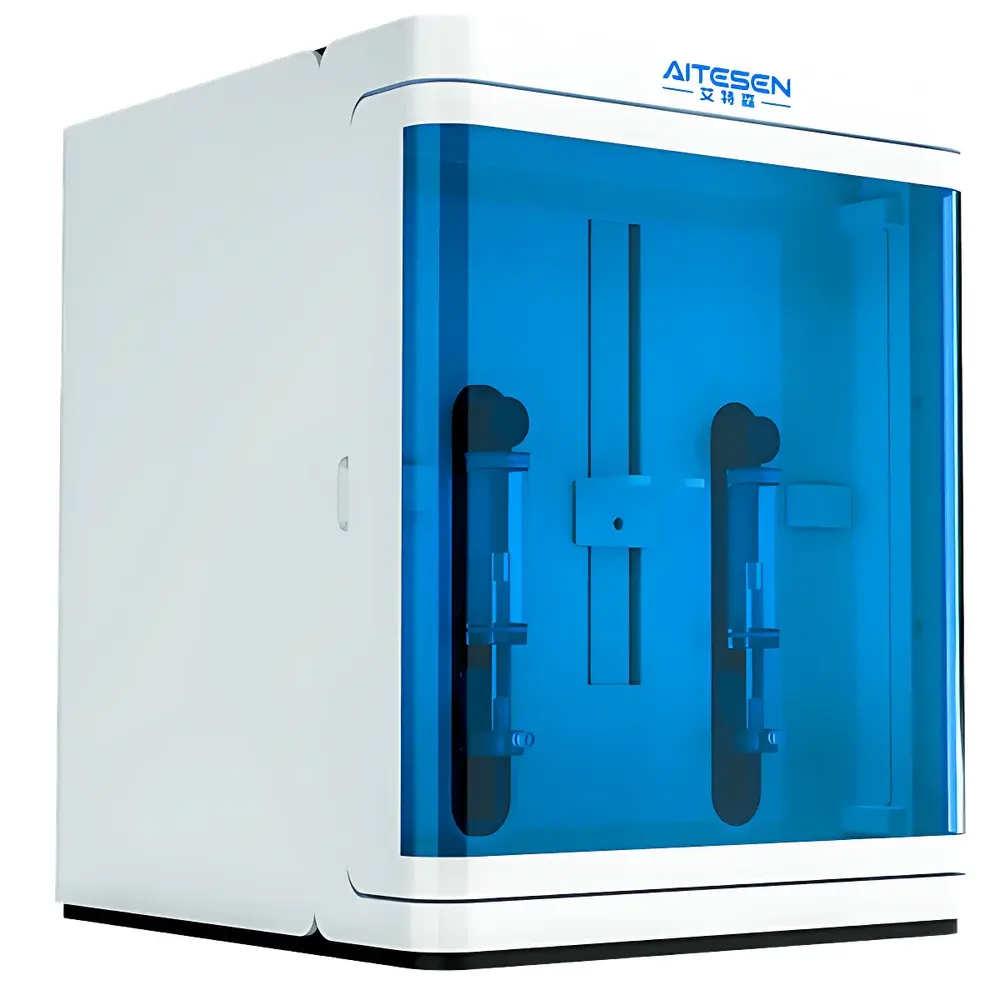
Aitesen MPE-L2 Microfluidic Nanomedicine Production System
| Brand | Aitesen |
|---|---|
| Origin | Jiangsu, China |
| Manufacturer Type | Authorized Distributor |
| Product Category | Domestic |
| Model | MPE-L2 |
| Carrier Type | Lipid Nanoparticles (LNP) |
| Sample Volume Range | Low-volume (µL–mL scale) |
| Particle Size Control Range | Down to <100 nm |
| Polydispersity Index (PDI) | <0.1 |
| Operational Mode | Continuous-flow, multi-injection capable |
| Compliance Framework | Designed for GLP-compliant process development and PAT-integrated workflows |
Overview
The Aitesen MPE-L2 Microfluidic Nanomedicine Production System is an engineered platform for the controlled, continuous synthesis of lipid nanoparticles (LNPs) and other nanocarrier formulations used in mRNA delivery, siRNA therapeutics, and vaccine development. It operates on the principles of laminar and turbulent microfluidic mixing—governed by precise Reynolds number modulation within geometrically defined microchannels—to enable reproducible nanoprecipitation, solvent displacement, and double-emulsion formation. Unlike batch-based sonication or thin-film hydration methods, the MPE-L2 implements a deterministic hydrodynamic environment where fluid residence time, shear rate, mixing ratio (A:B phase), and interfacial energy are independently tunable parameters. This architecture supports early-stage formulation screening, process parameter mapping (DoE), and scalable technology transfer—bridging the gap between lab-scale discovery and GMP-relevant process validation.
Key Features
- Modular dual-syringe pump system with independent flow control for precise A/B phase delivery (e.g., lipid ethanol solution + aqueous buffer), enabling stoichiometric accuracy down to ±0.5% CV
- On-the-fly multi-injection capability: allows sequential introduction of additional reagents (e.g., PEG-lipids, stabilizers, or post-formulation modifiers) without interrupting the primary emulsification stream
- Interchangeable high-pressure microfluidic chips with configurable channel geometries—including T-junction, herringbone, and staggered pillar designs—to tailor mixing regime (laminar vs. transitional vs. turbulent) and residence time distribution
- Integrated pressure monitoring and real-time flow feedback loop to maintain stable operation under variable backpressure conditions (up to 20,000 psi)
- Compact benchtop footprint (W × D × H: 420 × 380 × 260 mm) with CE-marked electrical safety and IP20-rated enclosure for laboratory use
- Chip-mounting interface compatible with industry-standard PDMS, glass, or silicon-based microfluidic devices; supports rapid chip replacement and cleaning protocols
Sample Compatibility & Compliance
The MPE-L2 accommodates a broad range of nanocarrier chemistries beyond LNP formulations—including polymeric nanoparticles (PLGA, chitosan), liposomes, exosome-mimetics, and inorganic colloids (e.g., iron oxide or gold nanoclusters)—provided viscosity remains below 20 cP and particulate content is filtered to ≤0.22 µm pre-injection. All wetted components are constructed from chemically inert stainless steel (316L), PEEK, and fluoropolymer tubing, ensuring compatibility with organic solvents (ethanol, isopropanol), acidic/basic buffers (pH 2–12), and surfactants (e.g., DSPE-PEG2000). The system is designed to support compliance with ICH Q5A(R2), USP , and ISO 13485-aligned documentation practices. While not a GMP-certified instrument per se, its architecture enables full audit trails when paired with validated third-party data acquisition software—meeting FDA 21 CFR Part 11 requirements for electronic records and signatures in regulated environments.
Software & Data Management
The MPE-L2 operates via a dedicated Windows-based control interface that logs all critical process parameters—including individual pump flow rates, system pressure, elapsed time, temperature (via optional external probe), and chip identification—into timestamped CSV files. Exported datasets are structured for direct import into statistical analysis tools (e.g., JMP, Python pandas) and comply with ISA-88/ISA-95 hierarchical modeling conventions for batch process definition. Optional integration with PAT-ready spectrophotometers (e.g., inline UV-Vis or DLS modules) enables closed-loop feedback control based on real-time particle size or absorbance trends. All configuration files, method templates, and calibration records are stored with version control and user-access permissions—supporting ALCOA+ data integrity principles (Attributable, Legible, Contemporaneous, Original, Accurate, Complete, Consistent, Enduring, Available).
Applications
- Preclinical LNP formulation optimization for nucleic acid delivery (mRNA, saRNA, CRISPR RNP)
- Rapid screening of lipid molar ratios, PEG-lipid density, and ionizable amine pKa effects on encapsulation efficiency and colloidal stability
- Continuous manufacturing of sterile-filterable nanotherapeutics under ISO Class 5 hood-compatible conditions
- Process analytical technology (PAT) implementation for Quality-by-Design (QbD) workflows aligned with ICH Q8(R3)
- Scale-down modeling of commercial microfluidic production lines (e.g., matching residence time distributions observed at pilot scale)
- Teaching and training platforms for microfluidics-based pharmaceutical engineering curricula
FAQ
What types of nanoparticle carriers can be prepared using the MPE-L2?
The system is optimized for lipid nanoparticles (LNPs), but also supports liposomes, polymeric NPs (e.g., PLGA), micelles, and hybrid inorganic-organic colloids—subject to solvent compatibility and viscosity constraints.
Is the MPE-L2 suitable for GMP manufacturing?
It is intended for R&D, process development, and early clinical material generation—not final commercial manufacturing. However, its design facilitates seamless transition to GMP-compliant microfluidic platforms through identical fluidic principles and documented process parameters.
Can the system be integrated with real-time particle sizing instruments?
Yes—via standard analog/digital I/O ports and TCP/IP communication, the MPE-L2 supports synchronization with commercial inline DLS, UV-Vis, or FFF systems for automated feedback control.
What maintenance is required for long-term operational reliability?
Routine tasks include syringe pump calibration every 200 hours, microfluidic chip inspection after each run, and quarterly verification of pressure transducer linearity per ISO/IEC 17025 guidelines.
Does Aitesen provide application support for formulation development?
Authorized distributors offer technical consultation, method development workshops, and chip design advisory services—aligned with client-specific regulatory submission strategies (e.g., IND-enabling studies).
Related Products