
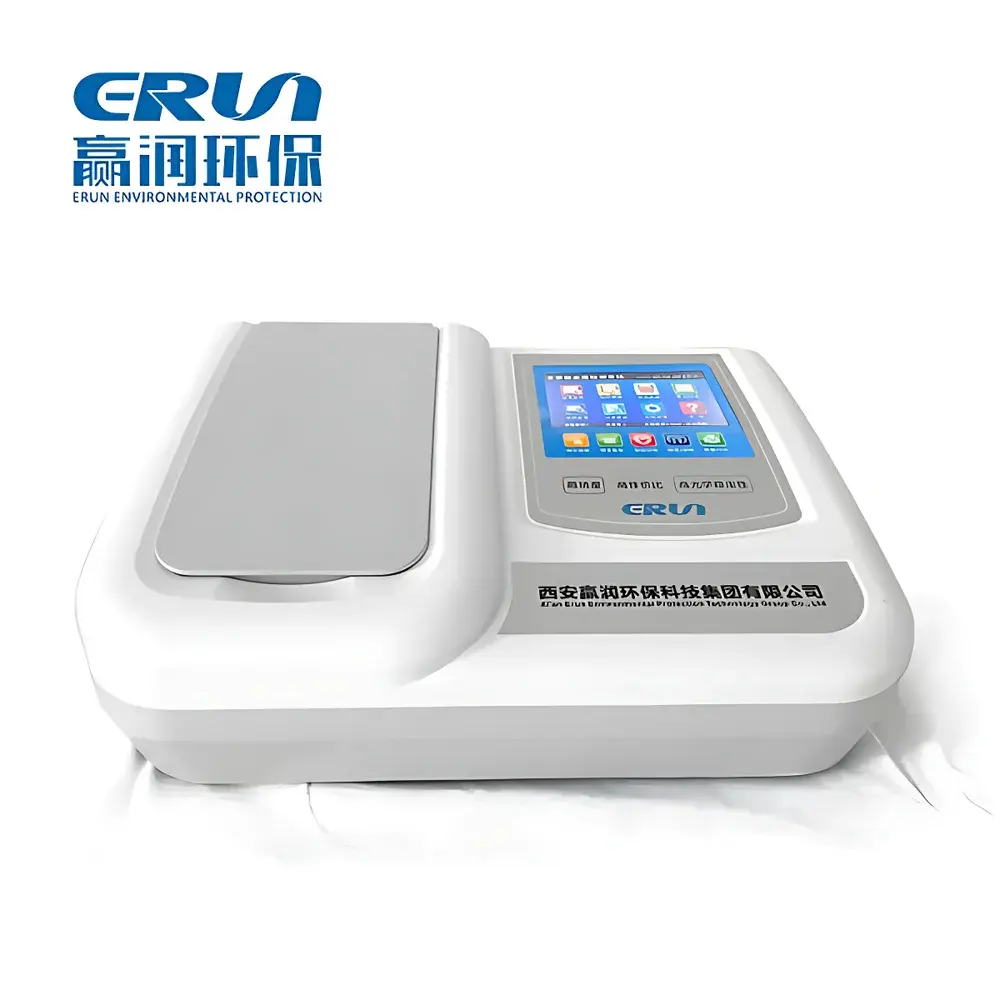
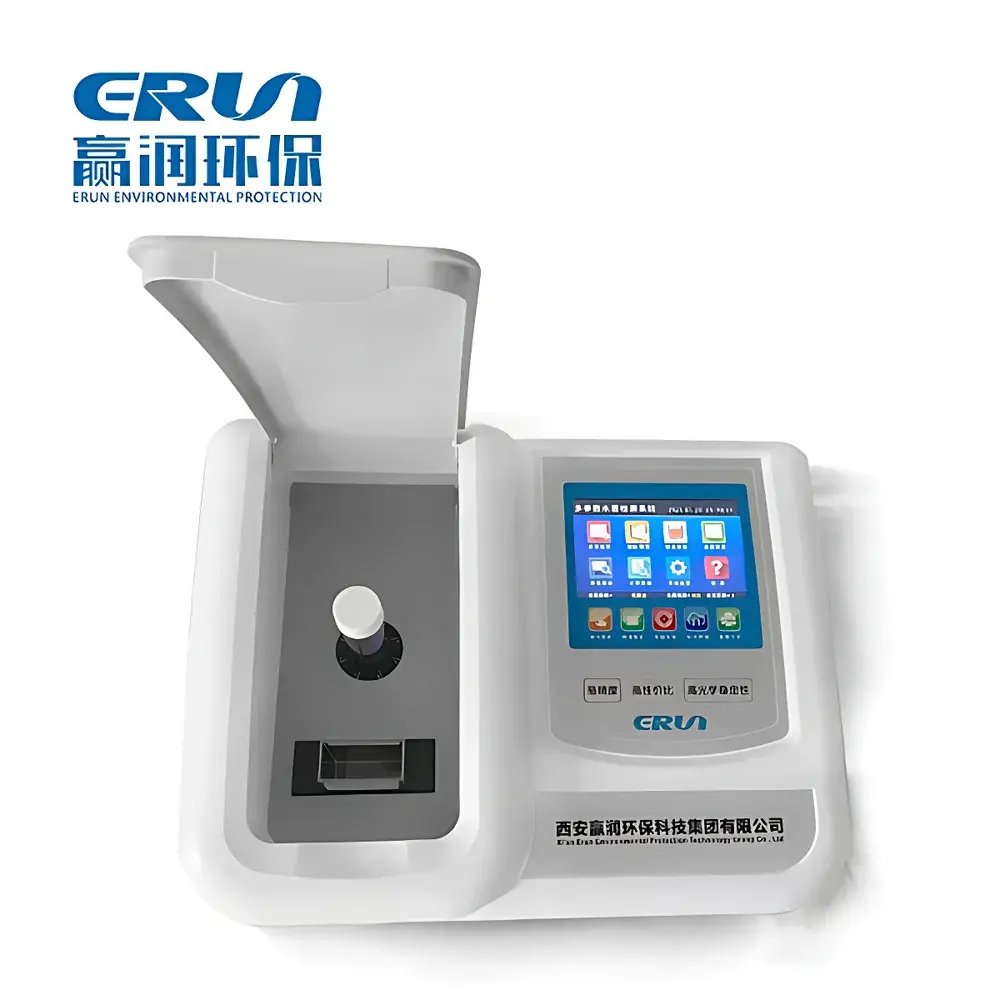
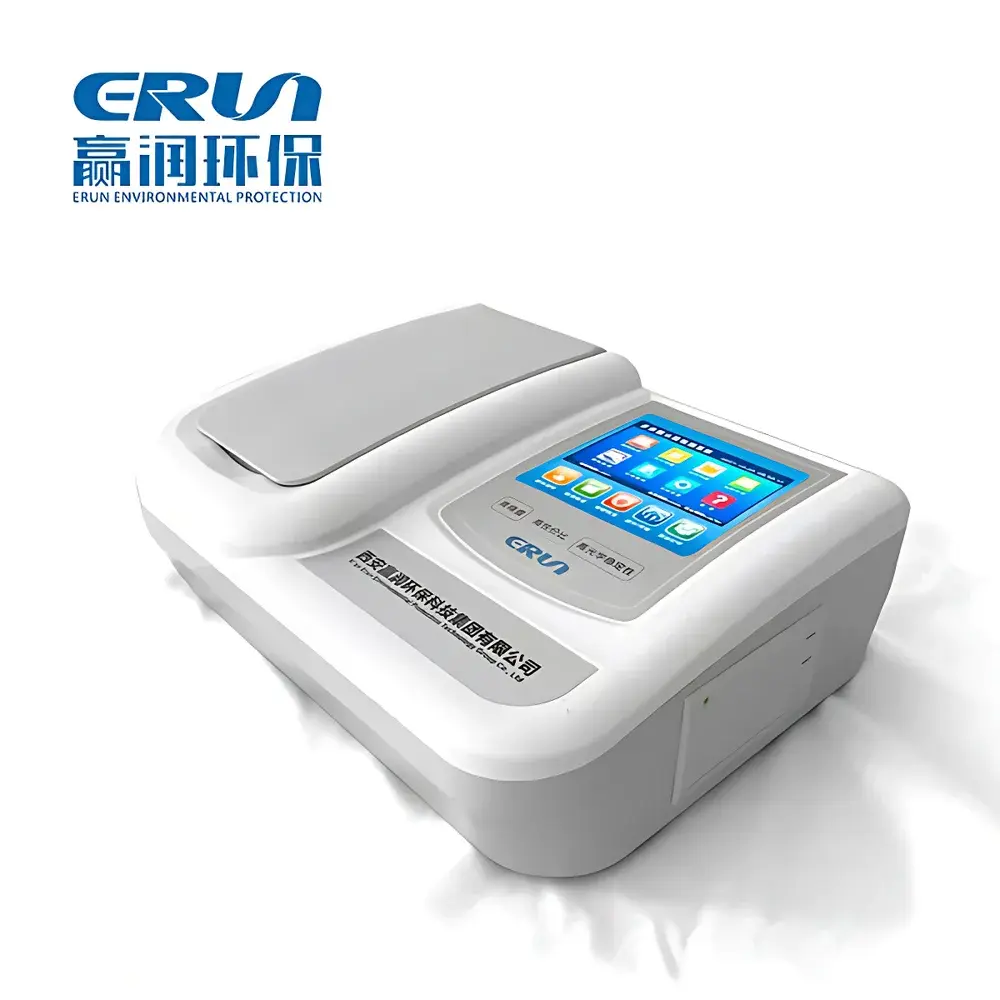
ERUN-ST7-B4 Volatile Phenol Analyzer (Laboratory Benchtop Spectrophotometric Analyzer)
| Brand | ERUN |
|---|---|
| Origin | Shaanxi, China |
| Manufacturer Type | Authorized Distributor |
| Country of Manufacture | China |
| Model | ERUN-ST7-B4 |
| Instrument Type | Laboratory Benchtop Volatile Phenol Analyzer |
| Measurement Principle | Spectrophotometry (4-Aminoantipyrine Method per ISO 6439 & HJ 503-2009) |
| Range | 0.2–10.00 mg/L |
| Accuracy | ±5% FS |
| Repeatability | ≤2% RSD |
| Baseline Drift | <0.002 Abs/30 min |
| Wavelength Selection | Auto-selectable (500 nm standard for phenol detection) |
| Optical System | Fixed-wavelength LED-based photometer with calibrated optical path |
| Light Intensity Control | 16-step adjustable intensity |
| Calibration Curve Options | Linear or Multi-point Nonlinear (up to 8 calibration points) |
| Data Storage | 100,000 records (timestamp, absorbance, transmittance, concentration, user ID, curve ID) |
| Display | 7-inch capacitive color touchscreen with on-screen operation guide |
| Connectivity | USB 2.0 host port for data export (CSV format), no network or cloud interface |
| Power Supply | AC 220 V ±10%, 50 Hz ±0.5 Hz |
| Environmental Requirements | Stable lab environment — no direct sunlight, minimal vibration, low EMI |
| Compliance | Designed to support compliance with ISO/IEC 17025 quality management systems |
Overview
The ERUN-ST7-B4 Volatile Phenol Analyzer is a dedicated benchtop spectrophotometric instrument engineered for precise quantification of volatile phenolic compounds in aqueous environmental samples. It implements the standardized 4-aminoantipyrine (4-AAP) colorimetric reaction—codified in ISO 6439:1982 and Chinese national standard HJ 503–2009—to generate a stable pink-colored quinoneimine dye proportional to phenol concentration. The analyzer operates at a fixed, factory-validated wavelength of 500 nm, eliminating manual wavelength alignment while ensuring high spectral fidelity. Its optical architecture features a temperature-stabilized LED light source, precision-aperture sample holder, and low-noise photodiode detection—designed to minimize stray light interference and deliver consistent photometric performance across extended operational cycles. Unlike portable or field-deployable units, the ERUN-ST7-B4 is optimized for controlled laboratory environments where reproducibility, traceability, and regulatory documentation are primary requirements.
Key Features
- Automated wavelength selection centered at 500 nm—no manual calibration or grating adjustment required
- 16-level programmable light intensity control to optimize signal-to-noise ratio across low- and high-concentration ranges (0.2–10.00 mg/L)
- Configurable calibration modes: linear regression or multi-point nonlinear fitting (up to 8 standards), enabling accurate quantification even for nonideal reaction kinetics
- Integrated data integrity safeguards: automatic timestamping, user-ID tagging, and dual-layer backup for calibration curves and measurement logs
- 7-inch high-resolution capacitive touchscreen with embedded contextual help—guides users through reagent addition, blanking, measurement, and report generation
- Onboard storage capacity for 100,000 complete records, each containing absorbance (A), transmittance (%T), calculated concentration (mg/L), operator ID, date/time stamp, and active calibration curve identifier
- USB 2.0 host interface supporting direct export of CSV-formatted datasets to external PCs—compatible with LIMS import protocols and spreadsheet-based QA/QC review
Sample Compatibility & Compliance
The ERUN-ST7-B4 is validated for use with clarified, filtered, or distilled water samples—including surface water, groundwater, drinking water pre-treatment streams, and industrial effluents from coking plants, coal gasification facilities, synthetic ammonia production, pulp & paper mills, and petrochemical wastewater treatment units. Sample preparation follows HJ 503–2009: distillation under acidic conditions (pH ≤ 4) to isolate volatile phenols prior to derivatization. While the instrument itself does not perform distillation, its photometric module is designed to accept standardized 10-mm quartz or high-transmission glass cuvettes (10 × 10 × 45 mm). The system supports GLP-aligned workflow documentation: all measurements retain immutable metadata, and calibration history is retained independently of user sessions. Though not FDA 21 CFR Part 11 certified out-of-the-box, audit trails generated via USB export meet minimum requirements for ISO/IEC 17025 internal audits when paired with institutional SOPs.
Software & Data Management
Operation is fully self-contained within the embedded firmware—no external PC or proprietary software installation is required. The touchscreen GUI provides real-time visualization of raw absorbance values, % transmittance, and concentration output. All calibration curves are stored in non-volatile memory with versioned identifiers. Critical parameters—including photometric zero stability, dark current drift, and LED intensity decay—are logged internally for preventive maintenance assessment. Data export via USB generates time-ordered CSV files with column headers compliant with common laboratory informatics systems: “Timestamp”, “Operator_ID”, “Sample_ID”, “Absorbance_500nm”, “Transmittance_%”, “Conc_mg_L”, “Curve_ID”, “RSD_%”. No cloud connectivity, remote access, or automatic firmware updates are implemented—ensuring deterministic behavior and cybersecurity isolation per ITAR- and NIST SP 800-53-aligned lab policies.
Applications
The ERUN-ST7-B4 serves as a core analytical tool in municipal and industrial environmental laboratories conducting routine compliance monitoring under national discharge permits. Its primary application domains include:
- Pre-compliance screening of coke oven wastewater prior to biological treatment
- Quality assurance testing of effluent from coal-to-chemical synthesis trains (e.g., Fischer–Tropsch and methanol production)
- Verification of phenol removal efficiency in activated carbon or advanced oxidation process (AOP) pilot studies
- Method validation and inter-laboratory comparison exercises aligned with CNAS accreditation criteria
- Educational use in university environmental engineering labs for teaching standardized colorimetric analysis principles
It is not intended for continuous online monitoring, unattended operation, or direct integration into SCADA systems.
FAQ
Does the ERUN-ST7-B4 comply with US EPA Method 420.1 or ASTM D1783?
No—it implements the 4-AAP method per ISO 6439 and HJ 503–2009. While chemically analogous, it is not validated against U.S. regulatory methods and lacks associated EPA certification documentation.
Can the instrument store custom reagent lot-specific calibration curves?
Yes—each calibration session is saved with user-defined identifiers, allowing lot-specific curve libraries to be recalled and applied without overwriting prior configurations.
Is thermal compensation included for ambient temperature fluctuations?
No—optical and electronic components are stabilized for operation within 15–30 °C ambient range, but no active temperature control or compensation algorithm is embedded.
What is the maximum allowable turbidity for sample analysis?
Samples must be filtered to <1 NTU prior to analysis; residual suspended solids will scatter incident light and invalidate absorbance readings.
Does the device support password-protected user roles?
No—it offers single-level operator access; administrative functions (e.g., calibration reset, data purge) require physical USB key authentication or service-mode entry via hidden menu sequence.







