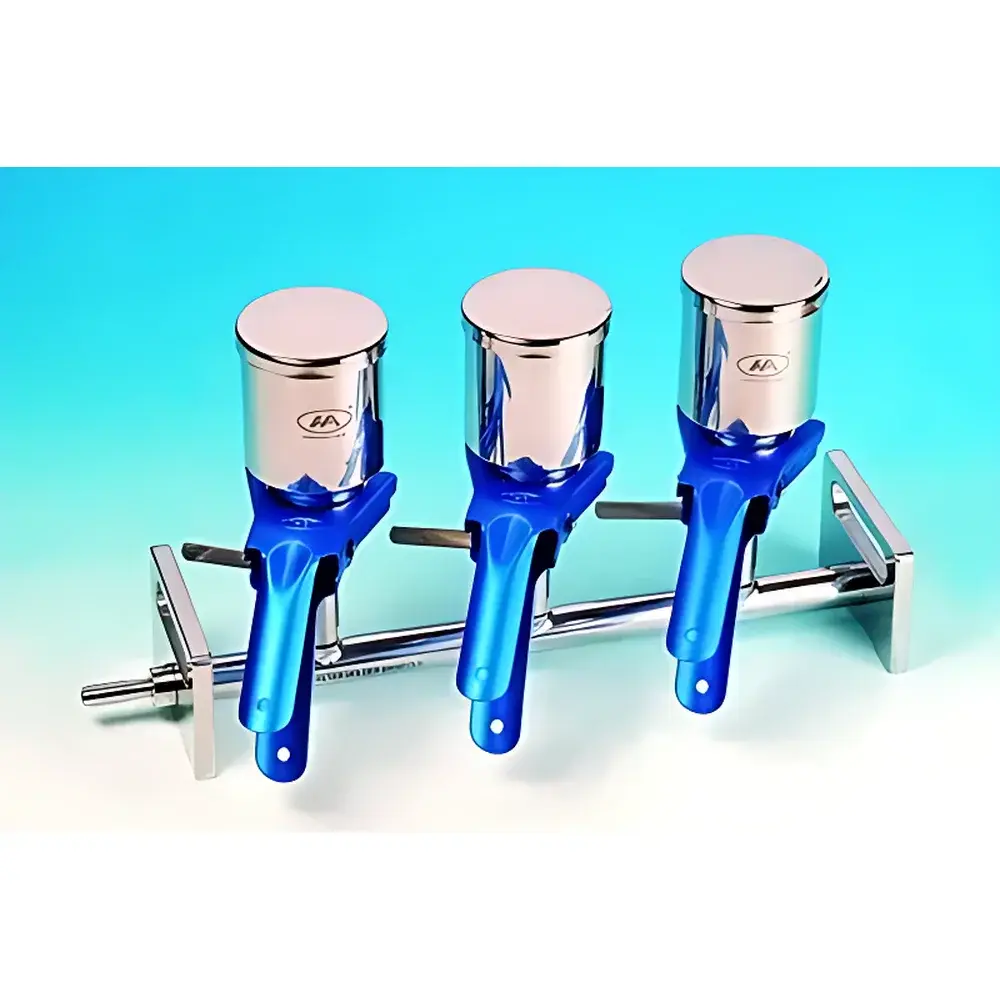
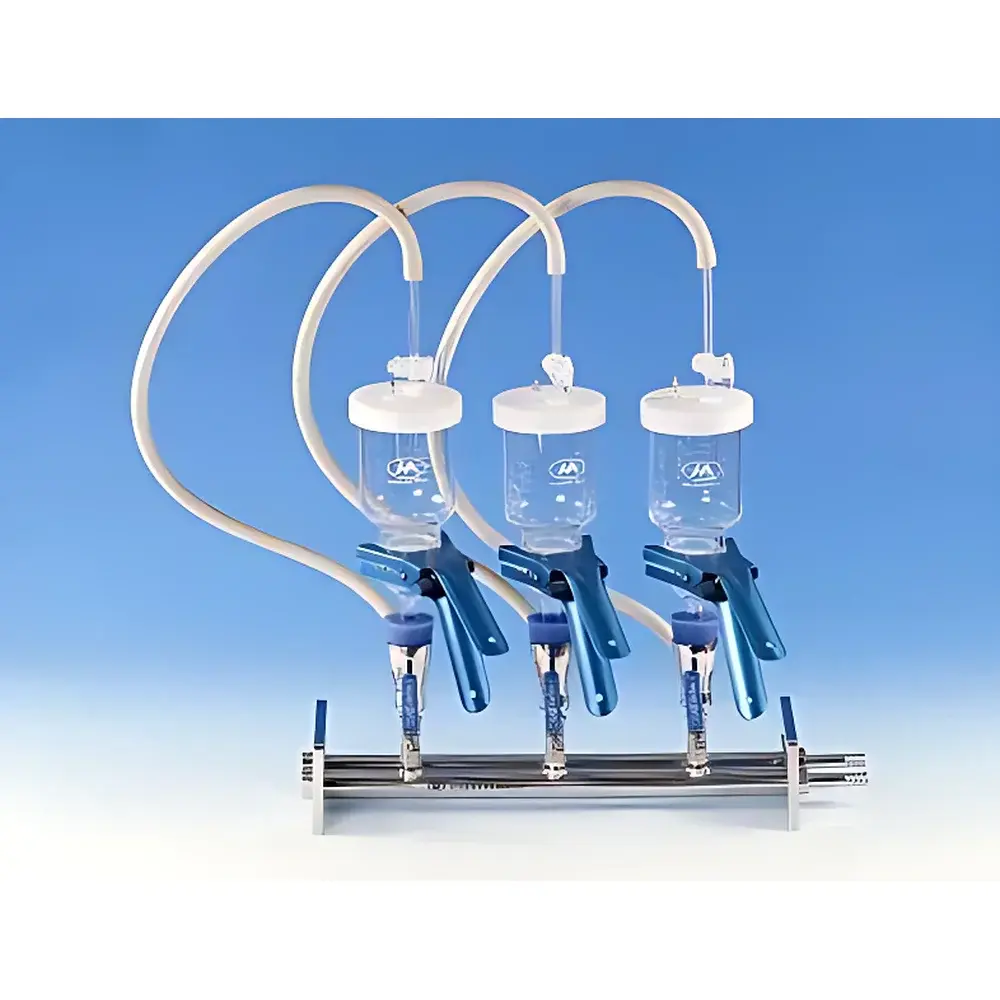
HengAo HSF-S3/S6 Stainless Steel Multi-Station Filtration System
| Brand | Tianjin HengAo |
|---|---|
| Origin | Tianjin, China |
| Manufacturer Type | Direct Manufacturer |
| Product Line | HSF-S1/S3/S6 (Stainless Steel Configuration) |
| Material | 316L Surgical-Grade Stainless Steel |
| Sterilization Compatibility | Autoclavable up to 180°C |
| Filter Capacity | 1/3/6 Stations (Configurable) |
| Compliance | USP <71> Sterility Testing, ISO 8573-1 Clean Air Classification (when used with certified vacuum source) |
| Vacuum Interface | Standard 1/4" NPT or Quick-Connect Fitting |
| Filtration Vessel Options | Removable 250 mL or 500 mL Stainless Steel Filter Cups with Sintered 316L Stainless Steel Frits (Pore Size: 0.2 µm or 0.45 µm standard) |
| Valve Type | Individual On/Off Ball Valves per Station |
| Sealing | FDA-Compliant Silicone or EPDM O-Rings (USP Class VI certified) |
| Dimensions (S6) | 320 × 220 × 280 mm (W × D × H) |
| Weight (S6) | 4.8 kg |
Overview
The HengAo HSF-S3 and HSF-S6 Stainless Steel Multi-Station Filtration Systems are engineered for high-integrity, parallel sterile filtration in regulated life science environments. Based on positive-pressure–assisted vacuum-driven membrane filtration, these systems operate under controlled negative pressure (typically –0.09 to –0.1 MPa) to draw liquid samples through standardized microporous membranes mounted in precision-machined stainless steel filter cups. Each station features independent flow control via stainless steel ball valves, enabling selective filtration without cross-contamination or system depressurization. The architecture complies with fundamental principles outlined in USP Sterility Tests and supports aseptic technique execution per ISO 13408-1. Designed for reproducible membrane retention testing, microbial recovery validation, and particulate load assessment, the HSF-S series eliminates variability introduced by sequential single-sample filtration—thereby reducing operator-induced error and improving inter-batch comparability in QC laboratories.
Key Features
- 316L surgical-grade stainless steel construction throughout—filter cups, support frame, manifold, and valve bodies—ensuring corrosion resistance against aggressive solvents, organic acids, and alkaline solutions (pH 1–14).
- Autoclavable at 121°C for 30 min or 180°C for 15 min (dry heat), validated for repeated sterilization cycles without dimensional drift or surface passivation loss.
- Individual quarter-turn stainless steel ball valves per station provide precise, tactile flow isolation—critical for maintaining sterility integrity during multi-sample workflows.
- Interchangeable sintered 316L frits (0.2 µm or 0.45 µm pore size, certified per ASTM E2954) serve as durable, non-shedding membrane supports compatible with nitrocellulose, PVDF, PES, and nylon membranes.
- Modular design allows seamless integration with standard laboratory vacuum pumps (≥25 L/min free air displacement), borosilicate glass or stainless steel collection flasks (250 mL or 500 mL), and ISO-certified inline filters for vacuum line protection.
- No adhesives, plastics, or glued joints in wetted pathways—eliminating extractables risk and ensuring full compliance with ICH Q5A and Q5D guidance for biopharmaceutical process validation.
Sample Compatibility & Compliance
The HSF-S3/S6 accommodates aqueous buffers, cell culture supernatants, fermentation broths, parenteral solutions, environmental water samples, and low-viscosity biologics (≤25 cP). It is routinely deployed in sterility testing of large-volume parenterals (LVPs), microbial limit testing per USP , endotoxin sample preparation per USP , and filter validation per ASTM F838-22. All wetted surfaces meet FDA 21 CFR Part 11 requirements when paired with compliant data logging systems. The system’s mechanical design satisfies ISO 14644-1 Class 5 cleanroom handling protocols when operated inside laminar flow hoods or isolators. Documentation packages include material traceability certificates (EN 10204 3.1), surface roughness reports (Ra ≤ 0.8 µm), and passivation verification per ASTM A967.
Software & Data Management
While the HSF-S3/S6 is a manually operated hardware platform, it integrates with industry-standard digital workflows. When used alongside validated vacuum controllers (e.g., KNF N86 KT.18 or Vacuubrand PC 3001 Vario), real-time pressure logging, cycle timestamping, and alarm-triggered event capture are achievable. Raw filtration data—including duration per station, applied vacuum level, and observed breakthrough—can be exported to LIMS or ELN platforms via CSV or OPC UA interfaces. Audit trails for filter lot numbers, operator IDs, and sterilization batch records are maintained externally in accordance with GLP and GMP Annex 11 requirements.
Applications
- Sterility testing of injectables, ophthalmic solutions, and medical device rinsates per USP and Ph. Eur. 2.6.1.
- Microbial enumeration in pharmaceutical excipients and raw materials per USP and ISO 21528-2.
- Clarification and particulate removal prior to HPLC or LC-MS analysis of biological matrices.
- Pre-filtration of culture media and buffer solutions in upstream bioprocessing suites.
- Environmental monitoring of cleanroom rinse waters and HVAC condensates per ISO 14644-2.
- Validation of filter compatibility and bacterial retention using Brevundimonas diminuta challenge tests (ASTM F838-22).
FAQ
Can the HSF-S6 be used for sterility testing of oil-based formulations?
No—oil-based or highly viscous (>50 cP) samples require pre-dilution with compatible solvents or alternative pressure-driven filtration systems due to capillary resistance limitations inherent in vacuum-based designs.
Is third-party calibration certification available for the HSF-S series?
Yes—certified calibration services (including pressure decay verification and valve leak testing) are offered by HengAo’s ISO/IEC 17025-accredited partner labs upon request.
What membrane diameters are supported?
Standard 47 mm and 50 mm diameter membranes; custom adapters for 25 mm membranes are available as optional accessories.
Does the system include a vacuum pump?
No—the HSF-S3/S6 is supplied as a filtration manifold only; vacuum pump selection must comply with local noise, oil-free, and exhaust filtration regulations.
How often should the sintered frits be replaced?
Under routine use with proper cleaning (e.g., 1% NaOH followed by deionized water rinse and autoclaving), frits maintain structural integrity for ≥500 filtration cycles; replacement is recommended after visible pitting or increased differential pressure across the frit.