
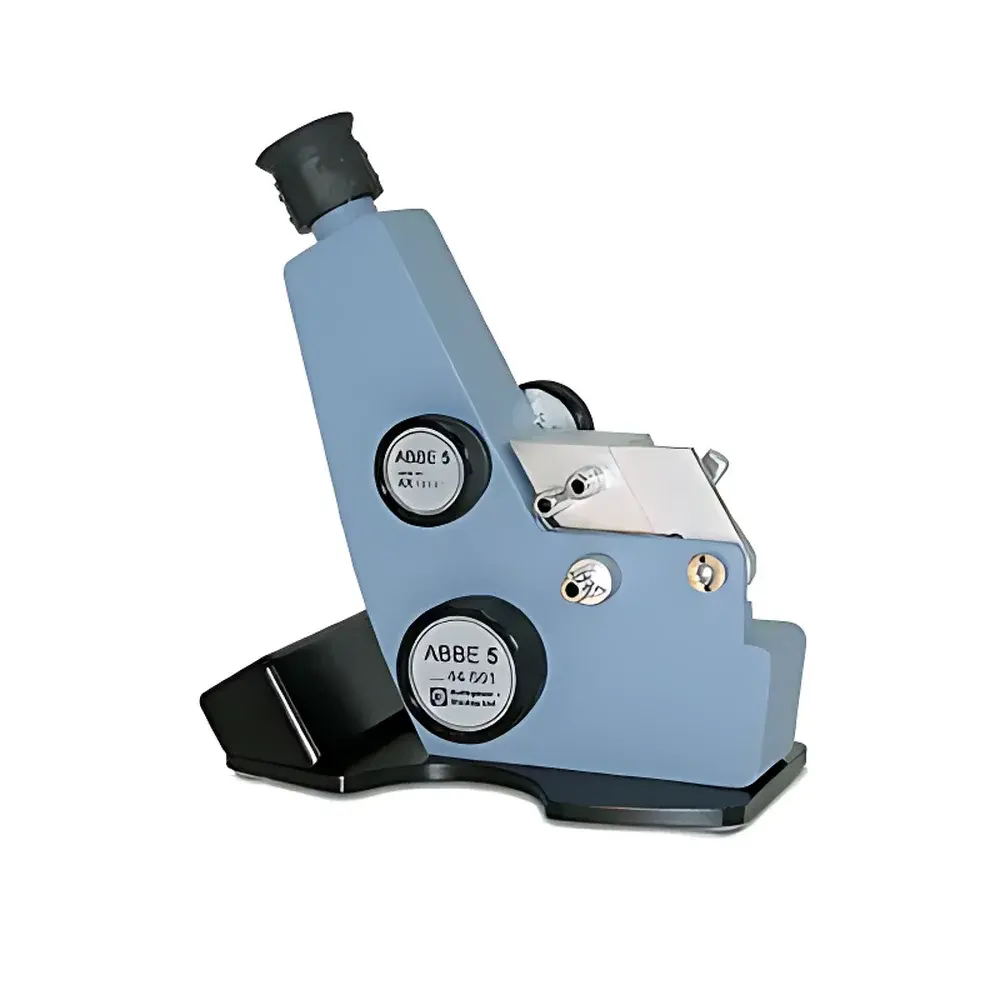
Bellingham + Stanley Abbe5 Refractometer
| Brand | Bellingham + Stanley |
|---|---|
| Origin | United Kingdom |
| Model | Abbe5 |
| Measurement Range | 1.30–1.70 RI, 0–95 % °Brix |
| Resolution | 0.0005 RI, 0.25 % °Brix |
| Operating Temperature | 5–70 °C |
| Temperature Display | Built-in digital sensor, 0.1 °C resolution |
| Light Source | Sodium D-line (589.3 nm) |
| Housing | Chemical-resistant, IP-rated enclosure |
| Compliance | BS EN ISO 9001:2000, UKAS-accredited manufacturing, CE marked |
Overview
The Bellingham + Stanley Abbe5 Refractometer is a precision optical instrument engineered for accurate and repeatable refractive index (RI) and Brix concentration measurements across laboratory, educational, and quality control environments. Based on the classical Abbe principle—utilizing total internal reflection at the prism-sample interface—the Abbe5 delivers traceable, temperature-compensated readings in accordance with internationally recognized optical metrology standards. Its design adheres to the fundamental requirements of ISO 21648 (refractometry), ASTM D1218 (liquid hydrocarbons), and USP (refractive index determination in pharmaceutical excipients). Unlike digital handheld units, the Abbe5 employs a high-stability glass prism assembly with calibrated collimated illumination, enabling direct visual observation of the critical angle boundary—a method preferred for method validation, reference material verification, and calibration transfer between instruments.
Key Features
- Optical architecture optimized for long-term stability: precision-ground BK7 glass prisms with anti-reflective coating and rigid aluminum alloy housing ensure minimal thermal drift and mechanical hysteresis over repeated use.
- Manual focusing eyepiece with fine-adjustment vernier scale allows precise alignment of the shadow line, supporting operator-dependent uncertainty control per ISO/IEC 17025 guidelines.
- Integrated Peltier-assisted temperature sensing (not active control) provides real-time sample-interface temperature monitoring with ±0.2 °C accuracy, referenced to the prism surface—not ambient air—enabling correction via built-in nomographic scales or external software.
- Wide dynamic range accommodates diverse sample classes: transparent liquids (e.g., solvents, essential oils), translucent gels (e.g., agarose, hydrogels), and polished solids (e.g., polymers, optical glasses) when coupled with appropriate contact fluid (e.g., bromonaphthalene, RI 1.66).
- Sodium D-line illumination (589.3 nm) ensures compliance with pharmacopoeial and food-grade measurement protocols requiring monochromatic reference wavelength.
- Chemically resistant enclosure meets IP54 rating for splash resistance and withstands exposure to common organic solvents, dilute acids, and alkaline solutions encountered in routine QC workflows.
Sample Compatibility & Compliance
The Abbe5 supports measurement of homogeneous, non-scattering media where optical contact with the prism can be reliably established. It is routinely deployed in accredited laboratories for raw material identity testing (e.g., ethanol purity per EP 2.2.7), syrup concentration verification (Codex Alimentarius STAN 212-1999), and polymer characterization (ASTM D523 for surface gloss correlation). All instruments are supplied with UKAS-traceable calibration certificates against NIST SRM 1484 (sodium nitrate solution) and certified quartz standards. The device complies with BS EN ISO 9001:2000 quality management requirements and bears CE marking under the EU Measuring Instruments Directive (MID 2014/32/EU) for class R2 refractometers.
Software & Data Management
While the Abbe5 operates as a stand-alone optical instrument, its analog output (shadow-line position) is compatible with optional digital imaging adapters (e.g., B+S RefCam Pro) for automated edge detection and data logging. When integrated with LIMS or ELN platforms via RS-232 or USB-to-serial conversion, measurement records—including operator ID, timestamp, temperature, and RI/Brix values—can be archived with full audit trail functionality. The system supports 21 CFR Part 11-compliant electronic signatures when deployed with validated third-party software (e.g., LabWare LIMS v11+ or Thermo Fisher SampleManager), fulfilling GLP and GMP documentation requirements for regulated industries.
Applications
- Pharmaceutical QC: Excipient identity testing (e.g., glycerin, propylene glycol), solvent lot release, and formulation consistency checks.
- Food & Beverage: Brix calibration of fruit juices, honey adulteration screening, and sugar syrup concentration monitoring in confectionery production.
- Academic Teaching: Demonstration of Snell’s law, dispersion analysis, and temperature dependence of refractive index in undergraduate physics and chemistry labs.
- Materials Science: Determination of RI for optical adhesives, lens coatings, and thermoplastic resins during R&D prototyping.
- Contract Laboratories: Method transfer support for pharmacopoeial assays requiring manual Abbe-type instrumentation per USP and Ph. Eur. 2.2.7.
FAQ
Is the Abbe5 suitable for measuring opaque or highly viscous samples?
No. The Abbe5 requires optical transparency at the prism-sample interface. Opaque suspensions, emulsions, or pastes must be centrifuged, filtered, or diluted to achieve clarity prior to measurement.
Can temperature compensation be applied automatically?
The Abbe5 provides real-time temperature readout but does not perform automatic digital compensation. Users apply correction using published temperature coefficients (e.g., dRI/dT = −0.00045/°C for water) or manufacturer-provided interpolation charts.
What calibration standards are recommended for routine verification?
Certified liquid standards (e.g., B+S RS-100 series) traceable to NIST SRMs, along with solid quartz calibration blocks (RI 1.4585 at 589.3 nm), are recommended for daily performance checks per ISO/IEC 17025 clause 6.6.
Does the instrument require annual recalibration by an accredited lab?
Yes. Accredited recalibration every 12 months—or after mechanical shock, prism re-polishing, or extended operation outside 15–25 °C—is required to maintain measurement traceability and satisfy ISO/IEC 17025 clause 6.5.
Is the sodium lamp replaceable by the user?
The sodium vapor lamp is field-replaceable using B+S part number SL-589-2; replacement requires optical alignment verification using a certified RI standard and should be documented in the instrument logbook.





