
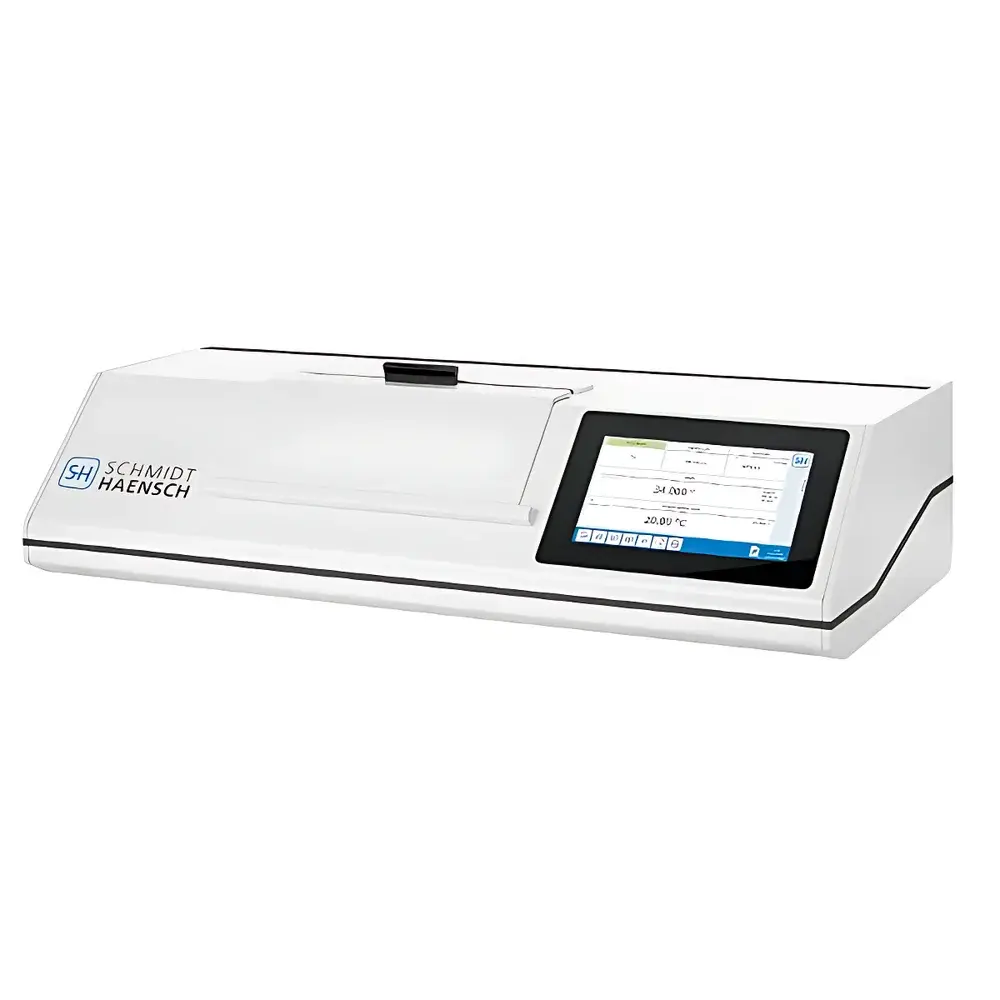
SCHMIDT + HAENSCH UniPol V Automated Polarimeter
| Brand | SCHMIDT + HAENSCH |
|---|---|
| Origin | Germany |
| Model | UniPol V |
| Sample Measurement Range | ±360° / ±259°Z |
| Angular Accuracy | ±0.005° / ±0.02°Z |
| Angular Resolution | 0.001° / 0.01°Z |
| Wavelength | 589 nm (LED) |
| Temperature Control | External Circulating Bath Interface |
| Display | Graphical LCD (16×16 characters) |
| Interfaces | 2× RS-232, 1× Parallel, PS/2, USB*, Ethernet* |
| Compliance | ASTM E1254, USP <781>, Ph. Eur. 2.2.7, FDA 21 CFR Part 11 (with optional audit trail software) |
Overview
The SCHMIDT + HAENSCH UniPol V is a high-precision automated polarimeter engineered for regulatory-compliant chiral analysis in pharmaceutical quality control, fine chemical synthesis, and food & beverage testing laboratories. It operates on the fundamental principle of optical rotation measurement—quantifying the angular deviation of plane-polarized light as it passes through an optically active sample—enabling direct determination of enantiomeric excess, concentration, and specific rotation ([α]) under controlled thermal and photometric conditions. Designed to meet the stringent metrological requirements of pharmacopoeial monographs—including USP , European Pharmacopoeia 2.2.7, and Japanese Pharmacopoeia 6.07—the UniPol V delivers traceable, repeatable measurements across the full ±360° angular range. Its modular architecture supports both standard single-wavelength operation at the sodium D-line (589 nm) and optional wavelength customization (e.g., 405 nm, 488 nm, or 633 nm) for method development and compound-specific optimization.
Key Features
- Full-range angular measurement capability: ±360° (degree scale) and ±259°Z (Zahn scale), segmented into user-selectable sub-ranges via intuitive menu navigation
- High-resolution angular detection: 0.001° resolution on degree scale and 0.01°Z on Zahn scale, with certified accuracy of ±0.005° and ±0.02°Z respectively
- Integrated temperature monitoring interface: Compatible with S+H temperature-sensing cells and quartz control plates (QCP/TQCP), enabling real-time display of sample temperature directly on the LCD
- Dual-mode thermal management: Supports external circulating water baths (via quick-connect fittings) for precise sample temperature stabilization between +10 °C and +40 °C ambient operating conditions
- Robust human-machine interface: Waterproof alphanumeric keypad (20-key layout), graphical LCD display (16×16 character matrix), and context-sensitive soft keys for rapid method selection and data entry
- Regulatory-ready connectivity: Equipped with two RS-232 serial ports, one parallel port, PS/2 interface (for barcode scanners or external keyboards), plus optional USB and Ethernet modules for networked data acquisition and LIMS integration
Sample Compatibility & Compliance
The UniPol V accommodates a wide variety of sample formats—from micro-volume cells (as low as 0.1 mL) to standard 100 mm, 200 mm, or custom-length tubes—ensuring flexibility across R&D, QC, and production environments. Optional chemically resistant cells (e.g., PTFE-lined or sapphire-window variants) extend operational lifetime when handling aggressive solvents or corrosive APIs. All measurement protocols adhere to internationally recognized standards: ASTM E1254 (Standard Practice for Calibration of Polarimeters), ISO 13872 (Optics and optical instruments — Polarimeters — Performance requirements), and ICH Q5C (Quality of Biotechnological Products: Stability Testing). When configured with validated firmware and audit-trail-enabled software, the system fully satisfies FDA 21 CFR Part 11 requirements for electronic records and signatures, supporting GLP and GMP documentation workflows.
Software & Data Management
Embedded firmware provides comprehensive data handling capabilities—including automatic sample ID logging, statistical evaluation (mean, SD, RSD, confidence intervals), customizable report templates, and direct export to printers or host PCs. Measurement history is retained in non-volatile memory with timestamping and operator identification. Optional PC-based PolarSoft™ software extends functionality with advanced curve fitting, multi-point calibration management, trend analysis over time, and secure database archiving compliant with ALCOA+ principles (Attributable, Legible, Contemporaneous, Original, Accurate, Complete, Consistent, Enduring, Available). Raw data files are stored in vendor-neutral CSV format, facilitating third-party statistical analysis or ERP/LIMS ingestion.
Applications
- Pharmaceutical QC: Quantitative assay of chiral active pharmaceutical ingredients (APIs) per USP/Ph. Eur. monographs; verification of enantiomeric purity during synthesis and purification
- Sugar analysis: Determination of sucrose, glucose, and fructose concentrations in syrups, juices, and fermentation broths using standardized °Z (Zahn) scale reporting
- Chemical manufacturing: In-process monitoring of asymmetric catalysis reactions; batch release testing of chiral intermediates and final products
- Academic research: Fundamental studies of optical activity in novel biomolecules, polymers, and liquid crystals
- Food & beverage: Regulatory compliance testing for honey adulteration, maple syrup grading, and citrus juice authenticity verification
FAQ
Does the UniPol V support multiple wavelengths out of the box?
No—the standard configuration includes a stable 589 nm LED source. Alternate wavelengths (e.g., 405 nm, 488 nm, 633 nm) are available as factory-installed options upon order specification.
Can temperature be actively controlled within the instrument itself?
The UniPol V does not incorporate internal Peltier or resistive heating/cooling elements. It relies on external circulating baths connected via its dedicated quick-release fluid interface for precise thermal regulation.
Is the system compatible with modern LIMS or ELN platforms?
Yes—when equipped with the optional Ethernet or USB module and PolarSoft™ software, the UniPol V supports bidirectional communication via TCP/IP or virtual COM port emulation, enabling seamless integration with enterprise laboratory informatics systems.
What validation documentation is provided with the instrument?
Each unit ships with a Factory Calibration Certificate traceable to PTB (Physikalisch-Technische Bundesanstalt), IQ/OQ documentation templates, and a complete set of test scripts aligned with ASTM E1254 and USP .
How is data integrity ensured during long-term operation?
All measurements include embedded timestamps, operator IDs (if enabled), and checksum-verified storage. With optional 21 CFR Part 11 software, full electronic audit trails—including user logins, parameter changes, and result modifications—are maintained in immutable format.




