
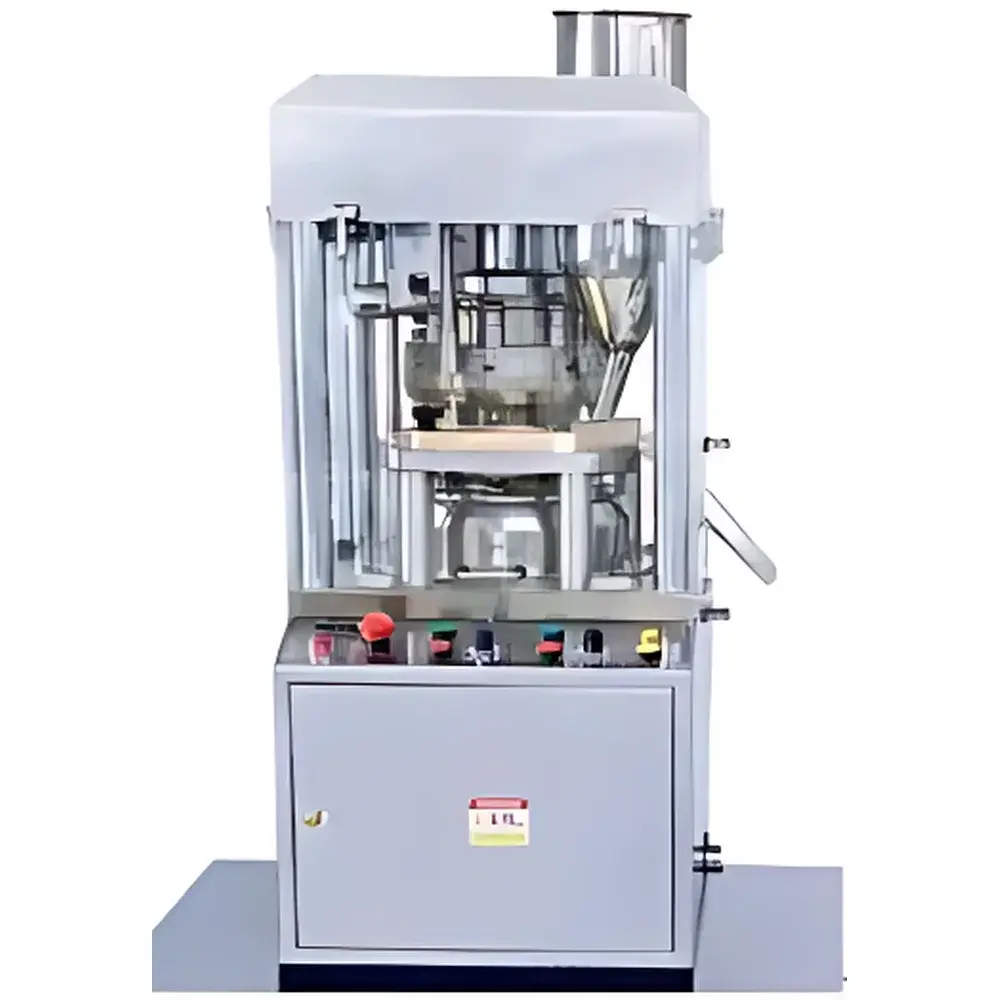
Pharmag Minipress 2 Rotary Tablet Press
| Brand | Pharmag |
|---|---|
| Origin | Germany |
| Model | Minipress 2 |
| Type | Benchtop GMP-Compliant Rotary Tablet Press |
| Max. Stations | 12 (configurable as 4×D, 4×B, 4×BB) |
| Max. Compression Force | 60 kN (6 ton) |
| Pre-compression Force | 20 kN (2 ton) |
| Max. Tablet Diameter | 23 mm |
| Max. Fill Depth | 20 mm |
| Max. Output | 27,600 tablets/hr |
| Drive System | AC Variable Frequency Motor |
| Feeding Options | Gravity or Forced Feeders |
| Tooling Compatibility | B, D, BB standard |
| Contact Materials | AISI 316 stainless steel |
| Safety | Interlocked guarding, emergency stop, mechanical overload protection |
| Regulatory Compliance | Designed per EU GMP Annex 1 & ISO 9001 |
| Optional Upgrades | Real-time compression force monitoring, vibration-damping feet, 316L turntable, automated tablet weight control integration |
Overview
The Pharmag Minipress 2 is a benchtop rotary tablet press engineered for precision, reproducibility, and regulatory compliance in pharmaceutical development, quality control laboratories, and small-scale contract manufacturing. Utilizing the fundamental principle of rotary compression—where upper and lower punches compress powder within rotating die cavities under controlled force—the Minipress 2 delivers consistent tablet geometry, hardness, and weight uniformity across batch sizes ranging from R&D prototypes to pilot-line production. Its compact footprint enables deployment in ISO Class 5–8 cleanrooms or regulated lab environments without requiring dedicated floor space or structural reinforcement. The system operates on a proven cam-guided turret architecture with hardened alloy tooling tracks, ensuring minimal wear and long-term dimensional stability of critical compression kinematics.
Key Features
- GMP-aligned mechanical design: All product-contact surfaces—including turret, dies, punches, feed frame, and scraper—fabricated from electropolished AISI 316 stainless steel, compliant with USP and EP 5.1.2 requirements for non-reactive, corrosion-resistant materials.
- Dual-stage compression: Independent pre-compression and main compression rollers allow optimization of densification profiles for challenging formulations (e.g., direct compression blends, high-API-load tablets, or moisture-sensitive actives).
- Modular tooling configuration: Supports interchangeable B-, D-, and BB-standard tooling sets; turret accepts up to 12 stations in mixed configurations (e.g., 4×D + 4×B + 4×BB) to accommodate diverse tablet geometries and coating readiness requirements.
- AC variable-frequency drive (ACVF) motor control: Enables precise speed regulation (typically 10–40 rpm), torque monitoring, and smooth acceleration/deceleration—critical for minimizing punch tip stress and maintaining fill consistency during start-up and shutdown cycles.
- Integrated safety architecture: Dual-channel interlocked guarding, mechanical overload clutches, and emergency stop circuitry conform to EN ISO 13857 and EN 62061 functional safety standards for machinery.
- Intuitive HMI interface: Touchscreen control panel permits real-time adjustment of compression force, fill depth, turret speed, and ejection height; parameter sets are password-protected and audit-trail enabled per FDA 21 CFR Part 11 requirements when connected to validated software systems.
Sample Compatibility & Compliance
The Minipress 2 accommodates granules, direct compression blends, and roller-compacted ribbons with particle size distributions ranging from 50 µm to 800 µm. It supports both free-flowing and cohesive powders via optional forced feeders equipped with adjustable paddle speed and hopper-level sensors. All operational parameters—including dwell time, compression dwell angle, and relative density—are traceable and configurable to meet ICH Q5A, Q5C, and USP guidance on process validation and scale-down modeling. The press is designed to support qualification protocols aligned with ASTM E2500-13 and EU GMP Annex 15, including Installation Qualification (IQ), Operational Qualification (OQ), and Performance Qualification (PQ) documentation templates.
Software & Data Management
While the base unit operates via standalone HMI, the Minipress 2 is compatible with Pharmag’s optional ELNP (Electronic Load & Navigation Platform) software suite for advanced data acquisition. ELNP records real-time compression force profiles, tablet thickness, weight deviation, and motor current draw at 100 Hz sampling rate. Data exports in CSV or SQL formats support integration into LIMS, MES, or electronic batch record (EBR) systems. Audit trails include user ID, timestamp, parameter change history, and reason-for-change fields—fully compliant with ALCOA+ principles and suitable for FDA, EMA, or PMDA inspection readiness.
Applications
- Formulation screening and excipient compatibility studies
- Process parameter mapping for Quality by Design (QbD) initiatives
- Stability batch production under cGMP conditions
- Reference standard tablet manufacturing for analytical method validation
- Training platform for GMP-compliant tablet compression operations
- Feasibility testing prior to full-scale production line transfer
FAQ
Is the Minipress 2 certified for use in regulated GMP environments?
Yes—the mechanical architecture, material certifications (EN 10204 3.1), and documentation package support IQ/OQ/PQ execution per EU GMP Annex 15 and FDA guidance. Final regulatory acceptance depends on site-specific validation and quality system integration.
Can the press be integrated with upstream granulators or downstream coaters?
It features standardized 4–20 mA and digital I/O ports for PLC-level interoperability; integration with fluid bed dryers or perforated pan coaters requires third-party engineering but is routinely implemented in pilot facilities.
What maintenance intervals are recommended for the turret and cam tracks?
Pharmag recommends visual inspection and lubrication of cam followers every 200 operating hours, with full turret alignment verification every 1,000 hours or after tooling changes exceeding 50 setups.
Does the system support statistical process control (SPC) output?
When paired with ELNP software, real-time SPC charts (X-bar/R, Cp/Cpk) for tablet weight, hardness, and thickness can be generated and exported to Minitab or JMP for continuous process verification.



