
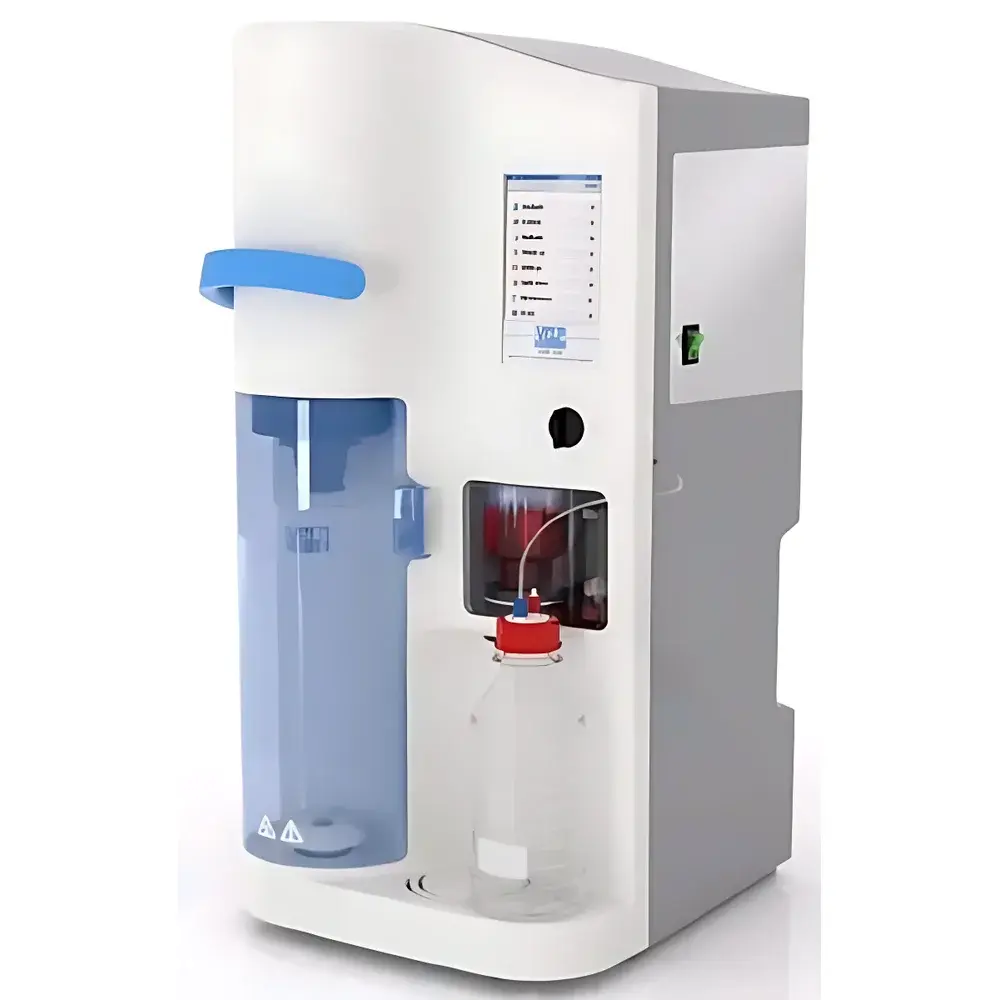
VELP UDK159 Automated Kjeldahl Nitrogen Determination System
| Brand | VELP |
|---|---|
| Origin | Italy |
| Model | UDK159 |
| Instrument Type | Kjeldahl Nitrogen Determinator |
| Automation Level | Semi-Automated Kjeldahl System |
| Compliance Standards | AOAC, ISO 8968, ISO 1871, EPA 350.1, DIN 10492, DIN 10493 |
| Construction Materials | Corrosion-Resistant Polymer Front Panel, Titanium Condenser, Patented Polymer Anti-Splash Head |
| Safety Features | Tube Presence Sensor, Safety Door Interlock, Alkali Reservoir Guard Rod, Waste Tray Level Detection, Condensate Flow Monitoring, Reagent Volume Monitoring, Color-Coded Tubing |
| Titration Method | Photometric (Colorimetric) Titration per AOAC Official Method 981.10 |
| Interface Options | USB 2.0, RS-232, Optional Ethernet Connectivity |
| Data Management | Onboard Storage, GLP-Compliant Audit Trail, Export via USB Drive or PC Connection |
| Peripheral Compatibility | Integrated Balance Interface, Thermal Printer Support, External Computer Synchronization |
Overview
The VELP UDK159 Automated Kjeldahl Nitrogen Determination System is a semi-automated, benchtop analytical platform engineered for precise quantification of total nitrogen—and by extension, protein content—via the classical Kjeldahl digestion and distillation methodology. Designed in accordance with internationally recognized wet-chemistry protocols, the UDK159 performs steam distillation of ammonium salts liberated from acid-digested samples, followed by automatic photometric titration of the liberated ammonia in boric acid solution. Its architecture integrates distillation and titration into a single, contiguous workflow, eliminating manual transfer steps and minimizing analyst exposure to hazardous reagents (e.g., concentrated NaOH, H2SO4, and hot vapors). The system is validated for routine use in food and feed laboratories where compliance with AOAC International Official Methods of Analysis (e.g., 981.10, 984.13), ISO 8968 (milk and dairy), ISO 1871 (cereals), EPA Method 350.1 (wastewater), and DIN standards is mandatory. While classified as semi-automated due to reliance on operator-initiated sample loading and digestion step preparation, the UDK159 executes all subsequent distillation, condensation, collection, and endpoint detection without intervention.
Key Features
- Patented Steam Generator: A pressure-free, low-thermal-inertia vapor generation module eliminates risk of overpressure events, requires no routine descaling or gasket replacement, and delivers stable steam output across variable load conditions.
- Titanium Condenser: Engineered for high thermal efficiency and chemical inertness, this condenser reduces cooling water consumption by up to 40% compared to conventional copper or stainless-steel units while maintaining consistent condensate temperature below 30 °C—critical for preventing ammonia loss during collection.
- Polymer Anti-Splash Head: A VELP-exclusive injection-molded polymer component replaces fragile glass splash guards, offering extended service life, resistance to alkali corrosion, and elimination of breakage-related downtime or safety hazards.
- Multi-Point Safety Interlock System: Includes real-time monitoring of digestion tube presence, safety door closure status, alkali reservoir guard rod position, waste tray fill level, condensate flow continuity, and reagent volume thresholds—each triggering audible/visual alerts and automatic process suspension if out-of-spec.
- Photometric Titration Module: Utilizes dual-wavelength absorbance detection (typically 570 nm and 700 nm) to identify the methyl red–bromocresol green endpoint with high specificity, minimizing interference from colored or turbid distillates common in complex matrices (e.g., meat extracts, fermented feed).
Sample Compatibility & Compliance
The UDK159 accommodates standard 100–500 mL Kjeldahl digestion tubes and supports sample weights typical for regulatory testing: 0.5–5 g solid or 5–20 mL liquid matrices. Prior digestion must be performed externally using compatible block digesters or microwave systems meeting ISO 20483 or AOAC 985.18 requirements. The system is routinely deployed in accredited laboratories conducting nitrogen analysis per ISO/IEC 17025:2017. Its hardware and firmware support full traceability—including user ID logging, method version stamping, timestamped run records, and electronic signature capability—aligning with FDA 21 CFR Part 11 expectations when paired with validated LIMS integration. Validation documentation packages (IQ/OQ/PQ templates) are available upon request for GMP and GLP environments.
Software & Data Management
The embedded VELP KjelSoft™ control interface enables method-driven operation: users select preconfigured or custom protocols defining steam duration, alkali/boric acid volumes, titrant concentration, and endpoint sensitivity. All parameters are stored with metadata (operator, date/time, sample ID). Data are retained onboard for ≥1,000 analyses and exportable in CSV or PDF formats via USB flash drive. RS-232 and USB ports allow bidirectional communication with laboratory balances (auto-import of sample mass), thermal printers (GLP-compliant hardcopy reports), and networked PCs running LIMS or ELN platforms. Audit trails record every parameter change, run start/stop, alarm event, and calibration action—supporting internal audits and regulatory inspections.
Applications
Primary application domains include nutritional labeling (protein calculation via N × conversion factors), quality control in dairy processing (casein, whey), animal feed formulation (soybean meal, fishmeal), and environmental monitoring (sludge, soil extracts). Secondary applications span pharmaceutical excipient verification (gelatin, albumin), brewing (wort nitrogen), and academic research requiring reproducible nitrogen partitioning studies. When coupled with appropriate digestion protocols, the UDK159 meets performance criteria for nitrogen recovery >99.5% and repeatability (RSD) ≤1.0% at 1–10 mg N levels—consistent with AOAC collaborative study requirements.
FAQ
Does the UDK159 perform digestion?
No. Digestion is conducted separately using external heating blocks or microwave digesters; the UDK159 handles only distillation and titration.
Is the photometric titration compliant with AOAC guidelines?
Yes. It implements AOAC Official Method 981.10, which specifies colorimetric endpoint detection for Kjeldahl nitrogen determination.
Can the system be integrated into a regulated QC environment?
Yes. With optional software validation kits and documented IQ/OQ protocols, it supports 21 CFR Part 11 compliance for electronic records and signatures.
What maintenance is required for the titanium condenser?
None beyond periodic visual inspection and deionized water flush after extended use; titanium resists scaling and corrosion under normal operating conditions.
How does the anti-splash head improve operational safety?
By eliminating glass components prone to thermal shock fracture, it prevents exposure to hot, caustic distillate and reduces risk of injury during routine cleaning or tube handling.
Related Products





