
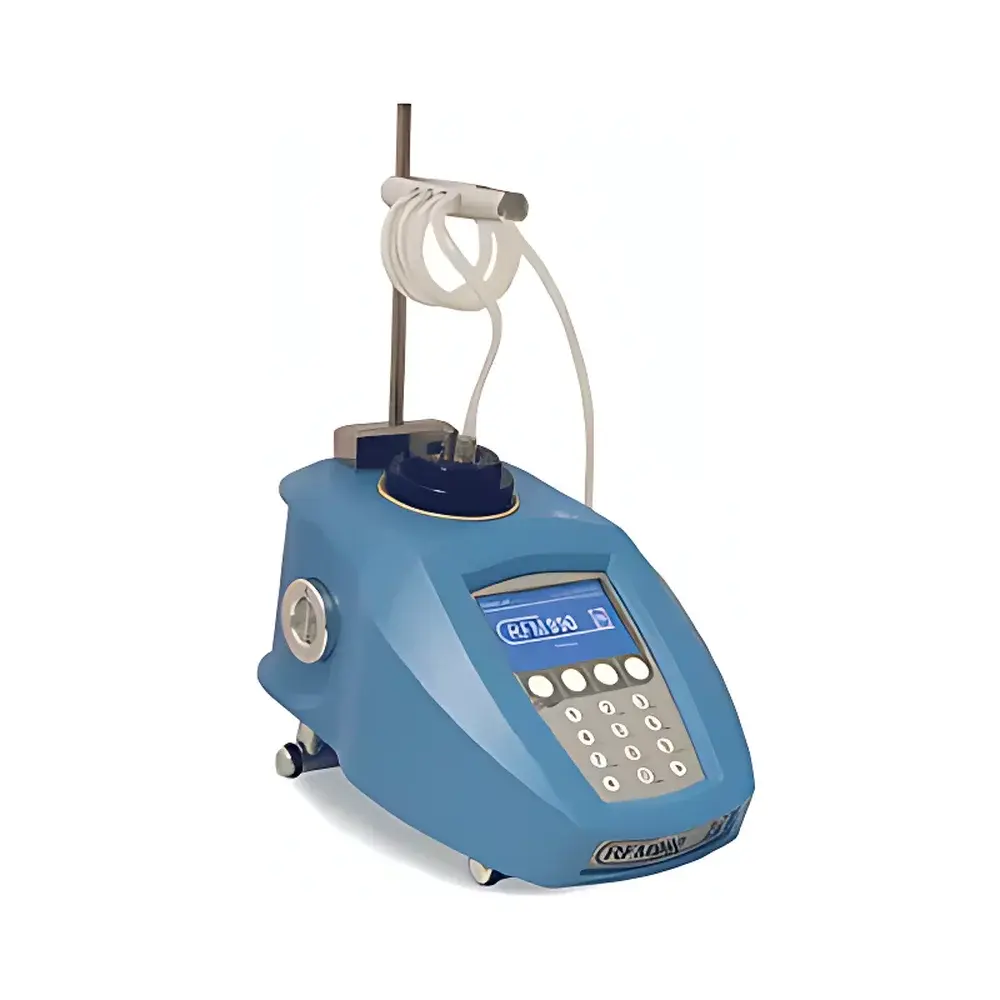
Bellingham + Stanley RFM990-Flow Automated Flow-Through Refractometer
| Brand | Bellingham + Stanley |
|---|---|
| Origin | United Kingdom |
| Model | RFM990-Flow |
| Refractive Index Range | 1.30–1.70 |
| Brix Range | 0–100 |
| RI Resolution | 0.00001 |
| Brix Resolution | 0.01 |
| RI Accuracy | ±0.00002 |
| Brix Accuracy | ±0.02 |
| Light Source | LED (589.3 nm, >100,000 hr lifetime) |
| Temperature Control | Integrated Peltier element |
| Sample Cell Volumes | 0.6 mL (micro), 1.2 mL (standard), 1.2 mL (funnel-type) |
| Compliance | OIML R22, ASTM D5006, USP <781>, EP 2.2.2, BP Appendix XVII, FDA 21 CFR Part 11, GLP/GMP data integrity requirements |
Overview
The Bellingham + Stanley RFM990-Flow Automated Flow-Through Refractometer is a high-precision, laboratory-grade optical instrument engineered for continuous, real-time refractive index (RI) and Brix measurement of liquid samples in process-critical or high-throughput quality control environments. Based on the fundamental principle of total internal reflection at the prism–sample interface, the RFM990-Flow employs a stabilized monochromatic LED light source (589.3 nm, sodium-D wavelength equivalent) to determine the critical angle of refraction with sub-micro-RI resolution. Its flow-through architecture enables unattended operation across extended production shifts, eliminating manual sampling bottlenecks while maintaining metrological traceability to international standards. Designed and manufactured in the United Kingdom, the instrument integrates thermally regulated optical path geometry and dynamic thermal equilibrium protocols to ensure measurement stability under variable ambient conditions.
Key Features
- Integrated Peltier temperature control system with SMART thermal stabilization logic — measurements are only executed once sample temperature has stabilized within ±0.02 °C of the setpoint, minimizing drift-induced uncertainty.
- High-intensity, narrow-band LED light source (589.3 nm) offering >100,000 hours of operational life, eliminating lamp replacement cycles and spectral drift associated with traditional sodium vapor lamps.
- RFID-enabled user authentication combined with PIN-based access control ensures role-based instrument operation and audit-ready operator accountability.
- Onboard memory stores up to 700 complete measurement records, each timestamped, user-tagged, and annotated with temperature, RI, Brix, and calibration status — fully compliant with GLP and GMP data integrity requirements.
- Dual communication interfaces: isolated RS-232 serial port and parallel digital output for seamless integration into SCADA, LIMS, or MES platforms.
- Modular flow cell design supporting three configurations: 0.6 mL micro-cell (low-volume, high-sensitivity applications), 1.2 mL standard cell (general-purpose QC), and 1.2 mL funnel inlet cell (for viscous or particulate-containing streams).
Sample Compatibility & Compliance
The RFM990-Flow accommodates aqueous and organic solutions across a broad RI range (1.30–1.70) and Brix scale (0–100%), including sucrose, invert sugar, high-fructose corn syrup (HFCS), and freeze-point depressants such as FSII (Fuel System Icing Inhibitor). Temperature compensation algorithms support ICUMSA (International Commission for Uniform Methods of Sugar Analysis), AG (Alcohol-Glucose), and user-defined polynomial models. The instrument conforms to OIML R22 (International Organization of Legal Metrology), ASTM D5006 (Standard Test Method for Refractive Index of Aviation Fuels), and pharmacopoeial monographs including USP , European Pharmacopoeia 2.2.2, and British Pharmacopoeia Appendix XVII. Full compliance with FDA 21 CFR Part 11 is achieved via electronic signature enforcement, audit trail logging, and immutable record archiving — enabling validated use in regulated pharmaceutical, food, and fuel manufacturing facilities.
Software & Data Management
Data acquisition and reporting are governed by B+S’s proprietary firmware architecture, which enforces ALCOA+ principles (Attributable, Legible, Contemporaneous, Original, Accurate, Complete, Consistent, Enduring, Available). Each measurement event captures instrument ID, operator ID (via RFID/PIN), date/time stamp, sample temperature, RI/Brix value, measurement uncertainty estimate, and calibration verification status. Export formats include CSV and fixed-width ASCII via RS-232, compatible with Excel, MATLAB, and industrial historians. Optional PC software provides advanced trend analysis, SPC charting (X-bar/R), and automated report generation aligned with ISO/IEC 17025 documentation frameworks.
Applications
- Continuous monitoring of sugar concentration in juice, soft drink, and confectionery production lines.
- In-line verification of antifreeze glycol concentration in automotive and HVAC coolant formulations.
- Real-time quality assurance of aviation turbine fuels per ASTM D5006 and DEF STAN 91-91.
- Concentration control during solvent recovery, distillation, and crystallization processes in fine chemical synthesis.
- Stability testing of pharmaceutical syrups and oral solutions under ICH Q5C guidelines.
- Validation of cleaning-in-place (CIP) rinse endpoints through conductivity-refractometry correlation.
FAQ
Does the RFM990-Flow support automatic calibration verification?
Yes — the instrument includes programmable auto-calibration checks using certified reference fluids (e.g., distilled water, sucrose standards), with pass/fail criteria logged to the audit trail.
Can the flow cell be cleaned in place without disassembly?
All three cell variants feature chemically resistant sapphire prisms and stainless-steel wetted parts; CIP-compatible protocols using 0.5–2.0 M NaOH or 10% phosphoric acid are validated for routine maintenance.
Is temperature control active during idle periods?
The Peltier system maintains setpoint temperature continuously when powered, ensuring minimal thermal lag upon sample introduction.
What is the maximum recommended flow rate for stable readings?
Optimal performance is achieved at 10–60 mL/min; laminar flow must be maintained to avoid air entrapment and interfacial turbulence at the prism surface.
How is data integrity ensured during power interruption?
Non-volatile flash memory preserves all unsaved measurements and configuration parameters; the system resumes operation from last-known valid state upon reboot without data loss.



