
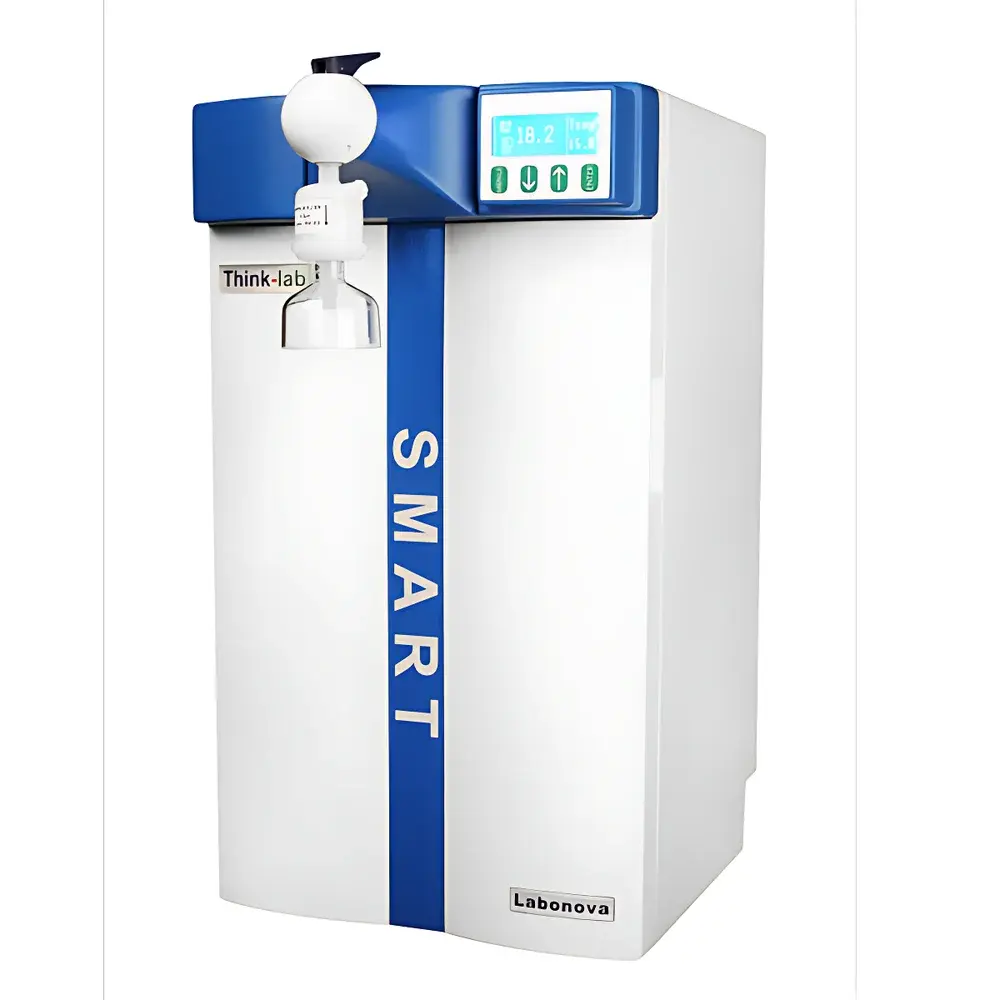
Think-lab Labonova Smart Ultra Pure Water System
| Brand | Think-lab |
|---|---|
| Origin | Germany |
| Model | Smart |
| Feed Water | Type I purified water (deionized, distilled or RO) |
| Product Water Resistivity | ≥18.2 MΩ·cm @ 25°C |
| TOC | <5 ppb |
| Microbial Count | <0.001 CFU/mL |
| Endotoxin | <0.001 EU/mL |
| Flow Rate | Up to 1.5 L/min |
| Feed Pressure Range | 0.1–6 bar |
| Integrated UV | Dual-wavelength (185 nm + 254 nm) |
| Final Filtration | 0.2 µm charged polyethersulfone (cPES) end-filter |
| Conductivity Monitoring | Dual-channel (feed & product) |
| Sanitization Method | Injection-based chemical recirculation sanitization |
| System Footprint | Compact integrated design |
Overview
The Think-lab Labonova Smart Ultra Pure Water System is an engineered solution for laboratories requiring continuous, on-demand production of Type I ultrapure water compliant with ASTM D1193-20, CLSI EP23-A, and ISO 3696:2017 Grade 1 specifications. It operates as a polishing system—accepting pre-purified feed water (e.g., deionized, reverse osmosis, or distilled water)—and further refining it via sequential electro-deionization (EDI), dual-wavelength ultraviolet oxidation, and terminal charge-modified filtration. The system employs a closed-loop internal circulation architecture extending to the point-of-use outlet, eliminating stagnant zones and minimizing microbial recontamination risk. Its core objective is reproducible delivery of water with resistivity ≥18.2 MΩ·cm at 25°C, total organic carbon (TOC) <5 ppb, bacterial count <0.001 CFU/mL, and endotoxin levels <0.001 EU/mL—parameters validated under steady-state flow conditions and monitored in real time.
Key Features
- Integrated dual-wavelength UV chamber (185 nm + 254 nm): Enables simultaneous photolysis of organic molecules and germicidal inactivation, achieving consistent TOC reduction to <5 ppb.
- Full-path recirculation loop: Maintains laminar flow from storage reservoir to dispensing valve, preventing biofilm formation and ensuring uniform water quality at point-of-use.
- Dual conductivity monitoring: Independent sensors continuously measure feed and product water conductivity, enabling real-time performance validation and automatic alarm triggering upon deviation.
- Charge-modified 0.2 µm polyethersulfone (cPES) terminal filter: Provides high-efficiency removal of gram-negative bacteria, spores, and pyrogens—including endotoxins—down to <0.001 EU/mL, critical for cell culture, molecular biology, and pharmaceutical QC applications.
- Wide-range feed pressure compatibility (0.1–6 bar): Eliminates need for external pressure regulators; accommodates variable municipal or central lab water supply conditions.
- Injection-based chemical sanitization protocol: Delivers controlled dosing and full-system recirculation of sanitizing agents (e.g., hydrogen peroxide or peracetic acid), validated for >3-log reduction of biofilm-forming organisms.
- Compact footprint and modular architecture: Designed for benchtop installation without dedicated utility infrastructure; includes built-in leak detection and dry-run protection.
Sample Compatibility & Compliance
The Labonova Smart is intended for use with pre-treated feed water meeting ASTM D1193 Type II or ISO 3696 Grade 2 specifications. It is not designed for direct connection to raw tap water. Output water complies with analytical requirements for HPLC mobile phase preparation, ICP-MS calibration standards, ELISA assay buffers, and sterile cell culture media formulation. System design and operational protocols support alignment with GLP and GMP environments: audit trails for sanitization cycles, sensor calibration logs, and user-access-controlled parameter modification are configurable via the onboard interface. While the system itself does not carry FDA 21 CFR Part 11 certification, its data logging architecture supports integration into validated laboratory information management systems (LIMS) where electronic record integrity is enforced.
Software & Data Management
The system features an embedded touchscreen interface with multilingual support (English, German, French, Spanish). All critical operational parameters—including conductivity, TOC trend estimates (derived from UV absorbance correlation), flow rate, UV lamp status, filter lifetime, and sanitization cycle history—are timestamped and stored locally for ≥12 months. Export options include USB dump of CSV-formatted logs compatible with Excel or statistical process control (SPC) platforms. No cloud connectivity or remote telemetry is enabled by default; all data remains on-device unless manually exported. Calibration events for conductivity sensors are logged with operator ID and verification values, supporting traceability per ISO/IEC 17025 requirements.
Applications
- Preparation of trace-metal-free standards for ICP-OES and ICP-MS analysis
- Formulation of low-endotoxin buffers for monoclonal antibody purification and vaccine development
- Cell line maintenance and transfection-grade media preparation
- HPLC and UHPLC mobile phase generation requiring sub-ppb organic contamination control
- Next-generation sequencing (NGS) library preparation and qPCR master mix dilution
- Calibration of clinical chemistry analyzers per CLIA and CAP guidelines
FAQ
What feed water quality is required to operate the Labonova Smart?
Type II purified water (ASTM D1193) or ISO 3696 Grade 2 water—such as from a reverse osmosis or deionization system—is mandatory. Tap water or untreated groundwater must not be used as feed.
Can the system be connected to a centralized lab water network?
Yes, provided the network delivers stable Type II water within the specified pressure (0.1–6 bar) and temperature (5–35°C) ranges; a dedicated isolation valve and particulate pre-filter are recommended upstream.
How often must the terminal filter be replaced?
Filter replacement is scheduled based on cumulative volume dispensed and real-time pressure differential monitoring; typical service life is 6–12 months under standard usage (≤200 L/day), but varies with feed water quality and ambient microbiological load.
Is third-party validation support available for IQ/OQ/PQ protocols?
Think-lab provides standardized qualification templates (IQ/OQ checklists, test protocols, and acceptance criteria) aligned with ISO 9001 and ISO/IEC 17025; site-specific PQ execution requires collaboration with certified lab validation partners.
Does the system meet USP Water for Pharmaceutical Purposes requirements?
While the Labonova Smart produces water exceeding USP specifications for Purified Water and approaches Water for Injection (WFI) purity thresholds, it is not validated or licensed for WFI generation; users requiring WFI must implement additional distillation or vapor-compression steps per pharmacopeial mandates.



